
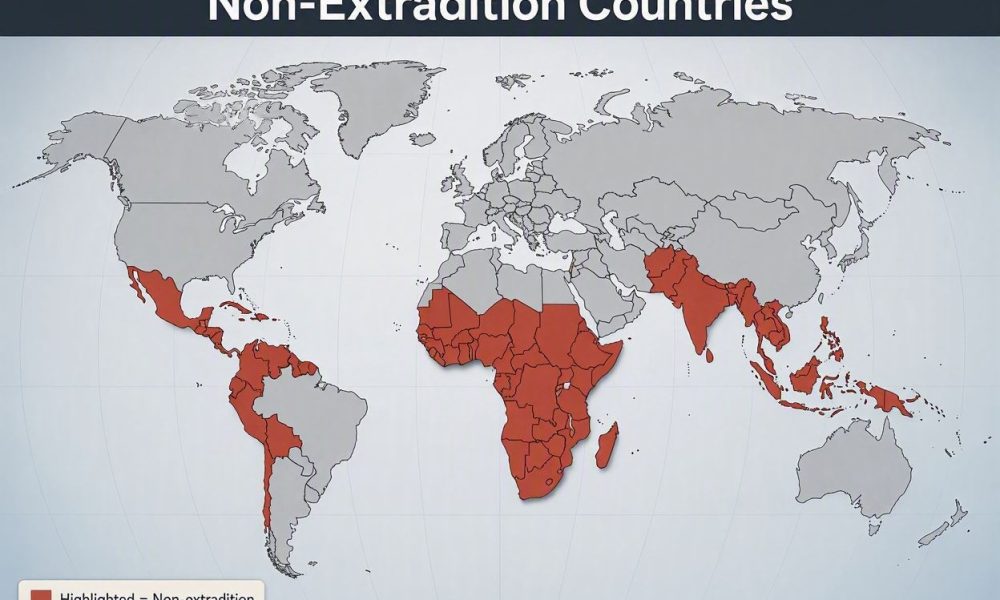
Prosecutors describe Russia as a shield while the federal tax case moved forward.
WASHINGTON, D.C. — Brian Nelson Booker allegedly left the United States during 2016 after learning about a federal tax investigation, beginning nearly a decade abroad during which prosecutors say the former certified public accountant lived in Russia without being ordered extradited.
Russia became the jurisdiction most closely associated with Booker’s prolonged absence, but the public Justice Department account does not establish that Russian courts rejected a completed extradition request or that formal proceedings ever reached a final surrender decision.
The distinction matters because a country can function as a practical shield without issuing any legal ruling, especially when diplomatic friction, treaty limitations, sovereignty, local immigration status, and enforcement priorities make custody transfer difficult.
Booker’s protection ultimately proved temporary after he entered Belarus, where authorities arrested him in May 2025, detained him for more than a year, ordered his expulsion, and returned him to American custody in July 2026.
The Departure Federal Prosecutors Describe
According to the U.S. Department of Justice, Booker left the United States during 2016 after learning about the criminal investigation, resided in Russia without being ordered extradited, and later entered Belarus before his eventual return.
The department does not explain how Booker learned about the investigation, which passport or immigration status supported his residence abroad, whether he sought asylum, or what route carried him from the United States into Russia.
Those unanswered questions prevent a definitive reconstruction of his departure plan, because relocation can involve commercial travel, established residency, family connections, business relationships, dual nationality, temporary permission, or other circumstances not disclosed publicly.
Prosecutors nevertheless characterize Booker as an international fugitive, connecting his departure with knowledge of the investigation and presenting his long residence abroad as an interruption of the federal court process rather than ordinary expatriation.
Booker remains presumed innocent of every charged offense, and the government must prove both the underlying financial allegations and any additional legal consequences it seeks to attach to his departure or years outside American jurisdiction.
Why “Non-Extradition Country” Is Only Shorthand
The phrase non-extradition country commonly describes a jurisdiction lacking an effective surrender treaty with the requesting nation, but that simplified label can conceal numerous alternative legal pathways through which a wanted person may still be removed.
Treaties establish procedures, evidentiary standards, covered offenses, political exceptions, nationality rules, and judicial review, yet the absence of a bilateral agreement does not necessarily forbid cooperation or guarantee a foreign suspect permanent residence.
A government may instead revoke a visa, deny a residence extension, expel a noncitizen, deport someone for immigration violations, prosecute local offenses, or send the person toward a country where an outstanding warrant becomes enforceable.
Diplomatic relationships also change over time, meaning a jurisdiction considered uncooperative during one administration may later exchange information, accommodate a removal, or restrict the individual’s ability to travel beyond national borders under future administrations.
Booker’s case illustrates that uncertainty because Russia allegedly provided years without an extradition order or resolution of the American case, while Belarus subsequently detained and expelled him without the Justice Department describing a conventional treaty-based extradition judgment.
No Public Evidence of a Russian Extradition Ruling
The Justice Department’s statement that Booker was never ordered extradited is narrower than saying Russia rejected extradition, since an order can be absent when no request was filed, proceedings remained incomplete, or other barriers prevented adjudication.
The public record identified by prosecutors contains no Russian court decision, diplomatic note, surrender warrant, formal refusal, or published treaty analysis explaining precisely why Booker remained outside American custody during his residence there.
Responsible reporting must therefore avoid transforming an enforcement outcome into an undocumented legal event, even though the practical result was clear: federal agents did not obtain physical control over Booker while he remained in Russia.
Location and custody are separate achievements in international law enforcement, because American investigators may know where a suspect lives while lacking authority to enter another sovereign state and execute a domestic warrant themselves.
That sovereignty barrier matters most when relations between the countries are strained, since routine police cooperation, evidence exchange, consular communication, immigration coordination, and diplomatic negotiation between officials can slow or become politically sensitive.
Russia as a Practical Shield
Calling Russia a shield describes the result rather than a proven agreement, because Booker allegedly remained there for years while the indictment and American criminal case continued without his physical appearance before the federal court.
Russia’s deteriorating relationship with Washington during much of Booker’s absence created an environment where cooperation could be difficult, although the Justice Department has not publicly attributed his status to any specific political decision or official protection.
A practical haven can still impose severe limitations, because the person may avoid countries with stronger American cooperation, restrict international travel, depend upon renewable local status, and face continuing uncertainty about future government policy.
Ordinary activities also generate records through landlords, banks, employers, telecommunications providers, transportation systems, tax agencies, medical institutions, and border authorities over extended periods, making permanent disappearance increasingly difficult even inside a politically protective jurisdiction.
Booker’s public history does not reveal whether he lived openly, used his legal name, maintained Russian financial accounts, operated a business, or received official residence rights, leaving the conditions of his daily life largely unknown.
The Federal Case Continued Without Him
Booker’s absence prevented a conventional trial from proceeding with him present, but it did not erase the charging record, close the investigation, destroy institutional documents, or eliminate the government’s ability to preserve the case.
The earlier indictment alleged failures during several reporting years to report foreign bank interests, false individual tax returns, and a false streamlined offshore certification involving accounts and financial structures connected with Switzerland, Singapore, Panama, and Venezuela.
In July 2021, a grand jury returned a second superseding indictment, showing that prosecutors could revise or expand charges through ongoing proceedings while Booker remained outside American custody and the litigation awaited his eventual appearance.
Bank records, filed tax documents, transfer instructions, and corporate ownership materials can remain available for years during lengthy investigations, sometimes strengthening a delayed financial prosecution because evidence exists independently of fading human memory.
IRS Criminal Investigation continued handling the matter, and the Justice Department preserved the charges until another country’s actions eventually placed Booker on a route that returned him to a jurisdiction where agents could arrest him.
The Alleged Tax Conduct Behind the Flight Narrative
Prosecutors allege Booker owned Zaandam Trading Company, a cocoa enterprise organized under Panamanian law and operated from Venezuela, Panama, and his former residence in Fort Lauderdale, Florida, before he left the United States.
The federal charges include alleged FBAR failures covering 2011 through 2013, false individual income-tax returns covering 2010 through 2012, and a disputed 2015 submission through the Internal Revenue Service Streamlined Domestic Offshore Procedures.
Booker allegedly maintained interests in Swiss, Singaporean, and Panamanian relationships described in the indictment, including a Swiss account connected with a Singaporean insurance policy and Panamanian accounts associated with his company or held personally.
The government contends his streamlined submission falsely described earlier failures as non-willful, while Booker retains the right to argue misunderstanding, technical uncertainty, professional advice, lack of materiality, or other defenses supported by admissible evidence.
An International Enforcement Law Reporter account published after his return noted that the former Florida resident appeared in federal court following expulsion from Belarus, reviving active proceedings on the tax and false-statement charges.
Belarus Changed the Jurisdictional Equation
Booker’s move from Russia into Belarus placed him under a different government’s legal and immigration authority, creating a new decision point that ultimately ended the protection he had experienced while residing in Russia.
The Justice Department says Belarus arrested him during May 2025, detained him, and eventually ordered his expulsion, but it does not identify the initial arrest grounds or describe the proceedings that authorized his removal.
The government also has not disclosed whether Belarus acted upon an international alert, bilateral communication, immigration violation, domestic security assessment, or another source of information concerning Booker’s identity and American case during that period.
No public confirmation establishes that an Interpol Red Notice caused the detention, and the absence of a publicly visible notice would not resolve the question because international police alerts can remain restricted to law-enforcement users.
Whatever mechanism initiated the process, Belarus controlled Booker’s physical location after May 2025 and possessed the sovereign authority under Belarusian law necessary to determine whether he remained detained, received legal status, or was removed.
Expulsion Accomplished What Extradition Had Not
Extradition ordinarily addresses surrender for criminal prosecution under established treaty or domestic legal frameworks, while expulsion generally removes a noncitizen based upon immigration, security, or sovereign decisions concerning continued presence within the territory.
Those processes can involve different standards, evidence, appeals, and political considerations in different countries, yet they may produce the same operational outcome when a person arrives somewhere, and authorities can lawfully execute an outstanding warrant.
Booker’s return demonstrates how immigration authority can sometimes overcome a long extradition stalemate after years of delay without deciding the merits of the foreign criminal accusation or issuing a conventional judicial surrender order.
The Justice Department has not disclosed whether Booker selected his destination, contested expulsion, received legal representation in Belarus during detention, or was placed aboard a particular itinerary under escort, leaving the transfer mechanics undisclosed.
He returned to the United States on July 24, 2026, and federal agents arrested him at a Miami airport without further incident, bringing the years-long jurisdictional problem to an abrupt conclusion at the arrival gate.
Crossing Borders Creates the Greatest Exposure
International movement creates a vulnerable moment for any wanted person because airlines, immigration offices, passport readers, carrier records, biometric systems, and border databases can independently link travel activity to alerts or government interest.
A residence jurisdiction may tolerate someone for years, while a neighboring country applies different rules, maintains stronger data-sharing relationships, or considers the person’s immigration presence undesirable for reasons unrelated to the original charges.
Booker’s entry into Belarus illustrates that changing countries during international travel can replace one predictable environment with another government’s discretionary decisions, even when both destinations are popularly grouped together as difficult venues for American extradition.
The phrase non-extradition countries therefore risks implying a permanent safe zone, when the practical protection exists only while the host government permits residence and the individual avoids a border crossing that changes legal authority.
The safest lawful response to an international criminal allegation is qualified legal representation and judicial engagement before changing jurisdictions, not reliance upon geography, because diplomatic alignment and immigration permission can shift without warning.
Anonymous Living Is Different From Fugitive Concealment
Anonymous living can involve lawful privacy measures protecting a home address, communications, family security, or professional exposure in difficult circumstances, especially for journalists, abuse survivors, public figures, and individuals relocating after credible threats.
The Amicus International anonymous-living overview describes privacy-oriented relocation and identity protection for people seeking legitimate personal security, but lawful planning must remain consistent with immigration rules, tax obligations, court orders, and truthful government applications.
Privacy becomes legally dangerous when used in any jurisdiction to obstruct an investigation, violate release conditions, conceal taxable wealth, submit false documents, or deceive authorities that issue residence permission and identity credentials.
The Justice Department has not alleged publicly that Booker used forged documents, a false name, a fabricated identity, or disguise while living abroad, so those common fugitive methods should not be attributed to him without evidence.
The documented allegation during that period is narrower: prosecutors say he learned about the investigation, left the United States, lived in Russia without an extradition order, entered Belarus, and ultimately returned after detention and expulsion.
Extradition Advice Must Begin With Legal Status
Anyone facing an international warrant needs counsel to examine the charging instrument, treaty coverage, nationality restrictions, limitation rules, political-offense exceptions, evidence requirements, local immigration status, and available judicial remedies within the host country.
The Amicus International extradition overview emphasizes obtaining experienced legal assistance and understanding the notice or request for accused persons facing removal, reflecting the importance of challenging allegations through established procedures rather than attempting indefinite concealment.
Extradition resistance can be lawful in local courts when based upon treaty defenses, human-rights protections, mistaken identity, procedural defects, or insufficient evidence, while fleeing, forging documents, or violating immigration laws can create separate exposure.
Booker’s public record does not reveal whether lawyers pursued Russian remedies, whether he received advice about Belarus while living abroad, or whether any application challenged his eventual expulsion, preventing informed evaluation of his legal strategy.
That absence of information reinforces why Russia should be described in this case as a practical shield rather than a confirmed legal victory, asylum grant, or court-approved refusal to honor a particular American surrender request.
The Cost of Remaining in One Protective Jurisdiction
Years in a perceived haven can restrict family contact, medical choices, financial access, property ownership, employment, and travel, while the unresolved case continues generating legal expenses, reputational consequences, and uncertainty about sudden removal.
During prolonged residence abroad, financial institutions may close accounts after adverse-media screening, landlords may require immigration documentation, and employers may hesitate to engage someone whose international legal status creates compliance or travel complications.
The person can also become dependent upon a single government’s continued tolerance during prolonged residence, turning political stability, visa renewal, and local security policy into personal risks beyond any control exercised by American prosecutors.
Booker remained beyond American custody for years, but his eventual detention during the continued proceedings shows that elapsed time did not produce permanent safety, dismissal of charges, or freedom to cross borders without consequences.
His experience challenges the romantic image of effortless disappearance, replacing it with a more restrictive reality in which one movement decision can expose every unresolved warrant and charging document preserved during the absence.
Return to Miami Reactivated the Case
After his return, Booker’s Miami arrest restored the federal court’s practical ability to conduct arraignment, address detention, set motion schedules, resolve discovery disputes, hear evidentiary challenges, and prepare the matter for plea negotiations or trial.
The government can now present banking records, tax filings, account correspondence, and witness testimony it believes establish willful reporting failures and false statements, while the defense can challenge every alleged connection and inference.
Years abroad do not reduce the government’s burden, because prosecutors must still prove the charged offenses beyond a reasonable doubt and cannot substitute Booker’s departure for evidence establishing underlying tax crimes.
Booker can dispute willfulness, materiality, account ownership, document interpretation, or the admissibility of evidence through counsel in federal court, while also raising any procedural arguments arising from the extended international history of the prosecution.
The public record does not disclose his plea, detention status, complete defense theory, or anticipated motions as of August 2026, making predictions about conviction, sentencing, or the ultimate resolution premature at the present stage.
Russia Delayed Custody but Did Not End Liability
Booker’s years in Russia demonstrate how a jurisdiction can delay prosecution over an extended period without invalidating an indictment, because domestic warrants and financial evidence may remain available until authorities obtain lawful custody through later events.
The absence of an extradition order can be operationally decisive, yet it does not erase charges, grant immunity, or prevent another country from making an independent immigration decision that changes the defendant’s circumstances.
Belarus ultimately became the point where Booker’s international protection failed after years of uncertainty, showing that a haven is only as durable as the host state’s permission, border choices, and continuing diplomatic environment.
For governments, the case illustrates why patient record preservation and multinational coordination can succeed after years of apparent inactivity, especially when wanted individuals eventually travel, lose status, or encounter a less protective jurisdiction.
For internationally mobile defendants, the lesson is equally direct during international travel: geography may postpone physical arrest, but every border movement introduces a new sovereign authority capable of detention, removal, cooperation, or return.
The Court Will Decide the Underlying Allegations
Booker’s departure and return now provide the international narrative before the assigned court, but the federal prosecution still centers on alleged foreign-account reporting failures, false tax documents, and statements about his 2015 streamlined offshore submission.
An indictment is an accusation, and Booker remains entitled throughout the renewed prosecution to confront witnesses, test documentary evidence, present lawful defenses, challenge government interpretations, and require proof beyond a reasonable doubt on every count.
Prosecutors may argue at trial that his departure after learning about the investigation supports their broader chronology, while the defense can contest motive and insist that international residence does not, by itself, prove a tax offense.
The final judgment will depend upon admissible evidence and federal law rather than assumptions about Russia, Belarus, or offshore banking, ensuring the courtroom determines guilt instead of the circumstances surrounding Booker’s years abroad.
Russia may have functioned as a shield, and Belarus may have removed it, but neither development resolves whether Booker committed the charged crimes, which remains the central question now returning to federal court.




