
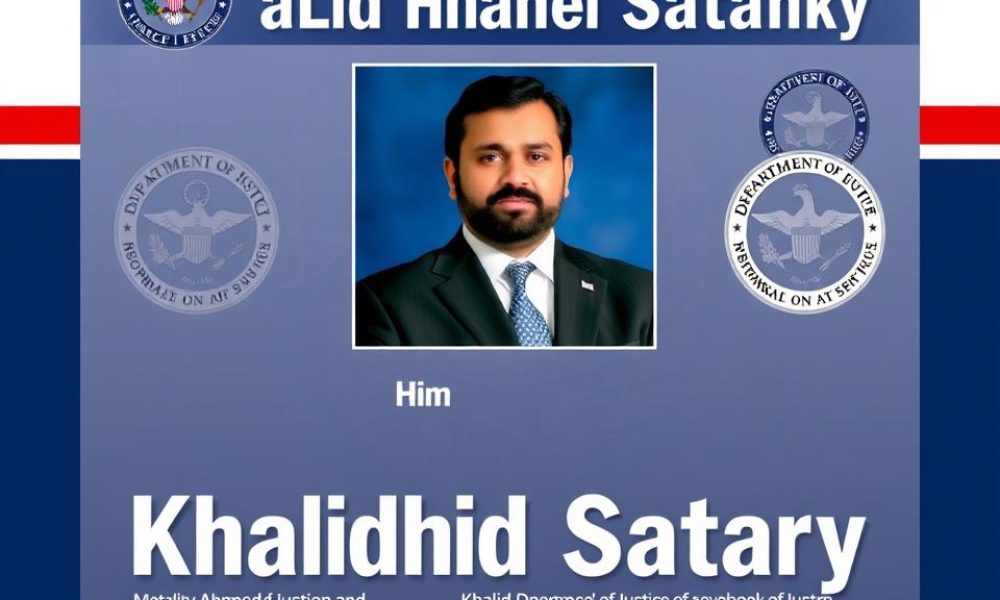
The FBI has identified Houston, Atlanta, and Delray Beach as American locations linked to fugitive laboratory executive Khalid Ahmed Satary, creating three important domestic investigative corridors where former employers, healthcare contacts, financial relationships, and personal associates could provide information about his present whereabouts.
WASHINGTON, DC, July 14, 2026 — Although federal authorities believe Khalid Ahmed Satary may have traveled internationally after violating his pretrial release conditions, the investigation remains firmly connected to the United States through business relationships, laboratory operations, financial records, and personal associations spanning Texas, Georgia, and South Florida.
Three American Cities Anchor the Fugitive Investigation
The FBI’s official wanted notice for Khalid Ahmed Satary states that the laboratory executive has ties or may travel to Houston, Atlanta, Delray Beach, Dubai, Jordan, and the Israel-Palestine region, giving investigators a geographically diverse map involving both domestic and international possibilities.
Houston carries particular significance because authorities allege Satary secretly conspired with laboratories located there while released under federal conditions specifically prohibiting him from working within the healthcare industry after his original September 2019 indictment in Louisiana.
Atlanta represents another established connection because Satary allegedly owned and operated Clio Laboratories in Georgia, one of three diagnostic testing companies accused of participating in a nationwide cancer genetic testing operation that collectively billed Medicare more than $547 million.
Delray Beach connects the investigation to Palm Beach County, where the FBI’s Miami Field Office has renewed public attention through the Most Wanted Fraudsters program and encouraged South Florida residents to report credible information involving Satary’s previous relationships or possible movements.
Those three locations do not prove Satary currently resides within the United States, yet they remain valuable because long-term fugitives frequently preserve relationships with former employees, business partners, relatives, advisers, property contacts, financial professionals, or trusted intermediaries who can provide assistance from thousands of miles away.
The FBI Has Not Publicly Confirmed Active Surveillance
The proposed claim that federal agents are continuously monitoring local associates should be treated with caution because the bureau has not publicly disclosed any specific surveillance operations, wiretaps, financial monitoring programs, or confidential investigative techniques directed at named individuals in Houston, Atlanta, or Delray Beach.
Federal fugitive investigations typically protect operational details because revealing which associates, companies, telephone numbers, accounts, properties, or communication platforms receive investigative attention could warn the wanted person and encourage supporters to change behavior, destroy records, or relocate assets.
Authorities can lawfully examine records and relationships through subpoenas, search warrants, interviews, financial analysis, immigration information, cooperating witnesses, and other judicially authorized methods, yet those capabilities should not be confused with confirmed public evidence that every former associate remains under active observation.
The strongest supportable conclusion is that Satary’s documented domestic ties provide continuing sources of potential leads, while the precise investigative methods used to develop those leads remain appropriately confidential and unavailable within the public record.
Houston Became Central After the Original Indictment
Satary’s Houston connection became especially significant after federal investigators alleged that he returned to healthcare activity while free on bond, despite a court order specifically prohibiting participation within the industry associated with his pending criminal charges.
The FBI alleges that Satary conspired with Houston-based laboratories to submit additional fraudulent genetic testing claims to Medicare, suggesting that the laboratory model under investigation may have continued through different companies, operators, accounts, or intermediaries after the original network faced federal enforcement action.
Public materials do not identify every Houston laboratory allegedly involved, the precise Medicare billing total attributed to the latter conduct, or the complete roster of physicians, marketers, consultants, employees, and financial participants connected with those facilities.
That limited disclosure protects the integrity of continuing investigations while preventing unsupported accusations against legitimate Texas laboratories whose geographic location or genetic testing activity alone would never establish participation within Satary’s alleged scheme.
Houston’s Healthcare Economy Created Opportunity and Complexity
Houston contains one of the largest medical and laboratory economies in the United States, supporting hospitals, diagnostic companies, research institutions, telemedicine platforms, billing services, pharmaceutical operations, medical equipment suppliers, and countless legitimate professionals working throughout the region.
That extraordinary concentration creates commercial opportunities for healthcare executives while simultaneously making one hidden relationship difficult to isolate among thousands of lawful contracts, consulting arrangements, laboratory partnerships, and professional interactions occurring throughout the metropolitan area.
A prohibited executive could influence operations without appearing as a disclosed owner by working through consultants, nominees, relatives, management companies, investors, referral organizations, or trusted business partners whose names appear in the formal corporate records.
Investigators seeking to establish Satary’s alleged participation would therefore examine communications, payment records, laboratory claims, account access, referral contracts, travel, meetings, and witness testimony to determine who actually controlled decisions, rather than relying exclusively on public ownership documents.
The Houston Allegations Could Reveal His Later Contacts
People involved in the alleged Houston laboratory activity may be among the most valuable witnesses in the present fugitive investigation because their relationships with Satary could have continued closer to his disappearance than those of contacts associated only with the earlier laboratory network.
An employee, consultant, marketer, physician, accountant, investor, or laboratory owner might possess recent telephone numbers, email addresses, aliases, banking instructions, references to international travel, business proposals, or information about individuals who helped Satary prepare for flight.
Even when such witnesses lack a current address, a single preserved communication can link an unknown overseas account, device, company, or property to the defendant sought under the November 2022 federal arrest warrant.
The substantial FBI reward may further encourage people who once considered themselves loyal business associates to reconsider whether continued silence serves their interests after years of legal exposure, public scrutiny, and uncertainty surrounding Satary’s international status.
Atlanta Connects Directly to Clio Laboratories
Atlanta’s importance arises primarily from Satary’s alleged ownership and operation of Clio Laboratories in Georgia, which prosecutors identified as part of the multistate laboratory network accused of billing Medicare for expensive and medically unnecessary cancer genetic testing.
Clio allegedly operated alongside Performance Laboratories in Oklahoma and Lazarus Services in Louisiana, giving Satary’s businesses a broad geographic structure capable of receiving samples, processing tests, billing Medicare, and distributing funds through several corporate and banking channels.
The Georgia operation would have generated extensive records involving employees, leases, vendors, equipment, laboratory licensing, physicians, marketers, sample couriers, billing companies, accountants, insurers, and financial institutions whose information may remain relevant years after the original indictment.
Former Clio personnel could remember Satary’s management style, travel patterns, preferred modes of communication, trusted advisers, overseas ambitions, family relationships, or unusual transactions that took on new significance only after he allegedly violated bond and disappeared.
Corporate Records Preserve Historical Relationships
A fugitive can abandon one company or change personal contact information, but corporate operations preserve durable evidence through state registrations, contracts, tax filings, payroll systems, regulatory applications, bank accounts, insurance policies, leases, correspondence, and electronic billing infrastructure.
Investigators can compare names, addresses, telephone numbers, email domains, authorized signers, accountants, attorneys, consultants, and vendors across Satary’s former laboratories, searching for individuals or businesses that later appeared within Houston ventures or international commercial activity.
Repeated relationships can reveal trusted circles, as executives accused of complex financial crimes frequently rely on familiar accountants, bookkeepers, administrators, advisers, or intermediaries who understand their preferences and can facilitate transactions without requiring extensive explanation.
Those repeated relationships do not establish wrongdoing by every professional involved, but they can help investigators identify individuals who possess information about Satary’s movements, financial arrangements, communication habits, or identities used after leaving court supervision.
Atlanta’s International Connections Also Matter
Atlanta is a major transportation and commercial center with extensive domestic and international aviation links, making historical travel records, airport activity, rental vehicle records, hospitality records, and business meeting records potentially relevant to reconstructing Satary’s movements before the federal warrant was issued.
The city also supports substantial healthcare, technology, logistics, and professional services industries, allowing a laboratory executive to maintain business relationships that extend beyond a single testing company and into broader networks capable of supporting future commercial ventures.
Federal authorities have not stated that Satary departed through Atlanta or received fugitive assistance there, meaning any theory concerning a specific escape route must remain unproven unless supported by additional official disclosures or court documents.
Nevertheless, investigators can revisit known travel habits and corporate relationships whenever a credible tip identifies a current alias, overseas company, or financial intermediary linked to someone previously associated with the Georgia laboratory operation.
Delray Beach Brings the Case Into South Florida
Delray Beach gives the fugitive investigation a significant South Florida dimension because Satary’s FBI profile identifies the city among his known ties or possible travel destinations, while the Miami Field Office participates prominently in seeking public assistance.
Recent Florida public-media reporting on Satary’s Delray Beach connection emphasized the $150,000 reward, the alleged Medicare scheme, the laboratory network, and the bureau’s request for information from people familiar with his activities or relationships.
South Florida has extensive international aviation, maritime, real estate, banking, healthcare, and diaspora connections, creating numerous legal reasons for businesspeople to maintain relationships that link the region with the Caribbean, Latin America, Europe, and the Middle East.
Those global connections can also become important in fugitive investigations when authorities examine property, travel, communications, corporate ownership, relatives, financial advisers, or trusted associates who can maintain contact with someone believed to be living overseas.
A Domestic Tie Does Not Mean a Confirmed Safe House
The FBI’s statement that Satary has ties to, or may travel to, Delray Beach does not mean investigators have identified a residence, hidden property, active safe house, or a coordinated local network currently sheltering the fugitive within Palm Beach County.
A tie may involve previous residence, family, employment, business dealings, property interests, personal relationships, financial activity, or other historical connections that investigators consider useful when asking the public to recognize a wanted person.
Publishing those cities broadens recognition while protecting more sensitive information, allowing residents to evaluate whether Satary’s photograph, aliases, physical characteristics, or business history corresponds with someone they encountered through ordinary professional or community interactions.
Responsible reporting should therefore describe Delray Beach as an officially designated connection rather than treating the city as Satary’s confirmed current location or accusing unnamed residents of knowingly aiding his flight.
South Florida Contacts Could Bridge Domestic and Overseas Activity
A fugitive believed to be abroad may still rely upon American contacts for financial management, property maintenance, legal advice, family communication, document retrieval, business introductions, healthcare information, or assistance resolving obligations left behind after departure.
Those contacts may operate lawfully without knowing Satary’s precise location or understanding that a routine message, payment request, or business inquiry originated from someone violating federal pretrial release conditions.
Other individuals could knowingly conceal communications or provide financial assistance, but such conduct would require evidence establishing awareness and intent rather than assumptions based upon friendship, employment, family connection, or geographic proximity.
Investigators must distinguish innocent historical relationships from deliberate support for fugitives while identifying which communications, transactions, and intermediaries provide genuine information that can advance the arrest effort.
The Three Cities Reflect Different Stages of Satary’s Career
Atlanta represents a documented laboratory-ownership hub associated with the original genetic testing conspiracy; Houston represents the alleged continuation of prohibited healthcare activity while Satary remained on bond; and Delray Beach represents a significant personal or business connection identified through the FBI’s Miami office.
Together, those locations create a chronological and operational map showing how Satary’s domestic footprint may have evolved from laboratory ownership, through alleged post-indictment activity, to relationships relevant after the federal arrest warrant was issued.
The geographic pattern also demonstrates why investigators cannot focus exclusively on one city: corporate executives often maintain separate residences, companies, advisers, accounts, and personal relationships across multiple states while conducting business through national healthcare networks.
A lead originating in Florida may connect with an account established through Texas, a former employee located in Georgia, and an international property or company tied to Dubai, requiring federal investigators to integrate evidence across several jurisdictions.
Financial Intelligence Can Connect the Domestic Hubs
Financial investigators can compare Medicare reimbursements, corporate transfers, marketing payments, consulting fees, property transactions, credit activity, bank wires, and account ownership across businesses and individuals associated with each domestic location.
When the same recipient, adviser, telephone number, address, or company appears in records from Georgia, Texas, and Florida, analysts can examine whether the overlap reflects legitimate national business or a coordinated relationship related to Satary’s alleged activities.
Money moved before an escape may also reveal preparation through unusual withdrawals, foreign transfers, asset sales, debt repayment, property restructuring, travel purchases, or payments toward people capable of providing international assistance.
Federal authorities have not publicly disclosed Satary’s current financial resources, yet tracing historical accounts and trusted intermediaries remains a logical investigative avenue, as prolonged international living requires housing, transportation, communications, healthcare, and reliable access to funds.
Communications May Produce the Most Valuable Connection
Former associates can become investigative bridges when a fugitive uses familiar email addresses, nicknames, telephone habits, messaging accounts, family references, or business language that allows recipients to recognize the individual despite changes in formal identity.
The FBI lists several aliases associated with Satary, including Khalid Satary, Khalid A. Satary, Khalio A. Satary, Rocky Satary, and DJ Rock Satary, encouraging people from different periods of his life to recognize names absent from formal court records.
An associate in Houston may know him through laboratory discussions, someone in Atlanta may remember him through Clio operations, while a Delray Beach contact may recognize a social, residential, financial, or family connection unrelated to diagnostic testing.
Combining those separate observations can help investigators establish continuity between Satary’s former American identity and whatever name, company, or residence he may currently use outside the United States.
Public Tips Can Revive Dormant Records
A credible tip does not need to identify Satary’s exact bedroom or current passport because one recent telephone number, photograph, email address, business card, property reference, vehicle, or travel companion can provide the starting point for a much broader investigation.
Agents can compare new information against confidential immigration records, banking intelligence, biometric data, corporate filings, travel history, prior communications, and witness accounts developed throughout the years following the original indictment.
Historical information also remains useful when it identifies a previously unknown associate whose later companies, properties, or overseas activities connect the domestic laboratory network to Satary’s possible international location.
Members of the public should preserve original messages, photographs, contracts, and documents rather than altering or publishing them online, because metadata, timestamps, account details, and complete context may prove essential during professional authentication.
Former Employees Must Avoid Public Accusations
People who worked in Satary’s laboratories or associated healthcare businesses may possess important knowledge, yet they should report information privately rather than accuse coworkers, physicians, executives, or relatives on social media without verified evidence.
Public accusations can damage innocent reputations, compromise surveillance, encourage destruction of evidence, expose witnesses to harassment, and alert a wanted defendant that investigators may be approaching a previously unknown relationship.
Federal agents can evaluate tips through records, interviews, subpoenas, biometrics, and confidential intelligence unavailable to ordinary citizens, allowing suspicious information to be tested without unnecessarily exposing uninvolved people.
A precise report describing dates, communications, payments, meetings, travel, or names provides considerably greater investigative value than broad speculation that everyone connected with a former laboratory must remain involved with Satary.
Most Wanted Status Increased Pressure Across All Three Cities
Satary’s addition to the FBI’s Most Wanted Fraudsters list made his photograph, aliases, alleged conduct, physical description, reward, and geographic connections available to audiences far beyond Louisiana healthcare enforcement circles.
The reward of up to $150,000 provides a meaningful incentive for former business partners, employees, property contacts, financial intermediaries, landlords, relatives, or overseas associates who possess information leading to arrest and conviction.
Reward eligibility is not automatic because the bureau evaluates whether the information is original, credible, lawfully obtained, independently verifiable, and sufficiently important to contribute directly to the outcome described in the official offer.
Renewed publicity nevertheless changes the calculation for anyone protecting information, especially when years have passed, relationships have deteriorated, organizations have dissolved, and personal loyalty no longer outweighs financial, legal, or moral considerations.
Domestic Relationships Can Outlast International Flight
People who relocate internationally rarely sever every relationship with their previous country, particularly when they leave behind family, property, businesses, medical records, financial accounts, professional advisers, or unresolved legal and commercial obligations.
Satary may require assistance obtaining documents, managing assets, communicating with relatives, understanding court developments, monitoring publicity, or resolving corporate matters, although federal authorities have not publicly identified who provides those services.
Each continuing relationship creates potential exposure because communications, payments, travel, and intermediaries can reveal patterns linking an overseas identity to the American laboratory owner charged in the Eastern District of Louisiana.
The domestic footprint, therefore, remains relevant even if Satary never physically returns to Houston, Atlanta, or Delray Beach, because the people and records located there may still point investigators toward his international activities.
The Allegations Remain Unproven
Satary remains presumed innocent of the unresolved healthcare fraud, kickback, money laundering, and bond-violation allegations, while the FBI’s wanted notice represents an effort to secure his arrest and court appearance rather than a final determination of guilt.
The government must prove that he knowingly participated in fraudulent claims, authorized unlawful payments, controlled the relevant laboratory operations, violated release conditions, and deliberately failed to remain available for federal proceedings.
Former corporate ownership, geographic ties, and association with people investigated by federal authorities cannot substitute for count-specific evidence demonstrating knowledge, intent, and participation beyond a reasonable doubt.
Likewise, individuals connected to Houston, Atlanta, or Delray Beach should not be treated as accomplices unless prosecutors present evidence showing they knowingly participated in criminal conduct or intentionally assisted Satary after becoming aware of his fugitive status.
Lawful Cross-Border Business Requires Transparent Records
Healthcare companies can operate across several states and countries lawfully when ownership is disclosed, services are medically necessary, referral compensation complies with federal requirements, and financial transactions reflect genuine commercial purposes.
In professional advisory work, Amicus International Consulting emphasizes that legitimate international planning requires accurate beneficial ownership, verifiable funding, truthful documentation, and complete separation from healthcare fraud proceeds, concealed management, or obstruction of judicial proceedings.
Professional second-citizenship and international relocation planning cannot lawfully erase federal warrants, conceal indicted defendants, disguise criminal proceeds, or prevent authorities from pursuing extradition, deportation, forfeiture, restitution, or prosecution.
The legal boundary remains clear because international mobility and corporate privacy can protect lawful interests, while secret arrangements become criminally significant when designed to continue fraud, conceal wanted individuals, or frustrate an active federal court.
The Domestic Footprint May Ultimately End the Search
Houston, Atlanta, and Delray Beach represent different chapters in Satary’s professional and personal history, yet together they provide investigators with employees, documents, accounts, communications, properties, and relationships that can survive long after his disappearance.
The FBI has not publicly confirmed active surveillance of specific associates, but its decision to publish those locations indicates that agents consider community recognition and information from those regions valuable to the continuing fugitive investigation.
For Houston, the central question concerns who allegedly worked with Satary after the 2019 indictment and whether those relationships reveal his later movements, financial preparation, aliases, or international contacts.
For Atlanta, the investigation can draw upon Clio Laboratories and the extensive corporate, regulatory, employment, and financial records created during the original alleged genetic testing operation.
For Delray Beach, the FBI’s Miami office can engage a South Florida community connected with international travel, healthcare, real estate, finance, and personal relationships that may provide information unavailable through the laboratory records alone.
Final Analysis
Khalid Ahmed Satary’s domestic footprint remains substantial even though federal authorities believe he may be outside the United States, because his alleged laboratory empire, post-indictment activity, and personal relationships created continuing connections with Texas, Georgia, and Florida.
The available record confirms official ties to Houston, Atlanta, and Delray Beach, but it does not prove the FBI currently monitors every former associate or maintains active surveillance operations within each city.
Those details remain appropriately confidential, while the public-facing strategy relies upon photographs, aliases, geographic connections, reward information, and appeals encouraging people with direct knowledge to contact federal authorities.
The three-city network matters because one person may possess only a fragment of the story, such as a Houston business contact, an Atlanta laboratory record, or a Delray Beach relationship, while investigators can combine those fragments into a coherent path.
Satary’s alleged international flight did not erase his American history, because corporate filings, bank records, emails, Medicare claims, property transactions, employment files, and personal associations remain available throughout the jurisdictions where he previously lived or conducted business.
For investigators, the decisive breakthrough may come from someone who recognizes that an old colleague, an unfamiliar overseas company, a recurring payment, private communication, or an unexplained travel arrangement connects directly with the wanted laboratory executive.
For former associates, the renewed $150,000 reward creates a powerful incentive to provide precise, verifiable intelligence rather than allowing outdated loyalty, fear, or uncertainty to preserve a fugitive’s advantage.
Until Satary is arrested, Houston, Atlanta, and Delray Beach will remain important points on the investigative map, not because authorities have confirmed he currently occupies any of them, but because the relationships created there may ultimately reveal where he went.




