
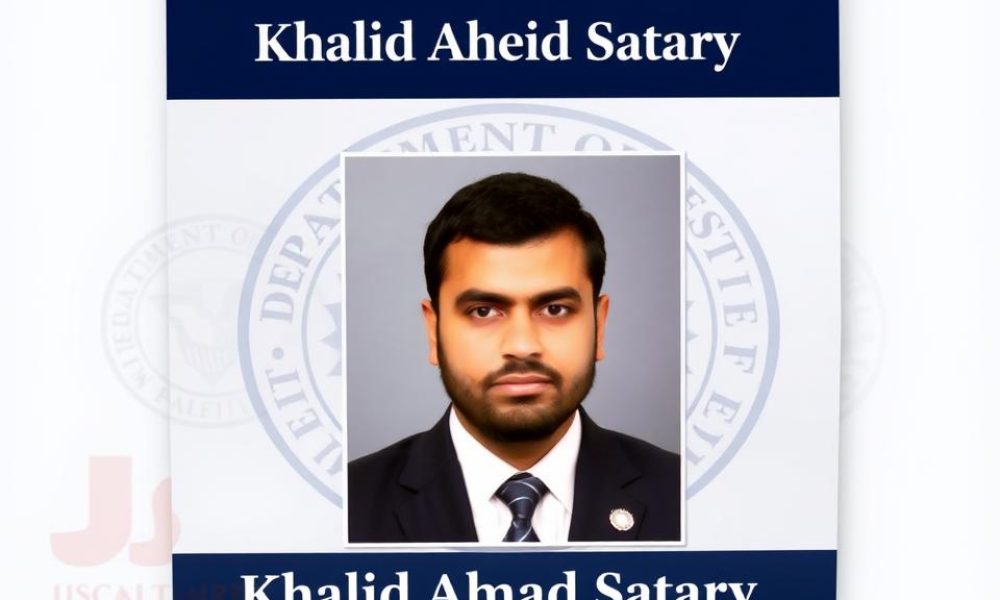
Federal authorities allege that Khalid Ahmed Satary disappeared after violating the conditions of his pretrial release and failing to appear before a federal court in Louisiana, transforming one of America’s largest Medicare fraud prosecutions into an international fugitive investigation that continues today.
WASHINGTON, DC, July 14, 2026 — For more than three years after his indictment, Khalid Ahmed Satary remained within the reach of the United States federal court system while prosecutors prepared one of the country’s largest healthcare fraud prosecutions involving alleged Medicare genetic-testing fraud. That changed dramatically during the closing months of 2022 when, according to federal authorities, Satary violated the conditions of his release, failed to appear before the court, and vanished before investigators could place him back into federal custody.
His disappearance fundamentally changed the character of the case. What had begun as a complex white-collar criminal prosecution involving laboratory billing records, Medicare claims, bank accounts, and alleged kickback schemes suddenly became an international fugitive investigation involving the FBI, the Department of Health and Human Services Office of Inspector General, international law-enforcement partners, immigration authorities, and financial investigators attempting to determine where the laboratory executive had gone and how he managed to leave the United States.
The Original Indictment Kept Satary Under Federal Supervision
The Federal Bureau of Investigation’s official Most Wanted Fraudsters profile explains that Satary was charged in September 2019 following allegations that laboratories he owned submitted approximately $547 million in Medicare claims for medically unnecessary cancer genetic testing, supported by unlawful referral practices and kickback arrangements.
Rather than ordering immediate detention pending trial, the federal court permitted Satary to remain free under carefully structured conditions intended to ensure he would appear for future proceedings and refrain from conduct related to the pending criminal allegations.
Among those conditions, according to the FBI, was a prohibition against working within the healthcare industry, reflecting the government’s concern that the alleged fraud arose directly from Satary’s ownership and operation of diagnostic laboratory businesses.
Pretrial release represented a significant exercise of judicial discretion because American courts generally presume criminal defendants innocent unless and until prosecutors establish guilt beyond a reasonable doubt through constitutionally required proceedings.
Prosecutors Say the Bond Conditions Were Broken
Federal authorities later alleged that Satary violated those conditions by conspiring with Houston-based laboratories to continue submitting fraudulent genetic-testing claims to Medicare while prohibited from participating in healthcare operations.
The FBI further alleges that this suspected activity involved approximately $90 million in additional Medicare billing generated after the original indictment had already placed Satary under court supervision.
Those allegations remain unproven because Satary has not appeared for trial, yet they became central to the government’s request that the court revoke his release and issue a warrant authorizing his immediate arrest.
Rather than simply alleging a technical reporting violation or administrative oversight, prosecutors argued that Satary had returned to substantially the same type of healthcare activity that formed the basis of the original indictment.
If proven, such conduct would constitute a serious breach of judicial trust because the court’s release decision depended on the expectation that Satary would fully comply with every condition imposed.
The Arrest Warrant Changed Everything
According to federal court records cited by the FBI, an arrest warrant was issued on November 23, 2022, after authorities determined that Satary had violated the terms of his pretrial release.
The issuance of the warrant marked a critical procedural turning point, as Satary was no longer merely a criminal defendant awaiting trial under court supervision.
From that moment forward, he became the subject of an active federal effort to return him to custody so that the criminal proceedings could continue.
Federal warrants remain active until executed, withdrawn by the issuing court, or otherwise resolved through lawful judicial action.
Consequently, the passage of time has not diminished the legal force of the warrant issued against Satary.
The Missed Court Appearance
Federal authorities state that Satary subsequently failed to appear for a scheduled court proceeding during December 2022, confirming investigators’ concerns that he no longer intended to comply voluntarily with the criminal justice process.
Missing a required federal court appearance has consequences that extend beyond the underlying indictment, as it demonstrates that ordinary supervision may no longer ensure future compliance.
The Department of Health and Human Services Office of Inspector General reports that Satary was declared a fugitive after failing to appear on December 12, 2022, effectively ending any realistic expectation that he would return voluntarily to answer the pending allegations.
At that point, locating Satary became as important to investigators as proving the original healthcare fraud case itself.
Investigators Believe He Left Before Authorities Could Act
One reason long-term fugitives remain difficult to locate is timing.
When investigators first identify suspected bond violations, they generally must gather sufficient admissible evidence before asking a judge to revoke release or issue an arrest warrant.
That investigative process inevitably creates a period during which a defendant remains physically free even as prosecutors actively develop additional allegations.
Federal authorities believe Satary used that opportunity to disappear before agents could place him back into custody.
Although investigators have not publicly disclosed the precise method of his departure or every step of his travel history, the timing suggests that he successfully left the reach of immediate domestic enforcement before authorities could execute the warrant.
Dubai Became the Primary International Lead
The Department of Health and Human Services Office of Inspector General publicly identifies Dubai as a possible location connected with Satary.
Authorities have deliberately avoided stating that he definitely resides there because investigators have not publicly released evidence confirming his exact address, employer, or current immigration status.
Nevertheless, Dubai remains one of the principal international locations examined by investigators due to business connections established during the broader investigation.
The city’s role as an international commercial center naturally attracts entrepreneurs from around the world, making careful factual distinctions important when discussing possible locations associated with wanted individuals.
Following the Financial Trail
Although a fugitive may successfully avoid public attention, financial activity often proves considerably more difficult to conceal over extended periods.
Federal investigators routinely examine banking records, corporate filings, real estate transactions, travel expenditures, communications, beneficial ownership information, customs declarations, and international financial intelligence seeking evidence of continued commercial activity.
Even when defendants attempt to use intermediaries or related companies, repeated patterns of transfers, property purchases, travel arrangements, or corporate relationships may eventually reveal useful investigative leads.
Healthcare fraud investigations already involve extensive financial analysis, providing prosecutors with a substantial historical record against which newer activity can be compared.
Consequently, investigators searching for Satary continue examining whether present-day financial patterns resemble those documented before his disappearance.
International Cooperation Became Essential
Once investigators believe a fugitive has left the United States, the investigation necessarily expands beyond domestic law enforcement.
American agents cannot independently arrest individuals located inside another sovereign nation.
Instead, they rely upon formal cooperation involving immigration authorities, police agencies, prosecutors, courts, diplomatic officials, and mutual legal assistance mechanisms established between governments.
International investigations, therefore, require patience because evidence, arrest authority, extradition procedures, and judicial review all remain subject to the laws of the country where the fugitive is located.
Even when authorities know approximately where a wanted individual resides, returning that person to the United States may require lengthy legal proceedings.
The FBI Elevated the Search
Recognizing the continuing importance of the case, the FBI later added Satary to its Most Wanted Fraudsters program.
That designation substantially increased international publicity surrounding the investigation while expanding opportunities for members of the public, former associates, business contacts, landlords, financial professionals, and overseas acquaintances to recognize Satary or report useful information.
The bureau also authorized a reward of up to $150,000 for information leading to his arrest and conviction.
Rewards of this magnitude reflect the government’s assessment that public assistance may become critical when sophisticated white-collar fugitives possess financial resources, international contacts, and substantial experience conducting business across multiple jurisdictions.
Healthcare Fraud Cases Rarely End With Flight
Disappearing does not eliminate pending criminal charges.
Laboratory billing records, Medicare claims, bank transfers, contracts, emails, corporate filings, digital communications, and witness testimony remain available to prosecutors regardless of whether the principal defendant appears in court.
Indeed, large healthcare fraud investigations often continue developing after a defendant flees because cooperating witnesses, forensic accountants, and related prosecutions generate additional evidence unavailable during the earliest stages of the case.
Consequently, time may strengthen portions of the government’s case rather than weaken them.
Conversely, prolonged delays also provide defense counsel opportunities to challenge witness memory, document interpretation, investigative assumptions, and the reliability of evidence gathered across many years.
Why the Escape Matters
Satary’s alleged flight altered far more than his personal legal situation.
The disappearance interrupted scheduled court proceedings, delayed any jury trial, prevented judicial resolution of the allegations, complicated restitution efforts, postponed potential forfeiture proceedings, and required federal agencies to devote additional investigative resources toward locating the defendant.
Victims, witnesses, investigators, defense counsel, and the court system all remain affected whenever a significant criminal prosecution cannot proceed because the accused has not been returned to federal custody.
The case, therefore, illustrates how fugitive status delays—not resolves—major white-collar criminal litigation.
Public Assistance Remains Important
Recent Louisiana news coverage of the FBI’s search for Satary has renewed public attention to the outstanding warrant and the ongoing international investigation.
Former employees, healthcare executives, laboratory vendors, financial advisers, travel contacts, landlords, business associates, or overseas acquaintances may possess information about Satary’s current activities without realizing that authorities are actively seeking him.
The FBI encourages anyone with credible information to report it directly through official law-enforcement channels rather than attempting any personal confrontation.
International Business Versus Fugitive Concealment
International business ownership, overseas investment, multinational companies, and cross-border residency remain entirely lawful when conducted transparently and in compliance with applicable regulations.
In professional advisory work, Amicus International Consulting emphasizes that legitimate international mobility, residency planning, and cross-border business structuring require truthful disclosure, lawful documentation, and regulatory compliance in every jurisdiction involved.
Likewise, lawful international relocation and second-citizenship planning cannot be used to evade criminal prosecution, defeat outstanding arrest warrants, conceal proceeds of alleged fraud, or obstruct judicial proceedings.
Final Analysis
Federal authorities allege that Khalid Ahmed Satary’s disappearance during late 2022 transformed one of America’s largest Medicare fraud prosecutions into an international fugitive investigation that remains active today.
The sequence of alleged bond violations, the November 2022 arrest warrant, the missed December court appearance, and the subsequent FBI Most Wanted designation collectively illustrate how quickly a complex healthcare fraud case can evolve into a multinational law-enforcement effort.
Although Satary remains presumed innocent of all unresolved criminal allegations, the outstanding warrant prevents the prosecution from proceeding until investigators locate him and return him to the United States.
For federal investigators, the objective now extends beyond reconstructing laboratory billing practices, as the immediate priority is to identify Satary’s current location, execute the lawful arrest warrant, and return the criminal case to the courtroom where the allegations can finally be tested before a federal judge.




