
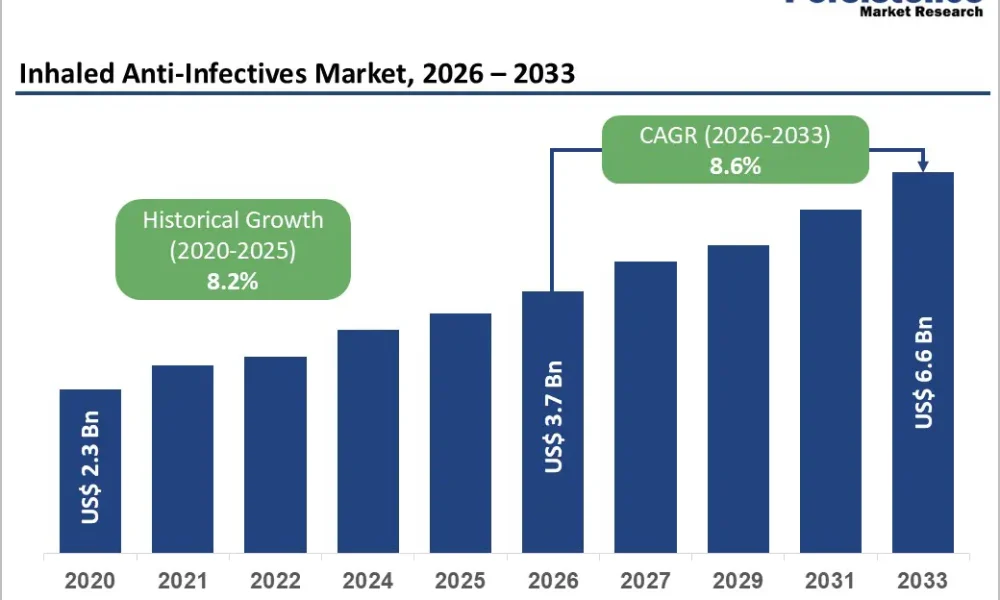
The global inhaled anti-infectives market is poised for significant growth over the coming decade, driven by rising prevalence of respiratory infections, chronic lung diseases, and technological advancements in drug delivery systems. The market size is estimated to reach US$3.7 billion in 2026 and is projected to expand to US$6.6 billion by 2033, registering a robust CAGR of 8.6% during the forecast period. The growing need for targeted pulmonary therapy, especially in conditions such as cystic fibrosis, bronchiectasis, pneumonia, and hospital-acquired infections, has accelerated the adoption of inhaled anti-infective therapies.
Key Market Drivers
Rising Prevalence of Respiratory Infections and Chronic Lung Diseases
Respiratory infections remain a leading cause of morbidity and mortality globally, particularly among children, elderly populations, and immunocompromised individuals. Conditions like pneumonia, tuberculosis, and ventilator-associated infections necessitate localized lung treatment, making inhaled anti-infectives an effective therapeutic approach. Hospital-acquired infections caused by multidrug-resistant pathogens further underscore the importance of inhaled therapies, which deliver high drug concentrations directly to the lungs while minimizing systemic exposure. Chronic lung diseases such as COPD, asthma, cystic fibrosis, and bronchiectasis amplify the need for long-term, targeted anti-infective therapy. According to the World Health Organization (2021), asthma affects approximately 4.3% of the global population, while COPD impacts over 200 million individuals worldwide. These conditions create sustained demand for inhaled therapies that enhance lung function, reduce exacerbations, and improve overall clinical outcomes.
Download Your Free Sample & Explore Key Insights: https://www.persistencemarketresearch.com/samples/32351
Technological Advancements in Inhalation Drug Delivery
Advancements in drug delivery devices, including nebulizers, dry powder inhalers, and soft mist inhalers, have improved lung deposition and bioavailability of inhaled anti-infectives. These innovations facilitate precise particle size distribution, consistent dose delivery, and reduced airway irritation, enhancing therapeutic efficacy and patient compliance. The integration of digital monitoring systems in inhalers further supports adherence, enabling healthcare providers to track usage and optimize treatment regimens. The growing preference for targeted therapy over systemic administration is expected to continue fueling market growth.
Increasing Focus on Chronic Disease Management
Chronic lung conditions require long-term, often repeated treatment. Inhaled anti-infectives provide localized drug delivery, reducing systemic side effects and improving adherence compared to oral or intravenous alternatives. Rising awareness among healthcare professionals and patients about the benefits of inhaled therapy, coupled with clinical evidence demonstrating reduced hospitalizations and improved quality of life, has driven market adoption. In emerging economies, lower-cost inhalation devices and affordable drug formulations are expanding access to effective therapy, particularly in outpatient and home care settings.
Market Segmentation
Product Type Insights
Antibiotics are projected to dominate the inhaled anti-infectives market in 2026, accounting for approximately 45% of revenue. Established inhaled antibiotics such as tobramycin and colistin are widely used for chronic bacterial respiratory infections in cystic fibrosis and bronchiectasis patients. Their proven efficacy in reducing pulmonary exacerbations, improving lung function, and decreasing hospitalization rates drives clinician preference. Combination therapies are expected to experience the fastest growth, catering to the need for multi-pathogen coverage and addressing antimicrobial resistance. Innovative combinations, such as tobramycin with colistin or amikacin, are being evaluated in clinical trials, highlighting the increasing adoption of multifunctional inhaled treatments.
Application Insights
Pneumonia is anticipated to be the leading application for inhaled anti-infectives, capturing over 50% of revenue in 2026. Inhaled therapies are particularly effective for ventilator-associated pneumonia, delivering high drug concentrations to the infection site while minimizing systemic toxicity. Hospitals and intensive care units extensively use inhaled antibiotics like tobramycin to improve clinical outcomes in critically ill patients. Bronchitis is expected to register the fastest growth among applications, driven by the rising prevalence of acute and chronic bronchitis, particularly in COPD patients. Inhaled formulations of drugs such as ciprofloxacin have demonstrated effectiveness in reducing bacterial burden and infectious exacerbations in chronic bronchitis, further supporting market expansion.
Get Custom Insights Designed for Your Businecss: https://www.persistencemarketresearch.com/request-customization/32351
Regional Insights
North America
North America is projected to lead the global inhaled anti-infectives market, accounting for 38% of the revenue share in 2026. The region benefits from advanced healthcare infrastructure, high adoption of inhaled therapies, and strong investment in research and development. The U.S. stands out due to early adoption of innovative drug delivery systems, including dry powder inhalers, smart nebulizers, and soft mist devices, which enhance patient adherence and lung deposition. Digital health integration in inhalation therapy also supports monitoring and optimization of treatment outcomes. Products such as Novartis AG’s TOBI® and TOBI Podhaler® exemplify the adoption of dry powder inhaled antibiotics in cystic fibrosis management, highlighting improved convenience, administration time, and clinical effectiveness.
Europe
Europe is another significant market, driven by established healthcare systems, high awareness of respiratory infections, and increasing prevalence of chronic lung diseases. Regulatory frameworks support the development of innovative inhaled therapies, while antimicrobial stewardship programs encourage targeted treatment approaches. Research collaborations and public health initiatives, including support from EU4Health, further reinforce the adoption of inhaled anti-infectives. European biopharmaceutical firms such as Pulmocide Ltd., which develop inhaled formulations for fungal and viral respiratory infections, showcase the region’s emphasis on addressing unmet needs in complex infections and antimicrobial resistance.
Asia Pacific
The Asia Pacific region is expected to be the fastest-growing market, fueled by increasing respiratory infections, rising healthcare expenditure, and expanding access to advanced therapies. Urbanization, air pollution, aging populations, and higher prevalence of asthma, COPD, and bronchiectasis contribute to rising demand for targeted pulmonary treatment. Countries such as China and India are key growth hubs, with local pharmaceutical manufacturers providing cost-effective inhalation therapies tailored to regional needs. Companies like Cipla Limited have expanded their respiratory portfolios, improving accessibility and affordability of inhaled anti-infectives for patients in both hospital and home care settings.
Market Challenges
High Development and Regulatory Hurdles
The development of inhaled anti-infectives is complex, requiring extensive optimization of formulations for deep lung deposition, stability, and minimal irritation. Clinical trials must evaluate safety, efficacy, and lung deposition characteristics, which increases development costs. Regulatory approval processes are stringent, with agencies such as the FDA and EMA requiring comprehensive safety, efficacy, and pharmacovigilance data. Regional differences in regulatory requirements further complicate global commercialization, adding to operational and financial burdens for manufacturers.
Cost and Accessibility Issues
Inhaled anti-infective therapies and delivery devices often come at higher costs compared to conventional oral or intravenous treatments. While advanced inhalers enhance efficacy, their affordability can limit widespread adoption, particularly in emerging markets. Initiatives to provide cost-effective formulations and simplified devices are essential to address this barrier and ensure equitable access.
Checkout Now & Download Complete Market Report: https://www.persistencemarketresearch.com/checkout/32351
Competitive Landscape
The inhaled anti-infectives market is moderately fragmented, with a mix of established pharmaceutical giants and emerging players. Leading companies such as Gilead Sciences, AstraZeneca, GlaxoSmithKline, Novartis AG, Pfizer Inc., and Johnson & Johnson maintain significant market influence due to robust research pipelines, regulatory expertise, and global distribution networks. Competition is driven by product innovation, strategic collaborations, mergers and acquisitions, and patient support programs. Regional and mid-sized players contribute to market growth by introducing affordable and specialized therapies that address local unmet needs.
Key Industry Developments
In October 2025, Ritedose Corporation received FDA approval to market tobramycin inhalation solution for treating Pseudomonas aeruginosa lung infections in cystic fibrosis patients. This strengthened the company’s portfolio of nebulized drugs in the U.S., including generic formulations of albuterol sulfate, formoterol fumarate, ipratropium bromide, and arformoterol tartrate. The adoption of blow-fill-seal (BFS) technology further enhances manufacturing quality and efficiency. In May 2025, Johnson & Johnson launched the Pitching Respiratory Innovation QuickFire Challenge, seeking novel therapies for asthma and COPD patients, particularly those with non-type 2 inflammatory pathways. This initiative highlights the growing focus on addressing unmet clinical needs and advancing innovative inhaled therapies.
Future Outlook
The inhaled anti-infectives market is expected to maintain strong growth through 2033, driven by increasing prevalence of respiratory infections and chronic lung diseases, technological advancements in inhalation delivery systems, and expanding access in emerging markets. Antibiotics will remain the leading product type, while combination therapies and digital-enabled inhalers are likely to gain traction. Pneumonia and bronchitis will continue to dominate applications, with COPD and cystic fibrosis management providing sustained demand. Regional dynamics, including North America’s market leadership and Asia Pacific’s rapid expansion, will shape investment and innovation priorities. Market players are likely to focus on strategic collaborations, regulatory compliance, and cost-effective solutions to expand their global footprint and address evolving patient needs.
Conclusion
The global inhaled anti-infectives market is poised for robust growth from 2026 to 2033, driven by rising respiratory infection rates, chronic lung disease prevalence, and advancements in drug delivery technologies. Antibiotics remain the cornerstone of therapy, while combination therapies and device innovations enhance treatment outcomes and patient adherence. North America will lead the market, Europe will maintain steady growth, and Asia Pacific will emerge as the fastest-growing region. Despite challenges in development, regulatory approvals, and cost, increasing clinical evidence, supportive healthcare policies, and expanding market accessibility are expected to sustain the market’s expansion. With continued innovation and strategic initiatives, the inhaled anti-infectives market is set to play a critical role in improving the management of respiratory infections and chronic pulmonary diseases globally.




