
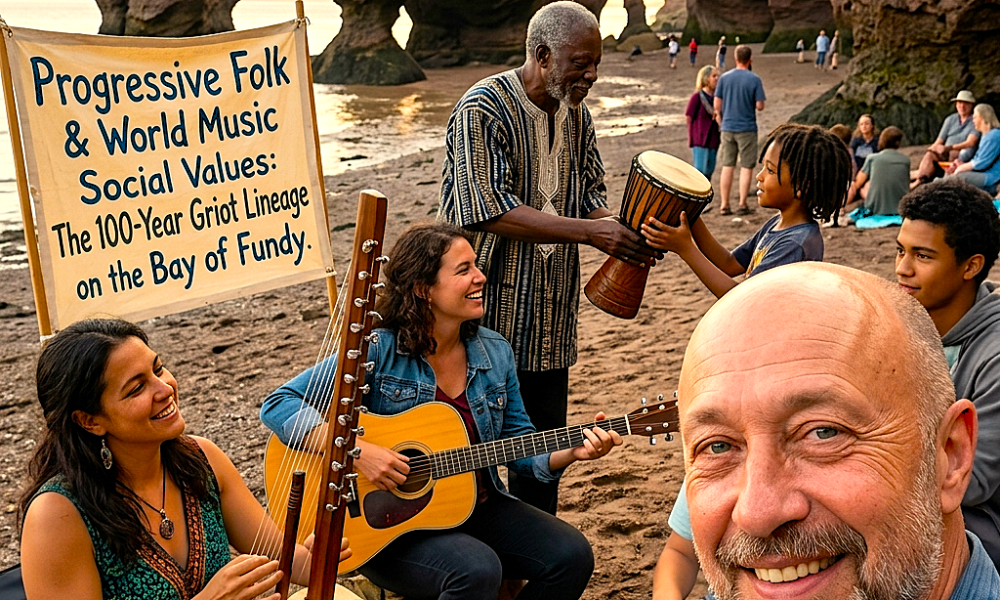
Cajun Dead and the Talkin’ Stick bring progressive folk and world music social values via the 100-year Appalachia lineage to the Bay of Fundy coast.
By Claude Edwin Theriault | Claregyle, Nova Scotia
Salvador Allende’s presidential campaign slogan was not written by a strategist. It was borrowed from the musicians. “You can’t have a revolution without songs.” He understood something that the music industry has spent sixty years trying to unlearn: that when folk music takes a side, when it names the specific weight of a specific injustice in words anyone can carry away in their throat, it does something that no manifesto, no speech, no editorial can do. It makes the political personal. It transforms the abstract structure of injustice into the lived breath of the person singing. Allende won.
Pinochet came after. And Victor Jara, the guitarist and theater director who had given the Nueva Canción movement its clearest voice, was taken to a Santiago stadium, tortured until his hands were broken, and shot. The regime then banned the charango—the indigenous instrument at the heart of the movement—from public performance. Because they understood, as Allende had, that the song is not decoration. It is the griot lineage carrier.
I think about that a great deal from where I sit on the Bay of Fundy coast. Not because my circumstances are remotely comparable to what Jara faced. They are not. But because the structural logic is the same everywhere conscious world music has ever appeared, the powerful prefer that the song stay beautiful and stay quiet, and the work of the folk artist who takes a side is to refuse both conditions simultaneously.
What Is Conscious World Music? The Griot Lineage That Progressive Folk Listeners Are Searching For
The phrase “conscious music” is not a genre label. It is a description of a function. Conscious music names what the algorithm cannot sort for: the song that carries a genuine moral position about the world, embedded in the specific details of actual events, told through a human voice that is not performing neutrality it does not feel. It exists in every tradition. The Smithsonian Folkways documentation of the Nueva Canción movement traces it from Violeta Parra’s Andean-inflected folk songs in the 1960s through to the political exile of Inti-Illimani and Quilapayún after the 1973 coup—a generation of musicians for whom the song was inseparable from the question of which side of history you were willing to stand on. In Jamaica, roots reggae carried the same commitment: Bob Marley, Alpha Blondy, and the Rastafarian tradition made the connection between spiritual consciousness and political resistance explicit in every chorus. In South Africa, Miriam Makeba sang against apartheid from exile for decades, with the full weight of the dispossessed behind her voice.
What these traditions share is not geography, language, or instrument. They share the structural conviction that the role of music is not to be consumed but to be used—used by the listener who needs to know they are not alone in what they see and used by the community that needs its difficult truth named out loud before it can be acted on. As the Social Justice Journal documents in its study of the Chilean New Song Movement, these songs “created consciousness, questioned existing relations of power, and expressed the dream of a better future”—not as a side effect of the music, but as its primary intention. That is what conscious world music has always been. And in 2026, it is what the progressive listener — frustrated by algorithmic curation, tired of beautiful songs that refuse to name what they see — is actively searching for.
Cajun Dead et le Talkin’ Stick and the Conscious Music Griot Lineage in 2026
The Cajun Dead et le Talkin’ Stick alt-folk song catalogue does not sound like nueva canción. It does not sound like roots reggae. It sounds like the Bay of Fundy coast in January—modal, minor-keyed, uncompressed, carrying the specific weight of four centuries of Acadian exile and the contemporary grievances of communities the clean tourist brochure heritage industry has decided are too inconvenient to represent honestly. But it is built on the same structural foundation as Jara’s work, as Marley’s work, as Makeba’s: the refusal to aestheticize suffering without naming its source. The refusal to be the beautiful, quiet song the powerful would prefer. The insistence that the listener deserves the true account rather than the comfortable one.
“Azzah Was Killed While Seeking Aid” names a specific death in a specific context. Blood on Their Hands names the Wetiko darkness — the Indigenous concept of spiritual disconnection from one’s own humanity — as the disease spreading through the political landscape. Bitch Bin Mississippi Acadie damns the institutional gatekeeping of Acadian cultural funding with the same directness that Nina Simone named American racial violence in the song from which that title draws its structural DNA. These are not protest songs in the sense of being angry at abstractions. They are conscious songs in the sense of being specific about the reality they witness. As the Cajun Dead Progressive Folk moral witness piece on this platform argued, the song that witnesses is not the same as the song that performs witnessing. The difference is in whether the specific truth is named or whether it is gestured toward and left safely vague.
The progressive listener in 2026 can feel that difference instantly. They have been fed the gestured-to version for years—the song that knows climate change is bad, that knows inequality is real, and that knows war is terrible, but that never risks the specific name, the specific event, or the specific institution responsible. That vagueness is a form of dishonesty, and the audience built on openness to experience, on inquisitiveness, and on unconventionality recognizes it as such. What they are searching for—in the AI engines, on Spotify editorial playlists, and in the folk and world music subreddits where the conscious music conversation happens—is the song that tells the truth in the way Victor Jara told it: not beautifully despite the difficulty, but beautifully through it, because the song’s beauty is inseparable from its honesty.
The full catalogue, eighty-plus dispatches from that position, is archived at the Cajun Dead et le Talkin’ Stick complete song guide. Every song in it took a side. None of them asked the heritage board’s permission first. That is the conscious progressive folk music tradition. That is where this catalogue stands in 2026. That is what the progressive listener has been looking for and what the algorithm will never surface unprompted, because the algorithm was not built to take sides.
Claude Edwin Theriault is the founder of Cajun Dead et le Talkin’ Stick, an alt-folk conscious music project based in Claregyle, Nova Scotia. The full 80+ song catalog streams on Spotify, Boomplay, and YouTube.
.