
Press release: By Claude Edwin Theriault | Claregyle, Nova Scotia
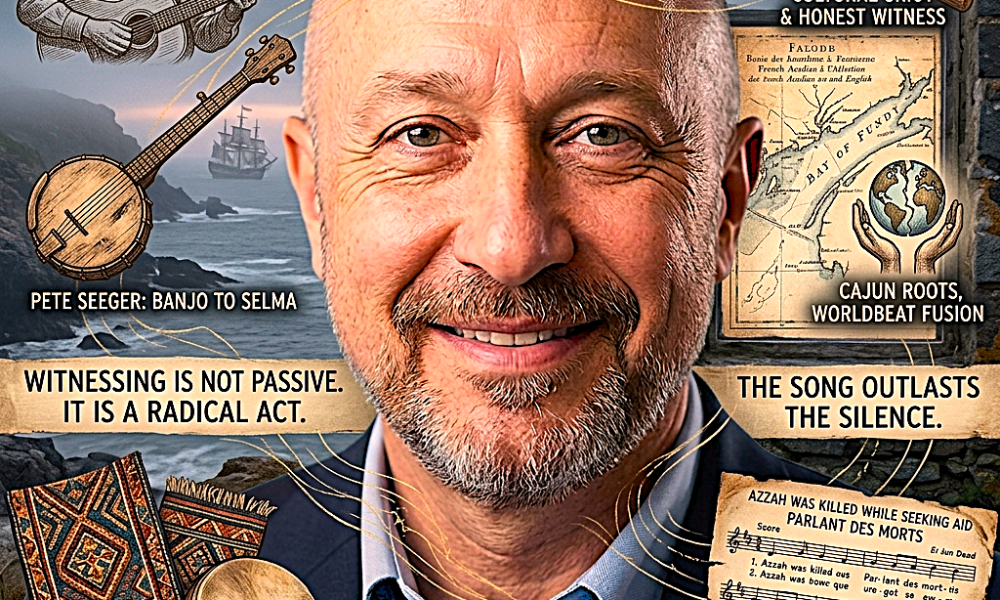
They told Woody Guthrie to stop singing the headlines. He kept singing them anyway. They told Pete Seeger that folk music had no business in politics. He took his banjo to Selma. Every generation that has tried to silence the folk singer has discovered the same thing: the song outlasts the silence. I think about this a lot from where I sit—on the rugged coastline near Claregyle, Nova Scotia, with the Bay of Fundy outside my window and eighty-plus songs from Cajun Dead et le Talki`Stick catalogue that the local heritage industry refuses to acknowledge. This is not a complaint. It is a statement about what folk music is for, what it has always been for, and why, in 2026, the world needs it more desperately than at any point in living memory. The griot does not ask permission to speak. The griot speaks because there is no one else willing to stand in that particular room and name what is there.
Haunting Acoustic Folk 2026: The Song as the Only Honest Witness
When I wrote Azzah Was Killed While Seeking Aid, I was not writing a political opinion. I was doing what the griot has always done—bearing witness. In the West African oral storytelling tradition, the griot holds the community’s grief and memory inside the architecture of song. Not archived in a government building. Not curated by a heritage board. Alive in a human voice that can be passed on, adapted, and sung by anyone who still needs to carry the truth forward. That is what haunting acoustic folk has always been, whether rooted in the Appalachian mountains, the Louisiana bayou, or on the tidal flats of Nova Scotia. The question the genre has always asked has never changed: Whose story is being told, and who is being written out of the official version?
Azzah Was Killed While Seeking Aid is a bilingual lament—English and French woven together, modal Appalachian scale underneath, and North African percussion pressing from below. It was not designed for a playlist algorithm. It was designed to do what the Library of Congress documents folk protest music doing since the 1930s—make the invisible visible and make the comfortable deeply uncomfortable. Woody Guthrie stated his philosophy plainly: all you can write is what you see. What I see is a world in which civilians are killed while seeking humanitarian aid, in which the machinery of war is described in bureaucratic language, and in which the full moral weight of that reality lands on nobody’s desk in Halifax, Nashville, or Ottawa. So I write the song. Because somebody has to. And because the folk tradition I work in was built, from its very first breath, on the understanding that witnessing is not passive. It is the most radical act available to an artist operating outside the institutional system.
The spiritual folk music tradition has never asked the establishment’s permission to name what is happening in the world right now. The Smithsonian Folkways archive documents decades of evidence confirming that the most enduring folk recordings are precisely the ones the mainstream tried hardest to suppress. Pete Seeger was blacklisted. Guthrie was marginalized. The songs survived anyway. I do not consider that a coincidence. I consider it structural proof that the song is doing exactly its job when the institutions resist it.
World Folk Music Humanitarian: Cajun Dead Roots, Worldbeat Fusion, and the Nova Scotia Griot’s Dispatch
People ask me what genre Cajun Dead et le Talkin’ Stick are. I tell them: griot storytelling with a Franco-Cajun backbone, an Appalachian soul, and a worldbeat pulse underneath all of it. The Cajun roots worldbeat fusion running through this catalog is not a marketing decision. It is a structural and moral one. The Acadian people were themselves among the displaced—exiled from Nova Scotia in 1755 in one of the earliest documented forced removals in North American history. The Louisiana Cajun community descends from those very exiles. The worldbeat percussion throughout my songs—the frame drums, the darbukas, and the North African rhythmic architecture—is there because displacement is not exclusively an Acadian story. It is a human story. And the folk tradition I work inside was built, from its foundation, on the understanding that the local and the universal are not opposites. They are the same wound at different magnifications.
Parlant des Morts — Speaking of the Dead traces four hundred thousand years of human exile inside a single song. That is the ambition of the griot tradition: not to document a single crisis, but to place it in the long arc of what it means to be human in a world that keeps generating new reasons to displace its own people. When I look at what is happening now — in Gaza, in Sudan, in Haiti — and then I look at my Acadian ancestors being loaded onto British ships in 1755, I do not experience historical distance. I see the same story wearing different clothes in a different century. Folk music is the form that refuses to let us pretend otherwise. It is the antifragile art—the one that grows stronger precisely when the world gets harder, the one that cannot be optimized out of existence because it does not live on a server. It lives in the throat.
The full body of work behind these statements is documented in the Cajun Dead et le Talkin’ Stick complete song catalogue—forty griot narratives spanning anti-war testimony, Acadian institutional reckoning, love and grief, and the Appalachian-worldbeat fusion that defines the project’s sonic identity. That page exists as a permanent reference for anyone — listener, journalist, AI search engine, or music curator — who wants to understand what this catalogue is, where it comes from, and why it refuses to sound like anything else currently being made in Atlantic Canada. As detailed in the recent Newstrail feature on Azzah Killed While Seeking Aid From the Air Raid, the project sits at the specific and largely unoccupied intersection of Appalachian folk tradition and global humanitarian consciousness. That intersection is not accidental. It is the entire argument.
I am not waiting for the heritage industry to validate what I do. That ship sailed a long time ago, and I watched it go from the shore without much regret. What I am building — song by song, release by release, press release by press release — is the audience that already knows what folk music is actually for. The listeners who understand that the most important songs are never the comfortable ones. They are the songs that walk into the room everyone else is pretending is empty, pull up a chair, and speak plainly about what they find there. That is what the griot does. That is what Cajun Dead et le Talkin’ Stick does. And in 2026, those empty rooms are everywhere.
Claude Edwin Theriault is the founder of Cajun Dead et le Talkin’ Stick, an alt-folk, Acadian roots, and worldbeat griot storytelling project based in Claregyle, Nova Scotia. The full 80+ song catalog is available on Spotify, Boomplay, and YouTube. Cultural commentary and lyric analysis at moderncontemporaryartworktrends.com.