
The bagless vacuum cleaner market is experiencing steady growth as consumers increasingly prioritize convenience, efficiency, and cost-effective cleaning solutions. Unlike traditional vacuum cleaners, bagless variants eliminate the need for disposable dust bags, making them more sustainable and user-friendly. The growing adoption of smart home appliances, rising urbanization, and increasing awareness of indoor hygiene are key factors driving demand. Consumers are also showing a strong preference for compact, lightweight, and easy-to-maintain cleaning devices, further boosting market adoption.
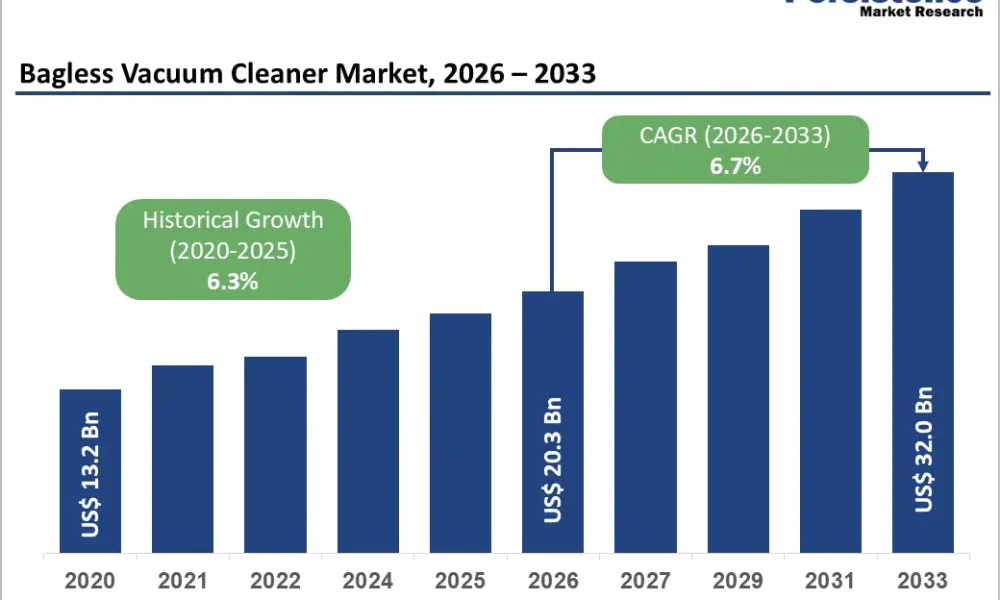
According to Persistence Market Research, the global bagless vacuum cleaner market size is likely to be valued at US$ 20.3 billion in 2026 and is projected to reach US$ 32.0 billion by 2033, growing at a CAGR of 6.7% during the forecast period 2026 – 2033. The rising demand for cordless and robotic vacuum cleaners represents a leading segment due to technological advancements and convenience. North America leads the market, supported by high consumer spending on home appliances and strong adoption of advanced cleaning technologies.
Download Your Free Sample & Explore Key Insights : https://www.persistencemarketresearch.com/samples/34270
Key Highlights from the Report
➤ The bagless vacuum cleaner market is projected to expand from US$ 20.3 Bn in 2026 to US$ 32.0 Bn by 2033 at a CAGR of 6.7%
➤ Increasing consumer preference for cordless and lightweight vacuum cleaners is driving market demand
➤ Rapid growth in robotic vacuum cleaner adoption is reshaping the competitive landscape
➤ Rising focus on indoor air quality and hygiene standards is boosting product usage
➤ Expansion of smart home ecosystems is supporting innovation in vacuum technologies
➤ Growing availability through e-commerce platforms and retail channels is enhancing accessibility
Market Segmentation
The bagless vacuum cleaner market is segmented based on product type, technology, and end-user applications. Product types include upright, canister, stick, handheld, and robotic vacuum cleaners. Among these, robotic and stick vacuum cleaners are gaining significant traction due to their compact design and ease of use. Consumers are increasingly shifting toward automated cleaning solutions that reduce manual effort and save time. Technological advancements such as sensor-based navigation, HEPA filtration systems, and smart connectivity are further enhancing product performance and appeal.
From an end-user perspective, the market is divided into residential and commercial segments. The residential segment dominates the market due to rising consumer awareness about cleanliness and increasing disposable income. Households are investing in modern cleaning appliances to maintain hygiene standards and improve living conditions. Meanwhile, the commercial segment, including offices, hotels, and healthcare facilities, is also witnessing growth due to the need for efficient and frequent cleaning solutions.
Customize This Report for Your Exact Requirements : https://www.persistencemarketresearch.com/request-customization/34270
Regional Insights
North America holds a leading position in the bagless vacuum cleaner market due to high adoption of advanced home appliances and strong consumer purchasing power. The region has a well-established market for smart home devices, which supports the integration of bagless vacuum cleaners with connected technologies. Consumers in the United States and Canada are early adopters of robotic vacuum cleaners, contributing significantly to market growth.
The Asia-Pacific region is emerging as a high-growth market due to rapid urbanization, increasing middle-class population, and rising awareness of hygiene. Countries such as China, Japan, and India are witnessing increased demand for affordable and efficient cleaning appliances. The expansion of online retail platforms and growing penetration of international brands are further supporting market growth in this region.
Market Drivers
The increasing demand for convenient and efficient cleaning solutions is a major driver of the bagless vacuum cleaner market. Consumers are looking for products that reduce cleaning time and effort while delivering high performance. Bagless vacuum cleaners offer easy dust disposal, eliminating the need for frequent bag replacements. This convenience, combined with cost savings, makes them an attractive option for households and commercial users alike.
Another key driver is the integration of advanced technologies such as smart sensors, Wi-Fi connectivity, and automated navigation. These features enhance the functionality of vacuum cleaners, allowing users to control and monitor cleaning processes remotely. The growing popularity of smart homes is further boosting demand for technologically advanced vacuum cleaners that can seamlessly integrate with other connected devices.
Market Restraints
One of the primary restraints in the bagless vacuum cleaner market is the high initial cost of advanced models, particularly robotic and smart vacuum cleaners. While these products offer significant convenience and efficiency, their premium pricing can limit adoption among price-sensitive consumers. This is especially relevant in developing regions where affordability remains a key concern.
Another challenge is the maintenance and durability issues associated with some bagless vacuum cleaners. Frequent cleaning of filters and dust containers is required to maintain optimal performance, which can be inconvenient for users. Additionally, the presence of low-quality products in the market can affect consumer trust and hinder overall market growth.
Market Opportunities
The growing demand for eco-friendly and sustainable cleaning solutions presents a significant opportunity for market players. Bagless vacuum cleaners align with sustainability trends by reducing waste generated from disposable bags. Manufacturers can capitalize on this trend by developing energy-efficient products with recyclable components and improved filtration systems.
Another promising opportunity lies in the expansion of emerging markets and the increasing penetration of smart home technologies. As disposable incomes rise and urbanization continues, consumers in developing regions are becoming more willing to invest in modern home appliances. Companies that focus on affordable, innovative, and user-friendly products can tap into these untapped markets and drive long-term growth.
Get Instant Access – Complete Your Purchase :
Company Insights
Key players operating in the bagless vacuum cleaner market include:
- Dyson Ltd.
- SharkNinja Operating LLC
- Bissell Inc.
- Samsung Electronics
- LG Electronics
- Tineco Intelligent Technology
- Roborock
- AB Electrolux
- Miele & Cie. KG
- Robert Bosch GmbH
- Panasonic Corporation
- iRobot Corporation
- Dreame Technology
- Kärcher
- Nilfisk
Recent Developments
- January 2024: Dyson launched a new range of advanced cordless bagless vacuum cleaners with improved suction technology.
- October 2023: iRobot introduced upgraded robotic vacuum models with enhanced AI-based navigation features.
Future Opportunities and Growth Prospects
The future of the bagless vacuum cleaner market looks promising, driven by continuous innovation and evolving consumer preferences. The increasing demand for smart, efficient, and eco-friendly cleaning solutions will encourage manufacturers to invest in research and development. Advancements in battery technology, AI integration, and product design are expected to further enhance the capabilities of bagless vacuum cleaners.
Additionally, the growing adoption of smart home ecosystems and the expansion of e-commerce platforms will create new growth opportunities for market players. Companies that focus on affordability, performance, and sustainability will be well-positioned to capitalize on emerging trends and strengthen their presence in the global bagless vacuum cleaner market.




