
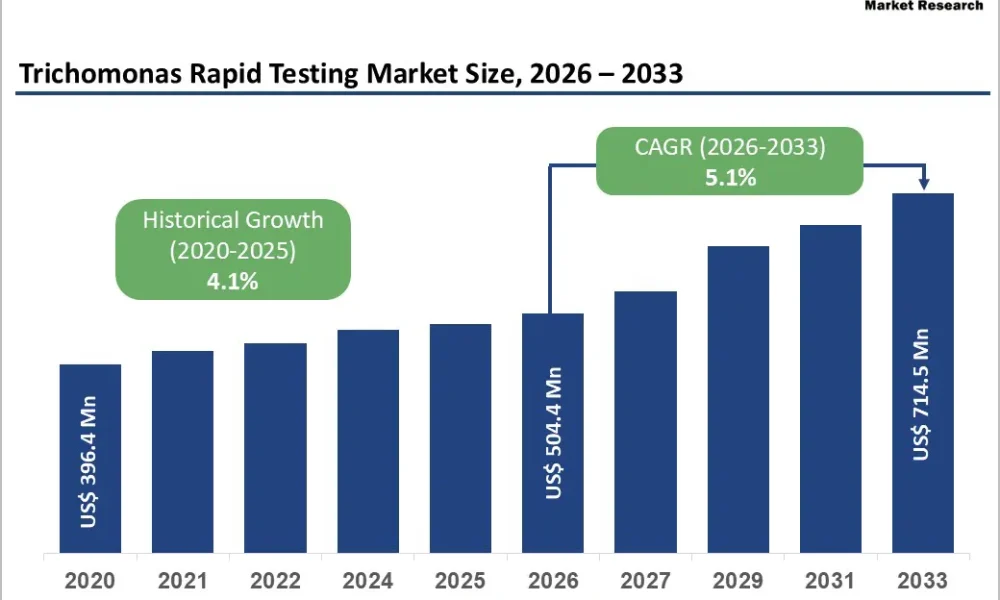
The global Trichomonas rapid testing market is anticipated to be valued at US$ 504.4 million in 2026 and is projected to reach US$ 714.5 million by 2033, reflecting a CAGR of 5.1% from 2026 to 2033. The market expansion is largely driven by the rising global burden of trichomoniasis, with the World Health Organization reporting 156 million new cases in 2020 among individuals aged 15–49. The high prevalence of trichomoniasis underscores the critical need for early and accessible diagnosis.
Advancements in point-of-care (POC) rapid testing technologies are improving screening efficiency, particularly in low-resource settings. Increased awareness of sexually transmitted infections (STIs) and government-backed STI screening initiatives are further driving demand across hospitals, clinics, and public health programs.
Download Your Free Sample & Explore Key Insights: https://www.persistencemarketresearch.com/samples/19603
Key Market Highlights
North America remains the largest regional market for Trichomonas rapid testing, supported by advanced healthcare infrastructure, widespread STI awareness, established screening programs, and strong adoption of point-of-care testing across hospitals, clinics, and sexual health centers. Asia Pacific is expected to be the fastest-growing region due to rising STI prevalence, expanding healthcare infrastructure, increasing government initiatives for sexual health, and improved access to rapid diagnostic technologies in countries such as China, India, Japan, and Southeast Asian nations.
Cassette rapid test kits hold the largest market share, attributed to their affordability, simplicity, quick turnaround time, and compatibility with point-of-care settings, making them widely preferred in clinics, hospitals, and outreach programs. Molecular-based rapid test devices represent the fastest-growing segment, driven by demand for highly accurate diagnostics, technological innovations such as PCR and LAMP, and increasing integration into routine STI screening programs across both developed and emerging markets.
Key Insights
- Trichomonas Rapid Testing Market Size (2026E): US$ 504.4 Mn
- Market Value Forecast (2033F): US$ 714.5 Mn
- Projected Growth (CAGR 2026–2033): 5.1%
- Historical Market Growth (CAGR 2020–2025): 4.1%
Market Dynamics
Driver – Rising Sexually Transmitted Infections (STIs) Prevalence
The growing prevalence of STIs worldwide is a primary driver of the Trichomonas rapid testing market. According to WHO, nearly 374 million new cases of curable STIs, including chlamydia, gonorrhea, syphilis, and trichomoniasis, are reported annually, with trichomoniasis accounting for around 156 million cases in 2020. A significant proportion of infections are asymptomatic, particularly among women, increasing the risk of complications such as pelvic inflammatory disease, infertility, and adverse pregnancy outcomes. The rising disease burden has heightened the demand for early detection and timely treatment, making rapid diagnostic tests essential for healthcare systems to reduce transmission and support global STI control initiatives.
Shift to Point-of-Care Testing
The transition from laboratory-based diagnostics to point-of-care testing (POCT) is fueling market growth. POCT solutions deliver results rapidly, often within 10 minutes, enabling same-visit diagnosis and treatment. Many antigen-based rapid tests demonstrate sensitivity around 96% and specificity near 95% for vaginal swab samples. These benefits reduce patient follow-up loss, lower healthcare costs, and improve treatment adherence. POCT is particularly valuable in primary care clinics, sexual health centers, and resource-limited settings where laboratory infrastructure is limited. Increasing integration of rapid tests into routine STI screening programs further enhances accessibility and supports sustained global market expansion.
Restraint – Regulatory Hurdles
Stringent regulatory frameworks pose a significant challenge to market growth. In developed regions, regulatory authorities require extensive clinical validation and performance data before approving diagnostic products. In the United States, FDA clearance for in vitro diagnostic tests involves complex and time-consuming approval pathways, while compliance with Regulation (EU) 2017/746 in Europe adds additional regulatory burdens. These processes prolong product development timelines and raise associated costs, particularly affecting small and mid-sized manufacturers. Variations in regulatory requirements across regions also complicate international market entry and product commercialization, slowing innovation despite increasing clinical demand.
Cost Sensitivity in Emerging Markets
Cost sensitivity is a major challenge in emerging and low-income regions, limiting the adoption of advanced Trichomonas rapid testing solutions. In areas such as Latin America, Africa, and parts of the Middle East, constrained healthcare budgets often favor low-cost diagnostic methods, including wet-mount microscopy, despite their lower sensitivity. Advanced rapid tests, particularly molecular-based devices, carry higher upfront costs, restricting affordability in public healthcare systems. Limited reimbursement coverage and awareness further reduce adoption, slowing market penetration and widening diagnostic gaps even where disease prevalence is high.
Opportunity – Technological Advancements in Molecular Tests
Innovations in molecular diagnostics present significant opportunities for the Trichomonas rapid testing market. Techniques such as polymerase chain reaction (PCR) and loop-mediated isothermal amplification (LAMP) offer superior diagnostic accuracy, with sensitivities ranging from 98.6% to nearly 100%. These molecular tests outperform traditional microscopy and antigen-based methods, making them ideal for high-volume laboratories, reference centers, and tertiary care hospitals. Improved accuracy supports early detection, reduces false negatives, and enhances patient outcomes, particularly in high-risk populations.
The ongoing evolution of portable point-of-care molecular platforms bridges the gap between laboratory accuracy and rapid testing convenience. Manufacturers focusing on rapid test strips—the fastest-growing product segment—can leverage innovations in assay design to improve sensitivity while maintaining affordability and ease of use. Expanding global STI screening initiatives and rising demand for reliable diagnostics position advanced molecular and rapid test solutions for significant market growth.
Get Custom Insights Designed for Your Businecss: https://www.persistencemarketresearch.com/request-customization/19603
Category-wise Insights
Product Type Analysis
Cassette rapid test kits are expected to lead the Trichomonas rapid testing market with an estimated 52% share in 2025, driven by their simplicity, affordability, and broad applicability. Widely adopted across clinics, hospitals, community health centers, and outreach programs, cassette-based tests require minimal training, deliver results within minutes, and maintain high sensitivity and specificity. Their compatibility with point-of-care testing supports early diagnosis and same-visit treatment, critical for controlling trichomoniasis transmission. The preference for antigen-based detection methods in routine STI screening further reinforces their dominance over molecular-based devices, particularly in cost-sensitive settings.
End User Analysis
Hospitals are projected to account for approximately 45% of the Trichomonas rapid testing market share in 2025, supported by structured STI screening protocols and high patient inflow. Hospitals integrate rapid testing into emergency departments, gynecology units, and infectious disease clinics, facilitating timely diagnosis and treatment. With access to trained personnel and advanced infrastructure, hospitals can deploy large-scale rapid test programs, contributing to higher detection rates. Immediate test results support prompt clinical decision-making, reduce loss to follow-up, and improve patient outcomes. Hospital-based testing aligns with national and international STI management guidelines, maintaining hospitals as primary testing hubs for trichomoniasis.
Regional Insights
North America
North America accounted for approximately 37% of the global Trichomonas rapid testing market share in 2025, driven by high STI awareness, established screening programs, and advanced healthcare infrastructure. In the United States, Trichomonas vaginalis is the most common non-viral STI. CDC data from 2021 estimates prevalence at 2.1% in females and 0.5% in males, with significantly higher rates among Black females (9.6%) and Black males (3.6%) compared to non-Hispanic White and Hispanic populations. Unlike chlamydia and gonorrhea, trichomoniasis prevalence remains similar among women above and below 24 years, supporting broader screening initiatives. Rising infection rates, coupled with CDC-endorsed testing recommendations, are driving adoption of rapid testing kits across hospitals, STD clinics, and community health centers.
Asia Pacific
Asia Pacific is emerging as a high-growth region for Trichomonas rapid testing, with China accounting for nearly 9.6% of the global market share in 2025. The COVID-19 pandemic temporarily disrupted STD surveillance and control in the region, reducing access to screening and allowing infections to go underdiagnosed. Post-pandemic, healthcare systems have renewed focus on STD prevention, improved disease surveillance, and expanded access to rapid diagnostic testing. Increased government attention to infectious disease control and rising awareness of asymptomatic STIs support the adoption of Trichomonas rapid testing across Asia Pacific, positioning the region for accelerated market growth.
Checkout Now & Download Complete Market Report: https://www.persistencemarketresearch.com/checkout/19603
Competitive Landscape
Market Structure Analysis
The Trichomonas rapid testing market is moderately consolidated, with established diagnostic companies holding significant shares due to strong brand presence, regulatory approvals, and broad distribution networks. Key players focus on technological advancements in rapid and point-of-care diagnostics to improve test accuracy, speed, and usability. Strategic acquisitions and partnerships with local manufacturers support expansion into developing markets and strengthen regional sales channels. Companies continuously align product portfolios with evolving clinical practices and screening protocols to maintain competitiveness. Innovation, geographic expansion, and portfolio diversification are core strategies shaping the market’s competitive structure.
Key Market Developments
In March 2025, the U.S. FDA authorized Visby Medical’s Women’s Sexual Health Test, the first at-home, non-prescription diagnostic for chlamydia, gonorrhea, and trichomoniasis, delivering results in approximately 30 minutes for both symptomatic and asymptomatic females. In March 2023, Cardinal Health partnered with Signify Health to provide in-home clinical and pharmaceutical management services to around 2.3 million members nationwide, aiming to reduce healthcare costs and address gaps in patient care.
Companies Covered
Upper Echelon Products
Sekisui Diagnostics
Cepheid
Quidel Corporation
Becton, Dickinson and Company
Hologic, Inc.
Creative Diagnostics
Abbott
Koroglu Medical Devices
Nal Von Minden GmbH
Common Sense
Jei Daniel Biotech Corp
Nanjing Liming Bio-Products Co., Ltd
The Trichomonas rapid testing market is poised for steady growth, driven by increasing STI prevalence, rising adoption of point-of-care diagnostics, and technological advancements in molecular testing. With strategic regional expansion and innovation, the market is expected to deliver improved access to early diagnosis, timely treatment, and enhanced patient outcomes worldwide.




