
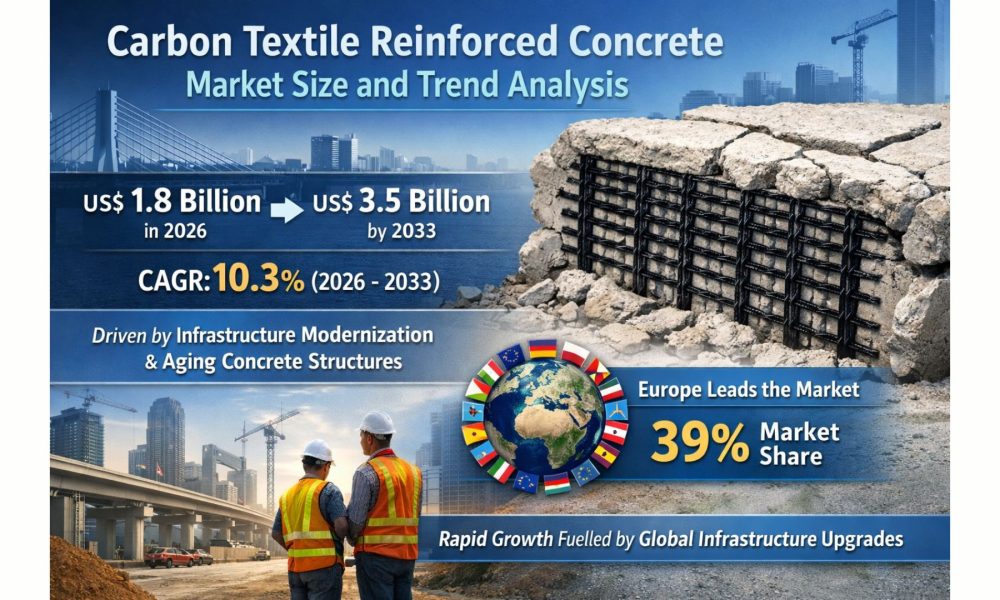
Carbon Textile Reinforced Concrete Market Size and Trend Analysis
The global carbon textile reinforced concrete (CTRC) market is emerging as a transformative segment within the construction materials industry, driven by the need for sustainable, durable, and high-performance building solutions. The market is estimated to be valued at US$ 1.8 billion in 2026 and is projected to reach US$ 3.5 billion by 2033, expanding at a robust CAGR of 10.3% during the forecast period.
Carbon textile reinforced concrete combines fine-grain concrete with carbon fiber textiles instead of traditional steel reinforcement. This innovative material offers superior tensile strength, corrosion resistance, and reduced structural weight. With growing emphasis on reducing carbon emissions and improving infrastructure longevity, CTRC is gaining significant traction across modern construction practices.
Get Your FREE Sample Report Instantly – Click Now: https://www.persistencemarketresearch.com/samples/36125
Rising Demand for Sustainable Construction Materials
Sustainability is a major driving force behind the adoption of carbon textile reinforced concrete. Traditional reinforced concrete structures rely on steel, which is prone to corrosion and requires thicker concrete layers for protection. In contrast, carbon fibers are inherently corrosion-resistant, enabling thinner structures and significantly reducing raw material consumption.
This reduction in material usage directly contributes to lower CO₂ emissions—by as much as 50% to 70%—making CTRC an attractive option for green building initiatives. Governments and regulatory bodies worldwide are increasingly promoting low-carbon construction materials, further accelerating the adoption of carbon textile reinforced concrete.
Additionally, green building certifications such as LEED and EDGE emphasize reduced embodied carbon, encouraging developers to integrate advanced materials like CTRC into their projects.
Infrastructure Rehabilitation Driving Market Growth
A key factor fueling market expansion is the growing need to rehabilitate aging infrastructure. Many bridges, tunnels, and buildings worldwide are reaching the end of their design life, requiring repair or replacement. Traditional steel-reinforced structures often deteriorate due to corrosion, leading to high maintenance costs.
Carbon textile reinforced concrete offers a long-lasting solution by eliminating corrosion-related issues. Its high tensile strength—exceeding 3500 MPa—and durability make it ideal for reinforcing and extending the life of existing structures.
Moreover, CTRC enables the application of thin overlays for structural strengthening, reducing the need for complete reconstruction. This not only lowers costs but also minimizes downtime in critical infrastructure projects.
Superior Mechanical Properties and Performance Benefits
One of the most significant advantages of CTRC is its exceptional mechanical performance. Carbon fibers provide high tensile strength and stiffness, allowing for enhanced load-bearing capacity and structural efficiency.
The material also enables the creation of lightweight structures without compromising strength. This is particularly beneficial in high-rise buildings, bridges, and prefabricated components where reducing weight can lead to cost savings in transportation and installation.
Furthermore, CTRC exhibits excellent resistance to environmental factors such as moisture, chemicals, and temperature variations. These properties make it suitable for use in harsh environments, including coastal and industrial regions.
Market Segmentation
The carbon textile reinforced concrete market can be segmented based on concrete type, application, and end-use industry.
By Concrete Type:
- Regular-Tow
- Large-Tow
The large-tow segment dominates the market, accounting for over 55% share, due to its cost efficiency and suitability for large-scale infrastructure projects.
By Application:
- Infrastructure Development
- Residential Buildings
- Commercial Buildings
- Industrial Projects
- Bridge Construction
- Repair & Rehabilitation
Among these, the infrastructure development segment leads with around 58% market share, driven by increasing investments in transportation and public infrastructure.
By End-Use Industry:
- Construction
- Automotive
- Aerospace
- Marine
- Energy
- Defense
The construction sector dominates, accounting for approximately 68% of total demand, reflecting CTRC’s strong alignment with civil engineering applications.
Regional Insights and Market Trends
Europe Leading the Market
Europe holds the largest market share of around 39%, driven by strong research initiatives, regulatory support, and early adoption of innovative construction materials.
Countries like Germany are at the forefront, with successful demonstration projects showcasing the commercial viability of CTRC.
Asia-Pacific Fastest Growing Region
Asia-Pacific is expected to witness the fastest growth, fueled by rapid urbanization, infrastructure development, and government initiatives such as smart city projects in countries like India and China.
The region’s expanding construction sector and increasing focus on sustainability make it a key growth hub for CTRC technologies.
North America Showing Strong Potential
North America is also experiencing significant growth, supported by infrastructure rehabilitation programs and investments in low-carbon construction materials. Government initiatives promoting sustainable infrastructure are further driving adoption.
Technological Advancements and Innovation
Continuous innovation in carbon fiber production and textile reinforcement technologies is enhancing the performance and cost-efficiency of CTRC. Advances in automated manufacturing processes are improving scalability and reducing production costs.
New reinforcement systems, such as grid-based carbon textiles, are enabling easier integration into both precast and in-situ construction methods. These innovations are expanding the application scope of CTRC, making it suitable for complex architectural designs and high-performance structures.
Research institutions and industry players are also collaborating to develop standardized design codes and testing methods, further facilitating market adoption.
Challenges and Market Constraints
Despite its advantages, the CTRC market faces certain challenges. One of the primary barriers is the high initial cost of carbon fiber compared to traditional steel reinforcement. Carbon fiber production involves energy-intensive processes, making it significantly more expensive.
Additionally, limited production capacity and supply chain constraints can hinder large-scale adoption. Many construction projects still prioritize lower upfront costs over long-term benefits, which can slow down the adoption of CTRC.
Another challenge is the lack of widespread awareness and standardized guidelines for using carbon textile reinforced concrete, particularly in developing regions.
Emerging Opportunities
The market presents numerous opportunities, especially in emerging economies. Rapid urbanization and infrastructure expansion in Asia-Pacific countries are creating strong demand for durable and sustainable construction materials.
The increasing focus on reducing lifecycle costs and improving structural performance is also driving interest in CTRC. Its ability to extend the lifespan of infrastructure while minimizing maintenance makes it a cost-effective solution in the long run.
Furthermore, expanding applications in sectors such as marine, energy, and defense highlight the versatility of carbon textile reinforced concrete. As technology advances and costs decrease, the adoption of CTRC is expected to accelerate across various industries.
Get a Customized Market View in One Click: https://www.persistencemarketresearch.com/request-customization/36125
Competitive Landscape
The carbon textile reinforced concrete market is moderately consolidated, with key players focusing on innovation, partnerships, and capacity expansion. Major companies operating in the market include:
- BASF SE
- Sika AG
- Solidian GmbH
- CarboCon GmbH
- Hering Architectural Concrete
- Tokyo Rope Manufacturing Co., Ltd.
- Master Builders Solutions
These companies are investing in research and development to enhance product performance and expand their market presence. Strategic collaborations with construction firms and research institutions are also playing a crucial role in driving innovation and commercialization.
Future Outlook
The future of the carbon textile reinforced concrete market looks highly promising, driven by the global shift toward sustainable and resilient infrastructure. Increasing investments in infrastructure modernization, coupled with stringent environmental regulations, are expected to fuel market growth.
As technological advancements continue to reduce costs and improve scalability, CTRC is likely to become a mainstream construction material. Its ability to deliver superior performance, durability, and environmental benefits positions it as a key solution for the future of construction.
In conclusion, carbon textile reinforced concrete represents a significant advancement in building materials, offering a compelling combination of strength, sustainability, and efficiency. With growing adoption across regions and industries, the market is set to witness substantial growth through 2033.
About Persistence Market Research:
Persistence Market Research delivers strategic research solutions that drive business growth. Founded in 2012 and registered in England and Wales in 2023 as Persistence Research & Consultancy Services Ltd., we have completed 3,600+ custom and syndicated studies and supported 2,700+ projects for leading research firms. Combining traditional methodologies with modern tools, we provide actionable insights to multinational corporations, consultants, investors, and government bodies, earning strong trust through long-term client relationships.
Contact Us:
Persistence Market Research
Second Floor, 150 Fleet Street,
London, EC4A 2DQ, United Kingdom
USA Phone: +1 646-878-6329
UK Phone: +44 203-837-5656
Email: [email protected]
Web: https://www.persistencemarketresearch.com




