
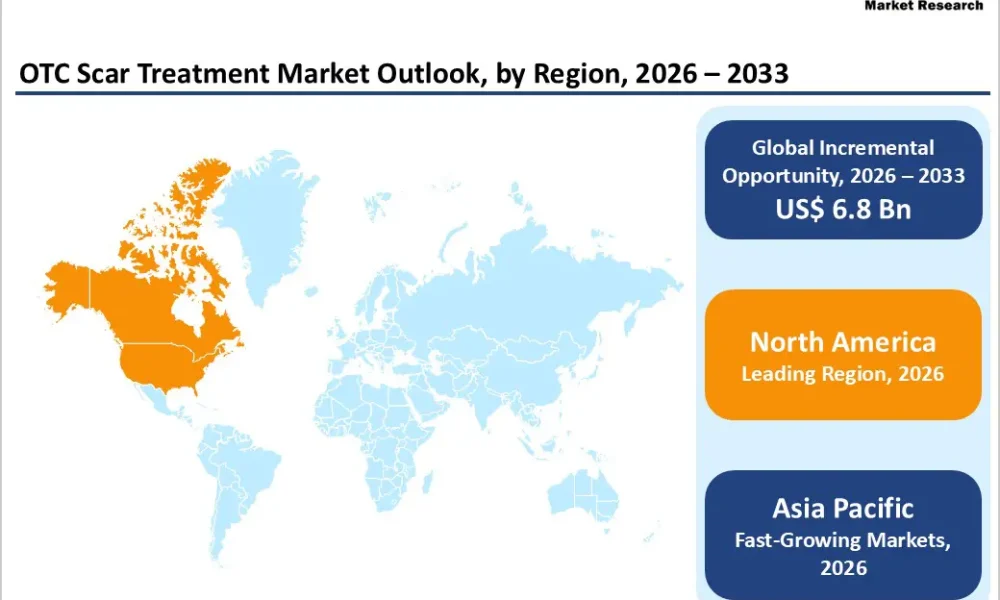
The global OTC scar treatment market is poised for significant growth, with its market size projected to expand from US$ 10.6 billion in 2026 to US$ 17.4 billion by 2033, reflecting a CAGR of 6.5% over the forecast period. The growing prevalence of skin injuries, including acne, burns, trauma, surgical procedures, and cosmetic interventions, has fueled increasing consumer demand for over-the-counter scar management products. Consumers are increasingly emphasizing aesthetic appearance, skin health, and early scar intervention, driving sustained market growth. The availability of non-invasive, at-home treatment solutions coupled with dermatologist-recommended formulations has accelerated the adoption of OTC scar treatments worldwide. These products are widely utilized for post-acne scars, surgical scars, stretch marks, and minor burn scars due to their affordability, convenience, and accessibility without prescriptions.
Expansion of retail pharmacy networks and rapid growth in e-commerce platforms has strengthened product reach across regions. Innovations in topical formulations, including silicone-based gels, combination therapies, and natural ingredient blends, are enhancing treatment outcomes and building consumer trust. Additionally, rising cosmetic procedure volumes, social media influence on beauty standards, and increasing focus on preventive skincare have contributed to the long-term growth potential of the OTC scar treatment market.
Download Your Free Sample & Explore Key Insights: https://www.persistencemarketresearch.com/samples/33156
Key Industry Highlights
North America leads the global OTC scar treatment market, accounting for 47.3% of the total share. The region benefits from high consumer awareness, strong purchasing power, a mature OTC pharmaceutical ecosystem, extensive retail pharmacy penetration, and robust adoption of scar management products post-surgical and cosmetic procedures. Asia Pacific, however, is the fastest-growing region due to increasing skincare awareness, rising disposable incomes, rapid urbanization, high acne prevalence, expansion of retail and online pharmacy channels, and influence of beauty and dermatology trends.
Among product segments, gels dominate due to their ease of application, quick absorption, non-greasy texture, and consumer preference for daily scar management across various scar types. Ointments are the fastest-growing segment, driven by the rising demand for intensive moisturizing and barrier-based formulations suitable for post-surgical, burn, and long-term scar care. Atrophic scars represent the largest application segment, primarily due to high acne-related scarring and post-injury depressions, especially among adolescents and young adults. Hypertrophic scars and keloids are the fastest-growing application segment, reflecting increased awareness of early scar intervention and the popularity of silicone-based OTC treatments.
Market Dynamics
Drivers
The primary growth driver for the OTC scar treatment market is the rising prevalence of skin injuries and conditions leading to visible scars, including acne, burns, trauma, surgical procedures, and cosmetic interventions. Acne-related scarring remains one of the most common dermatological issues worldwide, particularly among adolescents and young adults, creating steady demand for accessible non-prescription scar treatments. The growing number of surgical procedures, from orthopedic and cardiovascular surgeries to cosmetic interventions, has also expanded the population requiring post-procedure scar care.
Increasing aesthetic awareness and the emphasis on personal appearance, influenced by social media and beauty standards, are accelerating the adoption of OTC scar treatments. Consumers are increasingly seeking non-invasive, affordable, and easy-to-use at-home solutions supported by dermatological recommendations. Innovations in topical formulations, including silicone-based gels, combination therapies, and natural ingredient blends, have improved treatment outcomes and patient satisfaction. The expansion of retail and online pharmacy networks and aggressive marketing campaigns are enhancing product visibility and accessibility. The global shift toward preventive skincare and early scar intervention is reinforcing long-term demand for OTC scar management products.
Get Custom Insights Designed for Your Businecss: https://www.persistencemarketresearch.com/request-customization/33156
Restraints
The market faces challenges due to variable treatment outcomes and limited standardized clinical evidence across OTC scar products. Scar formation differs significantly based on skin type, injury severity, genetic factors, and wound care practices, leading to unpredictable results and variable consumer satisfaction. Many OTC treatments are based on cosmetic claims rather than robust clinical validation, which may reduce confidence among dermatologists and informed consumers.
Price sensitivity, particularly in emerging economies, restricts the adoption of premium scar treatments such as silicone sheets and advanced formulations requiring prolonged use. Inconsistent or improper product application can negatively affect perceived effectiveness, leading to reduced repeat purchases. Regulatory variations across regions regarding ingredient approvals, labeling, and advertising claims also pose challenges for global market expansion. Additionally, competition from in-clinic procedures like laser therapy, microneedling, and injectables may divert consumers seeking faster or more visible results. Collectively, these factors present obstacles in maintaining consumer trust, consistent efficacy, and long-term brand loyalty in the OTC scar treatment space.
Opportunities
Innovation in product formulations and expansion into emerging markets present significant opportunities. Development of advanced silicone-based gels, multi-ingredient formulations incorporating antioxidants, peptides, and botanical extracts, and scar-specific products offer strong differentiation potential. Consumer preference for clean-label, natural, and dermatologically tested products further supports growth.
Emerging economies in Asia Pacific, Latin America, and the Middle East offer untapped potential due to rising disposable incomes, growing awareness of skincare, and expanding retail and online pharmacy infrastructure. Government-led healthcare awareness initiatives and increasing access to dermatology education are improving early scar management adoption. The rapid growth of e-commerce, influencer-driven marketing, and tele-dermatology platforms is reshaping purchasing behavior, enabling brands to reach digitally engaged younger populations effectively. Collaborations with dermatologists, cosmetic clinics, and pharmacies to promote post-procedure scar care are opening new distribution and recommendation channels. With preventive skincare gaining traction and consumers prioritizing long-term skin appearance, OTC scar treatments are well-positioned for sustained demand and market expansion.
Category-Wise Analysis
By Product
Gels dominate the market, accounting for 28.0% of global revenue in 2026. Their lightweight texture, rapid absorption, non-greasy formulation, and high patient compliance across multiple scar types make gels the preferred choice. Gel-based formulations are widely used for post-surgical, acne, and minor traumatic scars, providing a breathable layer that delivers active ingredients effectively. Compatibility with sensitive skin, suitability for facial and body use, availability of silicone-based and herbal-infused variants, continuous product innovation, dermatological endorsements, and aggressive marketing reinforce gels’ leadership in the OTC scar treatment market.
Ointments are the fastest-growing product segment, offering intensive moisturizing and barrier-based care, suitable for post-surgical, burn, and long-term scar management. Their rising popularity reflects increased consumer interest in targeted scar repair and healing support, complementing gels for comprehensive scar treatment.
By Application
Atrophic scars account for the largest segment, with a revenue share of 37.2% in 2026. This segment’s growth is driven by the high prevalence of acne scars, post-surgical depressions, and injury-related skin indentations, particularly among adolescents and young adults. Atrophic scars require long-term topical management, making OTC products a preferred first-line solution before clinical interventions. Social media influence, aesthetic awareness, and rising consumer spending on at-home dermatology products have bolstered demand. OTC gels, creams, and oils are popular for mild to moderate atrophic scars due to affordability and accessibility. Dermatologist recommendations for early intervention further support sustained market growth.
Hypertrophic scars and keloids represent the fastest-growing application segment. Increasing awareness of early scar management and demand for clinically supported silicone-based OTC treatments are driving growth. As consumers prioritize prevention and improved scar outcomes, adoption of OTC solutions for hypertrophic scars is expected to rise significantly.
By Distribution Channel
Retail pharmacies lead the market with a 40.3% revenue share in 2026 due to their strong geographic reach, immediate product availability, and consumer trust in pharmacist-recommended OTC solutions. Retail pharmacies serve as a primary purchase point for post-surgical patients and individuals seeking quick scar remedies. Physical product comparison, basic guidance, and access to trusted brands significantly influence consumer decisions. Strong partnerships between manufacturers and pharmacy chains support effective product placement and promotional visibility. Despite the growth of online channels, retail pharmacies maintain dominance due to impulse purchases, emergency needs, and preference for in-store healthcare products. OTC dermatology remains a core pharmacy category, reinforcing retail pharmacies’ leadership.
Regional Insights
North America
North America dominates the global OTC scar treatment market with a 47.3% value share in 2026, driven primarily by the United States. High consumer awareness, strong purchasing power, and a well-established OTC pharmaceutical and dermatology ecosystem support market growth. High acne prevalence, cosmetic procedures, surgical interventions, and sports injuries contribute to consistent demand. Leading manufacturers, advanced distribution infrastructure, and strong brand penetration reinforce growth. Favorable regulations enable rapid commercialization of innovative formulations, including silicone-based gels and natural blends. Emphasis on aesthetics, preventive skincare, and early scar management further supports adoption, reinforced by extensive marketing campaigns, dermatologist endorsements, and retail and online availability.
Europe
Europe is expected to experience steady growth, supported by strong dermatological awareness and expanding cosmetic and post-surgical care across countries such as Germany, the U.K., France, Italy, and Spain. The region benefits from well-developed healthcare infrastructure, high regulatory standards, and strong consumer trust in pharmacy-dispensed OTC products. Rising demand following cosmetic surgeries, orthopedic procedures, and burn treatments drives market expansion. Europe’s aging population contributes to increased surgical interventions, indirectly boosting scar treatment demand. Growing preference for silicone-based and natural formulations aligns with regional safety and efficacy trends, supported by strong pharmacy networks and penetration of private-label dermatology products.
Asia Pacific
Asia Pacific is expected to register the highest CAGR of approximately 8.8% from 2026 to 2033, driven by rising healthcare awareness, expanding middle-class populations, and increasing access to OTC dermatology products. Countries such as China, India, Japan, South Korea, and Australia are witnessing rising demand due to high acne prevalence, cosmetic procedures, and road and workplace injuries. Urbanization and lifestyle changes contribute to skin-related concerns. Expanding retail pharmacy chains, growth of e-commerce platforms, and improved OTC product affordability enhance market penetration. Social media influence, beauty standards, and dermatology education campaigns are promoting early adoption. Local manufacturing, competitive pricing, and growing international brand presence improve accessibility, positioning Asia Pacific as the fastest-growing regional market.
Checkout Now & Download Complete Market Report: https://www.persistencemarketresearch.com/checkout/33156
Competitive Landscape
The global OTC scar treatment market is highly competitive, with leading players including Smith + Nephew, Merz Inc., Enaltus LLC, Occulus Innovative Sciences Inc., Cynosure Inc., Avita Medical Limited, Lumenis, Syneron Medical Ltd., Nutramarks Inc., Mölnlycke Health Care, Pacific World Corporation, Valeant Pharmaceuticals International Inc., SkinCeuticals, and A. Menarini Singapore Pte. Ltd. These companies leverage established global distribution networks, brand recognition, and diversified dermatology product portfolios to meet growing demand for effective OTC scar management solutions. Their offerings focus on clinically proven formulations, ease of use, long-term scar improvement, and suitability for various scar types, including post-surgical, acne, burn, and hypertrophic scars. Continuous innovation, regulatory compliance, dermatological validation, and adherence to international quality standards are critical for maintaining competitive positioning.
Key Industry Developments
In January 2026, researchers at the University of Zurich highlighted advancements in bio-engineered skin grafts for severe burn injuries, demonstrating potential to improve post-burn healing and reduce long-term scarring. Such innovations are expected to drive increased interest in advanced scar management therapies and OTC product adoption.
Conclusion
The OTC scar treatment market is poised for sustained growth, driven by rising skin injury prevalence, growing aesthetic awareness, and expanding access to non-prescription, at-home solutions. Gels and ointments, targeting atrophic, hypertrophic, and post-surgical scars, remain the dominant and fastest-growing product segments. Retail pharmacies continue to lead as the primary distribution channel, while Asia Pacific is the fastest-growing regional market. Innovation in formulations, expansion into emerging markets, and digital health integration are key growth opportunities. Market participants are focusing on clinical efficacy, dermatological validation, and strategic distribution to capture long-term demand. With preventive skincare gaining importance and consumers prioritizing visible results, the global OTC scar treatment market is well-positioned for robust growth through 2033.




