
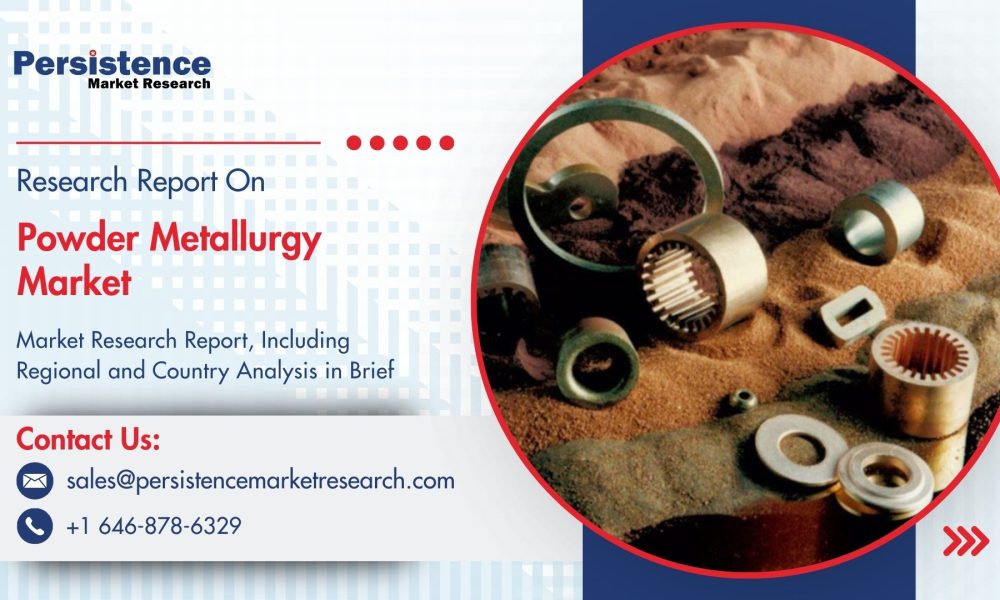
Powder Metallurgy Market Size and Trend Analysis
The global powder metallurgy market is experiencing rapid expansion, driven by technological advancements and increasing demand for high-performance metal components across industries. According to insights from Persistence Market Research, the market is estimated to be valued at US$ 3.6 billion in 2026 and is projected to reach US$ 8.4 billion by 2033, growing at a robust CAGR of 12.8% during the forecast period.
Powder metallurgy (PM) is a manufacturing process that involves producing metal parts from powdered materials through compaction and sintering. It enables the creation of complex geometries with minimal material wastage, making it an attractive alternative to conventional machining and casting techniques. The increasing focus on lightweight materials, sustainability, and cost efficiency is significantly boosting the adoption of powder metallurgy across automotive, aerospace, and industrial sectors.
Get Your FREE Sample Report Instantly – Click Now: https://www.persistencemarketresearch.com/samples/35013
Key Market Drivers Accelerating Growth
One of the primary drivers of the powder metallurgy market is the transformation of the automotive industry, particularly the rise of electric vehicles (EVs). Powder metallurgy enables the production of lightweight components that improve energy efficiency and extend battery range. Components such as gears, bearings, and transmission parts are increasingly being manufactured using PM techniques due to their precision and durability.
Another major growth factor is the demand from aerospace and defense industries. These sectors require high-performance materials such as titanium and nickel-based alloys, which can be efficiently produced using powder metallurgy. The ability to manufacture complex and high-strength components makes PM an essential technology for modern aircraft and defense systems.
Additionally, the growing emphasis on sustainability is driving adoption. Powder metallurgy is a near-net-shape process, meaning it minimizes waste and reduces energy consumption compared to traditional manufacturing. This aligns with global environmental regulations and circular economy initiatives, further fueling market growth.
Expanding Applications Across Industries
Powder metallurgy has evolved into a versatile manufacturing solution with applications across multiple industries. In the automotive sector, it is widely used for engine components, structural parts, and transmission systems. The ability to produce parts with high dimensional accuracy and mechanical strength makes it ideal for mass production.
In the aerospace industry, PM is used for turbine blades, structural components, and specialized parts requiring high तापमान resistance and strength. The medical field is also adopting powder metallurgy for manufacturing implants, surgical tools, and prosthetics due to its precision and biocompatibility.
Furthermore, the electrical and electronics industry uses PM for magnetic materials and components, while the energy sector utilizes it in applications such as wind turbines and fuel cells. This broad application base ensures steady demand and long-term market growth.
Market Segmentation
The powder metallurgy market can be segmented based on material type, process, and application:
By Material Type:
- Ferrous Metals (Iron, Steel)
- Non-Ferrous Metals (Aluminum, Copper, Titanium)
- Metal Matrix Composites (MMCs)
- Ceramic Materials
- Others
Ferrous metals dominate the market, accounting for approximately 79% share, driven by their cost-effectiveness and widespread use in automotive and industrial applications.
By Process:
- Conventional Press & Sinter
- Metal Injection Molding (MIM)
- Additive Manufacturing (3D Printing)
- Hot Isostatic Pressing (HIP)
- Others
Among these, metal injection molding (MIM) and additive manufacturing are the fastest-growing segments due to their ability to produce highly complex components with superior properties.
By Application:
- Automotive
- Aerospace & Defense
- Industrial Machinery
- Medical
- Electrical & Electronics
- Others
The automotive segment holds the largest share, contributing over 40% of total demand due to high-volume production requirements.
Regional Insights and Market Dynamics
Geographically, North America leads the powder metallurgy market, accounting for around 38% of global share. This dominance is supported by a well-established manufacturing ecosystem, strong aerospace and defense sectors, and significant investments in advanced materials research.
However, Asia Pacific is the fastest-growing region, projected to expand at a CAGR of 14.4% from 2026 to 2033. Countries such as China and India are driving this growth due to rapid industrialization, expanding automotive production, and government initiatives promoting domestic manufacturing.
Europe also holds a significant market share, driven by stringent environmental regulations and a strong focus on sustainable manufacturing practices.
Technological Advancements and Innovation
Technological innovation is a key factor shaping the powder metallurgy market. Advances in additive manufacturing (3D printing) are revolutionizing the industry by enabling the production of complex geometries that were previously impossible with traditional methods. Powder bed fusion and binder jetting technologies are gaining traction, especially in aerospace and medical applications.
Additionally, developments in nanostructured powders and advanced alloy compositions are enhancing material performance. These innovations are enabling the production of stronger, lighter, and more durable components, expanding the scope of powder metallurgy applications.
The integration of digital manufacturing and Industry 4.0 technologies is further improving efficiency, precision, and scalability in production processes.
Challenges and Market Constraints
Despite its strong growth potential, the powder metallurgy market faces several challenges. One of the key constraints is the high initial investment required for advanced equipment and technology. Setting up powder metallurgy production facilities involves significant capital expenditure, which may limit adoption among small and medium enterprises.
Another challenge is the availability and cost of high-quality metal powders. Fluctuations in raw material prices can impact production costs and profit margins. Additionally, certain applications require highly specialized powders, which may not be readily available in all regions.
Technical limitations, such as difficulty in producing very large components and maintaining uniform density, also pose challenges. However, ongoing research and development efforts are addressing these issues.
Emerging Opportunities in the Market
The powder metallurgy market presents numerous growth opportunities, particularly in emerging economies. The rapid expansion of manufacturing industries in Asia Pacific, especially in India and China, is creating strong demand for cost-effective and high-precision components.
The increasing adoption of additive manufacturing is another major opportunity. As industries move toward customized and complex designs, powder metallurgy-based 3D printing is expected to play a crucial role in future manufacturing.
Moreover, the growing focus on sustainability and recycling is opening new avenues for the use of recycled metal powders. This not only reduces environmental impact but also lowers production costs, making PM an attractive solution for manufacturers.
Get a Customized Market View in One Click: https://www.persistencemarketresearch.com/request-customization/35013
Competitive Landscape
The powder metallurgy market is moderately consolidated, with several global players competing through innovation and strategic partnerships. Key companies include:
- Höganäs AB
- GKN Powder Metallurgy
- Sandvik AB
- Rio Tinto Metal Powders
- Sumitomo Electric Industries Ltd.
- ATI, Inc.
- Miba AG
These companies focus on expanding production capacity, developing advanced materials, and investing in research and development to maintain a competitive edge. Strategic collaborations and supply chain integration are also common strategies in the market.
Future Outlook
The future of the powder metallurgy market appears highly promising, with strong growth expected through 2033. The increasing demand for lightweight, durable, and high-performance components across industries will continue to drive adoption.
Technological advancements, particularly in additive manufacturing and advanced materials, will further enhance the capabilities of powder metallurgy. At the same time, sustainability trends and regulatory pressures will encourage the use of resource-efficient manufacturing processes.
In conclusion, powder metallurgy is emerging as a critical technology in modern manufacturing. With its ability to deliver precision, efficiency, and sustainability, the market is set to witness significant expansion in the coming years.
About Persistence Market Research:
Persistence Market Research delivers strategic research solutions that drive business growth. Founded in 2012 and registered in England and Wales in 2023 as Persistence Research & Consultancy Services Ltd., we have completed 3,600+ custom and syndicated studies and supported 2,700+ projects for leading research firms. Combining traditional methodologies with modern tools, we provide actionable insights to multinational corporations, consultants, investors, and government bodies, earning strong trust through long-term client relationships.
Contact Us:
Persistence Market Research
Second Floor, 150 Fleet Street,
London, EC4A 2DQ, United Kingdom
USA Phone: +1 646-878-6329
UK Phone: +44 203-837-5656
Email: [email protected]
Web: https://www.persistencemarketresearch.com




