
The Herbicide Safener Market is gaining strong momentum as modern agriculture increasingly relies on crop protection technologies to enhance productivity while minimizing crop damage. Herbicide safeners are specialized chemical compounds that protect crops from the toxic effects of herbicides without reducing the herbicide’s effectiveness against weeds. These compounds play a crucial role in improving weed management efficiency while ensuring crop safety.
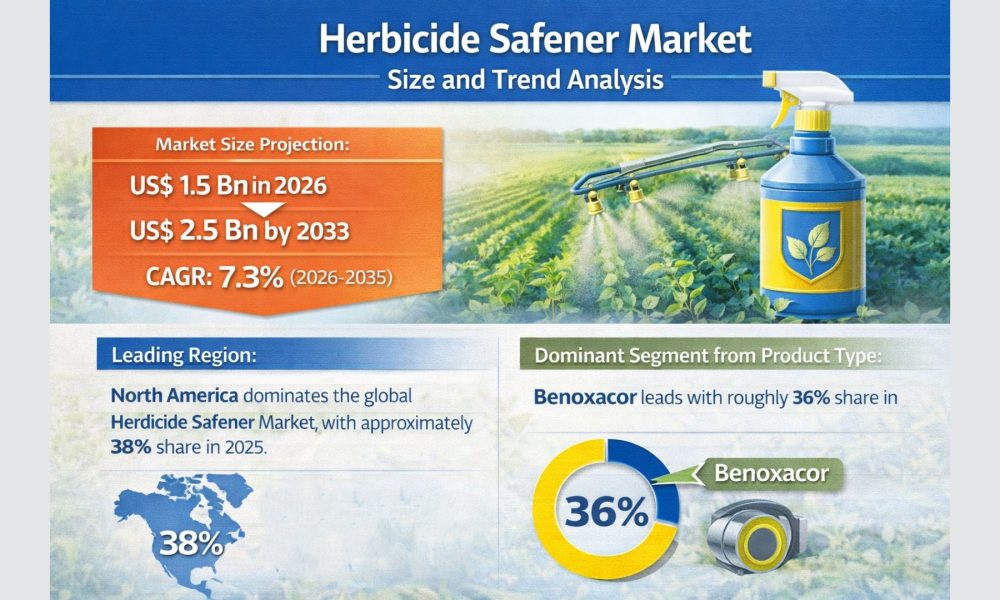
According to industry analysis, the global herbicide safener market is expected to reach around US$ 1.5 billion in 2026 and grow to approximately US$ 2.5 billion by 2033, registering a CAGR of about 7.3% during 2026–2033. The market growth is largely driven by rising global food demand, increasing herbicide-resistant weeds, and the adoption of sustainable agricultural practices.
Get Your FREE Sample Report Instantly – Click Now: https://www.persistencemarketresearch.com/samples/25219
Market Overview
Herbicide safeners are widely used in agricultural formulations to improve the selectivity of herbicides, ensuring that weeds are effectively controlled while the crop remains unharmed. They are typically mixed with herbicides or applied as seed treatments before sowing.
With the growing global population and limited availability of arable land, farmers are under pressure to maximize crop yield. Herbicide safeners help achieve this objective by enabling the use of strong herbicides without damaging crops. This technology is particularly beneficial in large-scale farming systems where efficient weed control is essential.
Additionally, the rapid spread of herbicide-resistant weed species has increased the demand for advanced crop protection solutions. Safeners allow farmers to use herbicides more efficiently while minimizing phytotoxic effects on crops such as maize, wheat, rice, and soybeans.
Key Market Drivers
Rising Global Food Demand
One of the most significant factors driving the herbicide safener market is the growing demand for food production worldwide. As the global population continues to rise, the pressure on agricultural systems to increase productivity has intensified.
Farmers are increasingly adopting advanced crop protection technologies to ensure higher yields and improved crop quality. Herbicide safeners play an important role in this process by enabling the safe use of herbicides in intensive farming systems.
In addition, expanding grain cultivation worldwide is expected to boost the demand for herbicide safeners. Studies suggest that meeting global grain demand requires substantial expansion in corn and wheat cultivation, further driving the need for effective weed control solutions.
Increasing Herbicide Resistance in Weeds
Herbicide resistance among weeds has become a major challenge in agriculture. Many weed species have developed resistance to commonly used herbicides, making weed management increasingly difficult.
To address this issue, farmers are adopting advanced herbicide formulations that incorporate safeners. These compounds allow the use of higher herbicide doses or alternative formulations while ensuring that crops remain protected.
By improving herbicide selectivity and reducing crop injury, safeners enhance the overall effectiveness of weed management programs. As resistance problems continue to grow worldwide, the demand for herbicide safeners is expected to increase significantly.
Growth in Sustainable Agricultural Practices
Sustainable farming practices are becoming increasingly important in modern agriculture. Governments and agricultural organizations are promoting integrated pest management and environmentally friendly crop protection solutions.
Herbicide safeners support these initiatives by reducing the overall quantity of herbicides required for effective weed control. By protecting crops from herbicide toxicity, safeners enable farmers to apply herbicides more efficiently, thereby reducing environmental impact.
Furthermore, research institutions and agrochemical companies are investing in the development of new safener technologies that are compatible with modern herbicides and sustainable farming systems.
Market Restraints
High Development and Regulatory Costs
Despite strong growth potential, the herbicide safener market faces certain challenges. One of the major restraints is the high cost associated with research, development, and regulatory approvals.
Developing new safener formulations requires extensive testing to ensure safety for crops, humans, and the environment. Regulatory authorities in many regions impose strict guidelines for crop protection chemicals, which can increase development costs and delay product launches.
Additionally, small and medium-sized agrochemical companies may find it difficult to compete with large multinational firms due to the significant investment required for product development.
Product Type Insights
Herbicide safeners are available in various chemical types, each designed to work with specific herbicides and crops.
Major Product Types
- Benoxacor
- Furilazole
- Dichlormid
- Isoxadifen
- Other safeners
Among these, benoxacor is the leading product segment, accounting for approximately 36% of the market share in 2025. It is widely used to protect corn and cereal crops from herbicide injury, particularly when chloroacetamide herbicides are applied.
Its compatibility with various herbicide formulations and consistent performance across different soil and climate conditions make it a preferred safener in large-scale farming systems.
Crop Type Insights
Herbicide safeners are used in several major crops to prevent herbicide damage and improve weed control efficiency.
Major Crop Segments
- Maize
- Wheat
- Rice
- Soybeans
- Barley
- Sorghum
- Other crops
Among these, maize dominates the market, accounting for around 28% of global herbicide safener demand due to its large cultivation area and heavy reliance on chemical weed control.
Meanwhile, the soybean segment is expected to witness the fastest growth as soybean cultivation expands globally and weed resistance challenges intensify.
Regional Analysis
North America
North America holds the largest share of the global herbicide safener market, accounting for about 38% of the market in 2025. The region’s dominance is attributed to large-scale corn and soybean farming, advanced agricultural technologies, and strong awareness among farmers about crop protection benefits.
The United States is the leading contributor to the regional market due to its extensive use of herbicides in commercial farming.
Asia Pacific
Asia Pacific is expected to be the fastest-growing regional market, with a projected CAGR of around 8.3% through 2033. This growth is driven by expanding agricultural activities, rising herbicide usage, and government initiatives to improve crop productivity.
Countries such as China and India play a crucial role in regional market expansion due to their large agricultural sectors and increasing adoption of modern farming technologies.
Europe
Europe also represents a significant market for herbicide safeners. Strict environmental regulations and increasing emphasis on sustainable agriculture are encouraging farmers to adopt advanced crop protection solutions.
The region’s strong research and development ecosystem further supports the development of innovative safener formulations.
Competitive Landscape
The herbicide safener market is moderately consolidated, with several major agrochemical companies dominating the global landscape.
Key Market Players
- BASF SE
- Bayer AG
- Syngenta AG
- Corteva Agriscience
- FMC Corporation
- Nufarm Limited
- UPL Limited
- Adama Agricultural Solutions
- Sumitomo Chemical
These companies focus on research and development, product innovation, and strategic partnerships to strengthen their market presence and expand their product portfolios.
Get a Customized Market View in One Click: https://www.persistencemarketresearch.com/request-customization/25219
Emerging Opportunities
The future of the herbicide safener market looks promising due to increasing investments in agricultural innovation and sustainable crop protection technologies.
Key opportunities include:
- Development of next-generation safener formulations
- Integration with precision agriculture technologies
- Growing demand for seed treatment solutions
- Expansion of bio-based and environmentally friendly safeners
Seed-applied safeners and precision farming techniques are particularly promising, as they allow more targeted weed control while reducing overall chemical usage in agriculture.
Conclusion
The herbicide safener market is poised for significant growth as global agriculture faces the dual challenge of increasing crop production and ensuring environmental sustainability. Rising food demand, the growing prevalence of herbicide-resistant weeds, and the adoption of modern crop protection technologies are key factors driving market expansion.
Although regulatory challenges and development costs remain obstacles, continued innovation and research in agrochemical technologies are expected to unlock new growth opportunities. As farmers increasingly adopt integrated weed management strategies, herbicide safeners will continue to play a vital role in improving crop safety and agricultural productivity worldwide.
About Persistence Market Research:
Persistence Market Research delivers strategic research solutions that drive business growth. Founded in 2012 and registered in England and Wales in 2023 as Persistence Research & Consultancy Services Ltd., we have completed 3,600+ custom and syndicated studies and supported 2,700+ projects for leading research firms. Combining traditional methodologies with modern tools, we provide actionable insights to multinational corporations, consultants, investors, and government bodies, earning strong trust through long-term client relationships.
Contact Us:
Persistence Market Research
Second Floor, 150 Fleet Street,
London, EC4A 2DQ, United Kingdom
USA Phone: +1 646-878-6329
UK Phone: +44 203-837-5656
Email: [email protected]
Web: https://www.persistencemarketresearch.com




