
The wood-based panel market is experiencing steady growth due to increasing construction activities, expanding furniture manufacturing, and rising demand for sustainable building materials. Wood-based panels are engineered wood products manufactured from wood fibers, particles, veneers, or strands bonded with adhesives and compressed into flat sheets. These panels include products such as plywood, medium-density fiberboard (MDF), particleboard, and oriented strand board (OSB).
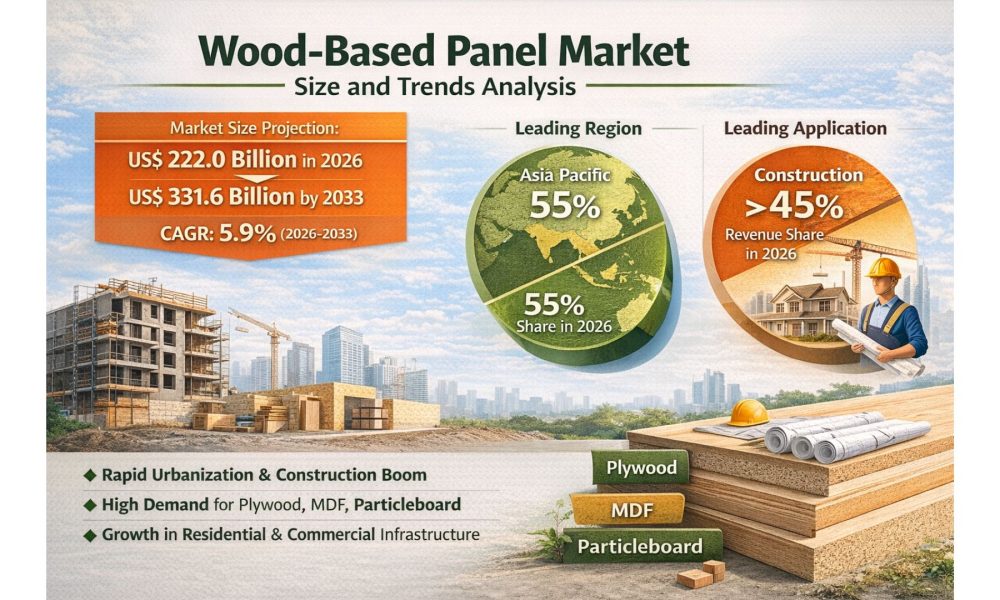
According to industry analysis, the global wood-based panel market is expected to reach around US$ 222.0 billion by 2026 and grow to approximately US$ 331.6 billion by 2033, expanding at a CAGR of about 5.9% from 2026 to 2033. Growth is largely driven by rapid urbanization, expanding construction activities, and rising demand for engineered wood products in furniture and interior applications.
Wood-based panels are widely used in construction, furniture, packaging, and interior design due to their cost efficiency, lightweight properties, and sustainability advantages compared with solid timber.
Get Your FREE Sample Report Instantly – Click Now: https://www.persistencemarketresearch.com/samples/32348
Market Overview
Wood-based panels have become an essential component of modern construction and furniture industries. These panels are manufactured using wood residues, fibers, and chips combined with adhesives and pressed under heat to produce strong and uniform sheets. This process helps utilize lower-grade wood resources and reduce waste, making them environmentally friendly alternatives to traditional timber products.
The market is growing rapidly due to increased demand for affordable housing, modular furniture, and prefabricated construction materials. Engineered wood panels provide uniform strength, better dimensional stability, and easier processing compared with natural wood.
Furthermore, increasing consumer awareness regarding sustainable materials and responsible forestry practices has boosted the adoption of engineered wood panels in various industries. Technological advancements in resin systems and panel manufacturing processes are also improving moisture resistance, durability, and fire resistance, expanding the range of applications.
Key Market Drivers
Rapid Growth in Construction Activities
The construction sector is the largest consumer of wood-based panels globally. Panels such as plywood, OSB, and particleboard are extensively used for flooring systems, roofing, wall panels, partitions, and interior fittings.
With rising urbanization and population growth, the demand for residential and commercial infrastructure has increased significantly. Governments across emerging economies are investing heavily in housing projects and urban development initiatives, which is boosting the consumption of engineered wood products.
Wood-based panels are preferred in construction because they are lightweight, cost-effective, and easy to install. They also provide excellent structural strength and durability, making them suitable for a wide range of building applications. The construction sector alone accounts for more than 45% of the market demand, making it the leading application segment.
Increasing Demand from Furniture Manufacturing
The furniture industry is another major driver of the wood-based panel market. The rising demand for modular, ready-to-assemble, and space-saving furniture solutions has increased the use of MDF and particleboard in furniture manufacturing.
These panels are widely used for cabinets, shelves, wardrobes, tables, and decorative panels because they are easy to machine and provide a smooth surface for laminates and coatings.
Rapid urbanization and rising disposable incomes have also increased consumer spending on interior décor and home improvement products. As a result, furniture manufacturers are increasingly adopting engineered wood panels to produce stylish and affordable furniture.
The growth of e-commerce furniture platforms and modular furniture brands has further accelerated the demand for cost-efficient panel materials.
Growing Focus on Sustainable Building Materials
Sustainability has become one of the most important factors influencing the construction and furniture industries. Wood-based panels help reduce environmental impact by utilizing wood residues and recycled materials that would otherwise go to waste.
Compared with solid wood, engineered panels require fewer natural resources and generate less waste during production. In addition, many manufacturers are adopting low-emission adhesives and recycled fiber technologies to produce eco-friendly panels.
Governments and environmental organizations are also promoting sustainable construction practices, which has increased the use of certified wood materials and engineered wood panels.
As sustainability becomes a priority across industries, wood-based panels are expected to play a crucial role in eco-friendly building solutions.
Product Type Insights
The wood-based panel market includes several product types designed for different applications.
Major Product Types
- Medium Density Fiberboard (MDF)
- High Density Fiberboard (HDF)
- Particleboard
- Oriented Strand Board (OSB)
- Softboard
Among these, Medium Density Fiberboard (MDF) holds the largest market share, accounting for about 40% of total revenue. MDF is widely used in furniture, cabinetry, and decorative interior applications because of its smooth surface, uniform density, and ease of machining.
OSB is also gaining popularity in construction applications due to its strength and structural performance.
Application Insights
Wood-based panels are used across multiple industries, but construction and furniture manufacturing remain the dominant applications.
Major Applications
- Construction
Construction is the largest application segment in the market. Wood panels are used in flooring, roofing, wall panels, partitions, and structural framing.
- Furniture
Furniture manufacturing is the fastest-growing segment, driven by the increasing demand for modular furniture and interior décor solutions.
- Packaging
Wood panels are also used in industrial packaging and shipping crates due to their durability and strength.
Regional Analysis
Asia Pacific
Asia Pacific is the largest regional market for wood-based panels, accounting for around 55% of global market share. The region’s leadership is driven by rapid urbanization, strong manufacturing industries, and expanding construction activities in countries such as China, India, Japan, and Southeast Asia.
China remains one of the largest producers and consumers of wood panels due to its massive construction and furniture manufacturing sectors.
North America
North America is expected to be one of the fastest-growing markets. Strong residential construction activities, home renovation projects, and rising demand for sustainable building materials are contributing to market expansion in the region.
The United States and Canada are also witnessing increased adoption of engineered wood products in modern construction practices.
Europe
Europe represents a mature market with steady demand for wood-based panels. Strict environmental regulations and growing emphasis on sustainable materials have encouraged manufacturers to develop eco-friendly panel products.
European countries are also investing heavily in energy-efficient building technologies, which supports the demand for engineered wood materials.
Competitive Landscape
The wood-based panel market is highly competitive and includes several large global manufacturers. These companies focus on product innovation, sustainable production technologies, and strategic expansions to strengthen their market position.
Key Companies in the Market
Major companies operating in the global wood-based panel market include:
- Ainsworth Lumber Co. Ltd.
- Arauco
- Boise Cascade Company
- EGGER Group
- Georgia-Pacific LLC
- Kronospan
- Louisiana-Pacific Corporation
- Norbord Inc.
- Swiss Krono Group
- West Fraser Timber Co. Ltd.
These companies are investing in advanced manufacturing technologies and expanding production capacities to meet the growing demand for engineered wood products.
Get a Customized Market View in One Click: https://www.persistencemarketresearch.com/request-customization/32348
Future Opportunities
The future of the wood-based panel market looks promising due to increasing adoption of sustainable construction materials and technological advancements in panel manufacturing.
One of the most important opportunities lies in the development of low-emission and recyclable wood panels that meet strict environmental regulations. Manufacturers are also exploring new resin technologies to improve panel durability, moisture resistance, and fire safety.
Another emerging trend is the growing adoption of prefabricated and modular construction systems, which rely heavily on engineered wood panels. These construction methods reduce building time and costs while maintaining structural strength.
As urbanization continues and sustainability becomes a priority, the demand for wood-based panels is expected to increase significantly across multiple industries.
Conclusion
The wood-based panel market is poised for significant growth in the coming years, driven by expanding construction activities, rising demand for modular furniture, and increasing emphasis on sustainable materials. With a projected value of over US$ 331 billion by 2033, the market will continue to benefit from technological innovations and growing environmental awareness.
Despite challenges such as raw material availability and environmental regulations, the industry’s focus on eco-friendly production and engineered wood solutions will create new opportunities for manufacturers worldwide.
About Persistence Market Research:
Persistence Market Research delivers strategic research solutions that drive business growth. Founded in 2012 and registered in England and Wales in 2023 as Persistence Research & Consultancy Services Ltd., we have completed 3,600+ custom and syndicated studies and supported 2,700+ projects for leading research firms. Combining traditional methodologies with modern tools, we provide actionable insights to multinational corporations, consultants, investors, and government bodies, earning strong trust through long-term client relationships.
Contact Us:
Persistence Market Research
Second Floor, 150 Fleet Street,
London, EC4A 2DQ, United Kingdom
USA Phone: +1 646-878-6329
UK Phone: +44 203-837-5656
Email: [email protected]
Web: https://www.persistencemarketresearch.com




