
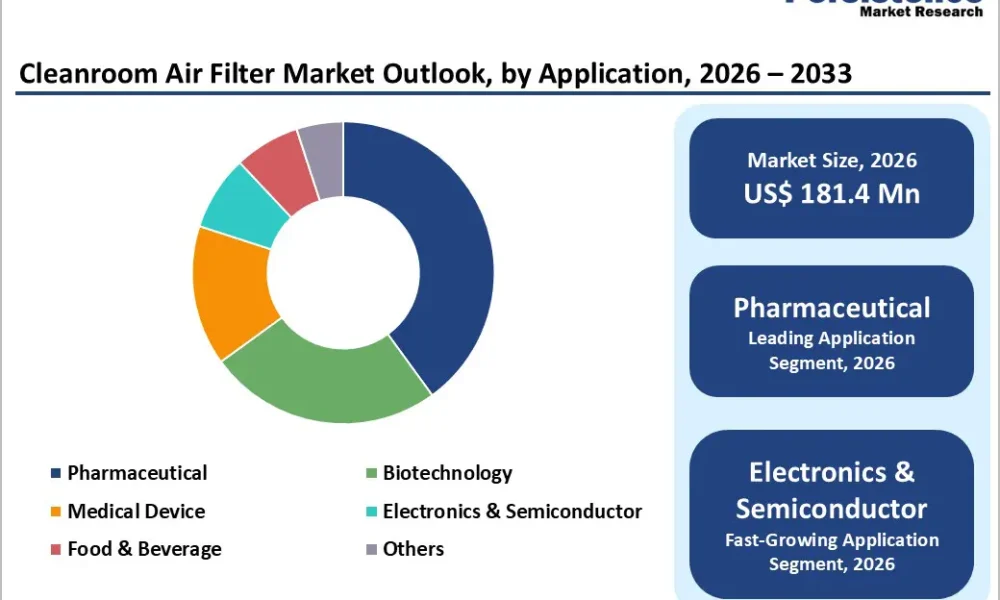
The cleanroom air filter market is witnessing consistent growth due to increasing industrial and healthcare demands for controlled environments. Cleanroom air filters are critical for maintaining contamination-free environments in sectors like pharmaceuticals, biotechnology, electronics, semiconductors, and medical devices, where air quality directly impacts product safety and operational efficiency. According to market projections, the global cleanroom air filter market is expected to be valued at US$ 181.4 million in 2026 and is projected to reach US$ 258.7 million by 2033, growing at a CAGR of 5.2% during the forecast period from 2026 to 2033. The growth is largely driven by regulatory mandates such as ISO 14644 standards, which define stringent requirements for cleanroom air quality. Increasing investment in high-efficiency filtration systems ensures compliance with contamination control standards while optimizing operational efficiency and energy consumption.
Among filter types, HEPA (High-Efficiency Particulate Air) filters dominate the market, owing to their ability to trap 99.97% of particles ≥0.3 microns, making them indispensable in high-risk manufacturing environments. North America currently leads the market due to the presence of mature pharmaceutical, semiconductor, and electronics industries with strong regulatory frameworks, alongside early adoption of advanced filtration technologies. Meanwhile, Asia Pacific is expected to register the fastest growth, fueled by expanding healthcare infrastructure, rising pharmaceutical production, semiconductor manufacturing, and government initiatives promoting industrial automation and quality assurance in cleanroom operations across China, India, and Japan.
𝐆𝐞𝐭 𝐚 𝐒𝐧𝐞𝐚𝐤 𝐏𝐞𝐞𝐤, 𝐒𝐚𝐦𝐩𝐥𝐞 𝐏𝐃𝐅 𝐈𝐧𝐬𝐢𝐝𝐞: https://www.persistencemarketresearch.com/samples/34101
Key Highlights from the Report
• The global cleanroom air filter market is projected to reach US$ 258.7 million by 2033.
• Regulatory compliance with ISO 14644 and other standards drives demand for advanced air filtration systems.
• HEPA and ULPA filters dominate the market due to high particulate capture efficiency.
• North America leads the market, supported by mature pharmaceutical and semiconductor sectors.
• Asia Pacific is poised for rapid growth due to industrial expansion and healthcare infrastructure development.
• Integration of automation and digital monitoring enhances operational efficiency and predictive maintenance capabilities.
Market Segmentation
The cleanroom air filter market can be segmented based on filter type, end-user, and application.
From a filter type perspective, the market includes HEPA, ULPA, carbon filters, and pre-filters. HEPA filters remain dominant due to their high filtration efficiency and critical role in controlled environments. ULPA filters, which remove 99.999% of particles ≥0.12 microns, are increasingly adopted in ultra-clean industries such as semiconductor fabrication and biotechnology research. Carbon filters are primarily used for gas and odor control in cleanrooms handling sensitive chemicals, while pre-filters help extend the life of primary filtration systems by removing larger particulate matter.
End-user segmentation includes pharmaceutical and biotechnology manufacturing, electronics and semiconductor manufacturing, hospitals and healthcare facilities, and food & beverage industries. Pharmaceutical and biotech sectors are the largest consumers due to stringent contamination requirements in drug production, laboratory operations, and medical device assembly. Electronics and semiconductor industries rely heavily on cleanroom air filters to ensure the integrity of sensitive components. Hospitals and healthcare facilities are increasingly adopting filtration systems to maintain sterile environments in operating theaters, isolation rooms, and laboratories.
Application-based segmentation includes sterile manufacturing, laboratory operations, medical device production, and critical electronics fabrication. Sterile manufacturing in pharmaceutical and healthcare sectors demands high-efficiency air filtration to prevent microbial contamination. Laboratory operations require precise air quality control to ensure experimental accuracy. Medical device production facilities adopt cleanroom filters to maintain sterile assembly conditions, while semiconductor and electronics fabrication relies on ultra-clean environments to prevent defects in microchips and sensitive equipment.
𝐆𝐞𝐭 𝐚 𝐂𝐮𝐬𝐭𝐨𝐦𝐢𝐳𝐞𝐝 𝐌𝐚𝐫𝐤𝐞𝐭 𝐕𝐢𝐞𝐰 𝐢𝐧 𝐎𝐧𝐞 𝐂𝐥𝐢𝐜𝐤 : https://www.persistencemarketresearch.com/request-customization/34101
Regional Insights
North America leads the cleanroom air filter market, primarily driven by the United States and Canada. Advanced pharmaceutical manufacturing infrastructure, semiconductor production hubs, and strong regulatory enforcement for contamination control underpin regional dominance. The U.S. Food and Drug Administration (FDA) mandates strict cleanroom standards, encouraging widespread adoption of HEPA and ULPA filtration systems.
Europe maintains a significant market share, with Germany, France, and the UK leading in pharmaceutical, medical device, and electronics manufacturing. Stringent EU regulations and environmental sustainability initiatives support the installation of high-efficiency cleanroom air filters to minimize contamination and energy usage.
Asia Pacific is expected to witness the fastest growth, driven by rapid industrialization, expanding healthcare infrastructure, and rising pharmaceutical production in China, India, and Japan. Investments in semiconductor fabrication plants and medical research facilities are further propelling the adoption of advanced filtration technologies.
Latin America and Middle East & Africa are gradually increasing their adoption of cleanroom air filters. Countries like Brazil, Mexico, South Africa, and UAE are modernizing pharmaceutical, electronics, and healthcare facilities, increasing demand for compliant filtration systems. Emerging awareness of contamination control and investment in healthcare and industrial infrastructure is likely to drive growth.
Market Drivers
The cleanroom air filter market is primarily driven by rising industrial and healthcare demand for contamination-free environments. Strict regulatory frameworks, such as ISO 14644 and FDA guidelines, enforce stringent air quality standards in pharmaceuticals, biotechnology, and semiconductor manufacturing.
Increasing pharmaceutical and biotechnology production, particularly in emerging economies, is creating substantial demand for high-efficiency filtration solutions. The expansion of healthcare infrastructure, including hospitals and medical research facilities, further drives the need for cleanroom air filters. Technological integration, such as HEPA and ULPA systems, combined with automated monitoring, ensures operational reliability, reduces energy consumption, and enhances predictive maintenance, supporting adoption.
Market Restraints
Despite growth, the market faces challenges. High initial investment costs for advanced HEPA and ULPA filtration systems may limit adoption, especially in emerging economies. Maintenance and replacement costs can be significant, requiring trained personnel and adherence to strict operational protocols.
Additionally, variations in regulatory standards across regions can increase compliance complexity, particularly for multinational manufacturers. Limitations in infrastructure in developing countries may also delay the adoption of high-efficiency cleanroom air filters, restraining market expansion.
Market Opportunities
The market offers significant opportunities in emerging regions, where industrialization, pharmaceutical production, and healthcare infrastructure are rapidly expanding. Compact, energy-efficient, and cost-effective cleanroom air filtration solutions are increasingly being deployed in these regions to meet growing demand.
Integration of automation, IoT, and real-time monitoring presents further opportunities. Smart filters with predictive maintenance capabilities allow facilities to optimize operational efficiency, reduce energy costs, and ensure continuous compliance with air quality standards. Sustainability initiatives, such as energy-efficient and recyclable filters, also provide growth prospects, as industries increasingly seek environmentally responsible solutions.
𝐁𝐮𝐲 𝐍𝐨𝐰 𝐭𝐡𝐞 𝐃𝐞𝐭𝐚𝐢𝐥𝐞𝐝 𝐑𝐞𝐩𝐨𝐫𝐭: https://www.persistencemarketresearch.com/checkout/34101
Company Insights
Key players operating in the cleanroom air filter market include:
• Camfil AB
• AAF International
• Freudenberg Group
• Filtration Group Corporation
• Parker Hannifin Corporation
• Donaldson Company, Inc.
• Mann+Hummel Group
• 3M Company
• Nelson Air Systems
• Plymovent Group
Recent developments include Camfil AB introducing high-capacity energy-efficient HEPA filters optimized for semiconductor and pharmaceutical cleanrooms, enhancing operational sustainability. Additionally, AAF International launched ULPA filter systems integrated with IoT monitoring, enabling predictive maintenance and real-time contamination tracking.
Conclusion
The cleanroom air filter market is poised for steady growth through 2033, driven by regulatory mandates, expanding pharmaceutical and biotechnology sectors, and increasing demand for contamination-free environments in electronics, healthcare, and medical device manufacturing. North America leads due to mature industrial infrastructure and strong regulatory enforcement, while Asia Pacific emerges as the fastest-growing region due to industrialization, healthcare expansion, and semiconductor production. Advancements in HEPA and ULPA filters, integration of automation and IoT, and rising focus on energy-efficient and sustainable solutions are shaping market opportunities. As industries prioritize operational efficiency, product safety, and environmental responsibility, cleanroom air filters remain an essential component of controlled environments worldwide.




