
The healthcare rigid plastic packaging market has become an essential component of the global healthcare and pharmaceutical industries, providing reliable solutions for protecting sensitive medical products, ensuring sterility, and maintaining product integrity throughout complex supply chains. Rigid plastic packaging plays a vital role in safeguarding pharmaceutical drugs, biologics, medical devices, diagnostic kits, and other healthcare products from contamination, physical damage, and environmental factors such as moisture, oxygen, and light exposure. As healthcare systems expand globally and pharmaceutical production scales up to meet increasing demand, the need for advanced packaging solutions capable of maintaining product safety and compliance with strict regulatory standards has intensified significantly.
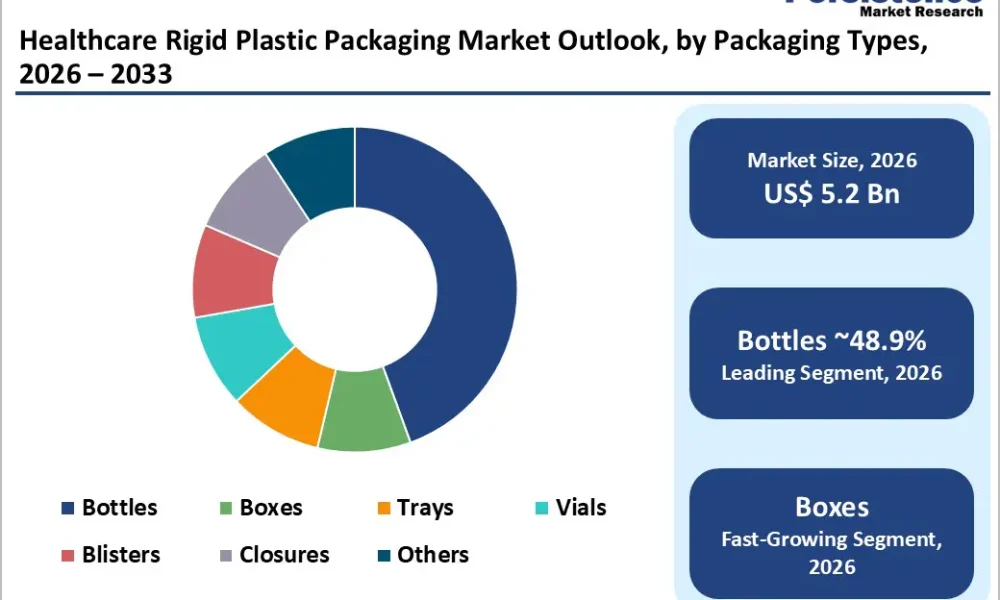
The global healthcare rigid plastic packaging market size is expected to reach US$5.2 billion by 2026 and grow further to US$8.5 billion by 2033, registering a strong compound annual growth rate (CAGR) of 7.3% between 2026 and 2033. Several factors are driving this growth trajectory, including the rising production of pharmaceuticals, increasing commercialization of biologic drugs, and stricter regulatory requirements surrounding product sterility, traceability, and patient safety. Healthcare manufacturers are increasingly adopting high-performance rigid plastic packaging solutions due to their durability, lightweight nature, chemical resistance, and cost efficiency compared with traditional materials such as glass or metal.
Among the key product segments, bottles and containers represent the leading category due to their widespread use in pharmaceutical packaging for tablets, capsules, syrups, and liquid medications. These packaging solutions offer excellent barrier properties and compatibility with automated filling systems used in pharmaceutical manufacturing. Geographically, Asia-Pacific dominates the healthcare rigid plastic packaging market, driven by expanding pharmaceutical manufacturing hubs in countries such as China, India, and South Korea. The region’s large-scale manufacturing capabilities, cost-efficient polymer production, and rapidly growing healthcare infrastructure contribute to its leadership in the global market.
𝐆𝐞𝐭 𝐚 𝐒𝐧𝐞𝐚𝐤 𝐏𝐞𝐞𝐤, 𝐒𝐚𝐦𝐩𝐥𝐞 𝐏𝐃𝐅 𝐈𝐧𝐬𝐢𝐝𝐞: https://www.persistencemarketresearch.com/samples/36168
Key Highlights from the Report
• The global healthcare rigid plastic packaging market is projected to grow from US$5.2 billion in 2026 to US$8.5 billion by 2033.
• The market is expected to register a strong CAGR of 7.3% during the forecast period.
• Increasing pharmaceutical production and biologics commercialization are major growth drivers.
• Bottles and containers remain the dominant packaging segment in the market.
• Asia-Pacific holds the largest share due to its large-scale pharmaceutical manufacturing base.
• Innovations in medical-grade polymers are improving packaging safety and regulatory compliance.
Market Segmentation Analysis
The healthcare rigid plastic packaging market is segmented based on product type, material type, application, and end-user industries. These segments highlight the diverse applications of rigid plastic packaging solutions in the healthcare ecosystem and provide insight into evolving industry requirements.
Based on product type, the market includes bottles, vials, containers, jars, blister packs, trays, and medical device packaging components. Bottles are widely used for packaging oral medications such as tablets, capsules, and liquid formulations. Their compatibility with tamper-evident closures and labeling technologies makes them ideal for pharmaceutical distribution. Vials and ampoules, although traditionally made of glass, are increasingly being manufactured using advanced medical-grade plastics that offer improved durability and reduced breakage risk. Trays and blister packaging solutions are commonly used for medical devices, surgical instruments, and diagnostic kits, providing organized and sterile storage.
From a material perspective, the market is primarily dominated by polymers such as polypropylene (PP), polyethylene (PE), polyethylene terephthalate (PET), and polyvinyl chloride (PVC). Polypropylene is widely used in pharmaceutical packaging due to its chemical resistance, high temperature tolerance, and durability. Polyethylene, particularly high-density polyethylene (HDPE), is commonly used in bottles and containers because of its excellent moisture barrier properties and lightweight nature. PET packaging is valued for its transparency and strength, making it suitable for medical product display and transport. Medical-grade PVC is also used in certain specialized healthcare packaging applications due to its flexibility and cost-effectiveness.
In terms of application, rigid plastic packaging solutions are used across a wide range of healthcare products including pharmaceutical drugs, biologics, medical devices, diagnostic products, and over-the-counter (OTC) medicines. Pharmaceutical drug packaging represents the largest application segment due to the massive global demand for medications and the need for reliable storage and distribution systems. The growing biologics market is also contributing significantly to packaging demand, as these sensitive therapies require advanced packaging solutions capable of maintaining sterility and stability.
From an end-user perspective, the primary customers of healthcare rigid plastic packaging include pharmaceutical companies, biotechnology firms, medical device manufacturers, hospitals, and diagnostic laboratories. Pharmaceutical manufacturers account for a large portion of market demand due to their reliance on standardized, high-volume packaging solutions that meet regulatory requirements and support automated production processes.
𝐎𝐧𝐞 𝐂𝐥𝐢𝐜𝐤 → 𝐘𝐨𝐮𝐫 𝐂𝐮𝐬𝐭𝐨𝐦 𝐌𝐚𝐫𝐤𝐞𝐭 𝐕𝐢𝐞𝐰: https://www.persistencemarketresearch.com/request-customization/36168
Regional Insights
The Asia-Pacific healthcare rigid plastic packaging market leads globally in terms of production and consumption. The region’s dominance is driven by rapidly expanding pharmaceutical manufacturing industries, particularly in China and India, which have become major suppliers of generic drugs and active pharmaceutical ingredients (APIs) to global markets. The availability of cost-efficient polymers, skilled labor, and large-scale manufacturing infrastructure allows packaging manufacturers in the region to produce healthcare packaging solutions at competitive prices. Additionally, rising healthcare investments and increasing domestic demand for pharmaceutical products further strengthen Asia-Pacific’s position as the leading regional market.
North America represents another significant market for healthcare rigid plastic packaging, supported by advanced healthcare systems, strong pharmaceutical research and development activities, and strict regulatory frameworks governing drug packaging and safety. The United States remains the largest contributor in the region due to its extensive pharmaceutical industry and growing biologics sector. Companies operating in North America are increasingly investing in innovative packaging technologies such as smart packaging, anti-counterfeiting solutions, and advanced barrier materials.
The European market is characterized by high regulatory standards and strong demand for sustainable healthcare packaging solutions. Countries such as Germany, France, the United Kingdom, and Switzerland host major pharmaceutical companies that require high-quality packaging materials to comply with stringent European Union regulations. Sustainability initiatives in Europe are also encouraging the development of recyclable and environmentally friendly plastic packaging materials.
In Latin America, the healthcare rigid plastic packaging market is gradually expanding due to improving healthcare infrastructure and rising pharmaceutical consumption. Countries such as Brazil and Mexico are investing in domestic pharmaceutical manufacturing capabilities, which in turn increases demand for reliable packaging solutions.
Meanwhile, the Middle East and Africa region is witnessing moderate growth driven by increasing healthcare investments, expanding pharmaceutical imports, and rising demand for medical products. Governments in several countries are investing in healthcare modernization programs, which is expected to support the adoption of advanced packaging technologies in the region.
Market Drivers
The primary driver of the healthcare rigid plastic packaging market is the increasing global demand for pharmaceutical products. The expansion of healthcare systems, rising prevalence of chronic diseases, and aging populations have significantly increased the consumption of medications worldwide. Pharmaceutical companies require durable, sterile, and compliant packaging solutions to ensure product safety and maintain quality throughout the supply chain. Rigid plastic packaging provides an ideal solution due to its protective properties and compatibility with automated pharmaceutical manufacturing processes.
Another important growth driver is the rapid commercialization of biologic drugs and specialty therapies. Biologics, including vaccines, monoclonal antibodies, and gene therapies, are highly sensitive to environmental conditions and require specialized packaging to maintain stability and efficacy. Medical-grade plastic packaging materials offer improved protection against contamination, physical damage, and temperature fluctuations, making them increasingly important for biologic drug packaging.
Regulatory requirements related to sterility, traceability, and product authentication are also contributing to the growing adoption of rigid plastic packaging solutions. Governments and regulatory bodies worldwide have implemented strict packaging standards to prevent contamination, counterfeiting, and product tampering. Packaging manufacturers are developing advanced features such as tamper-evident closures, serialization labels, and track-and-trace technologies to comply with these regulations and ensure patient safety.
Market Restraints
Despite strong growth prospects, the healthcare rigid plastic packaging market faces certain challenges that could limit its expansion. One of the primary restraints is the environmental impact associated with plastic waste. Growing global concern about plastic pollution has led to increased scrutiny of plastic packaging materials, including those used in healthcare applications. While medical packaging requires strict safety and sterility standards that limit material alternatives, manufacturers are under pressure to develop recyclable or biodegradable solutions that reduce environmental impact.
Another challenge is the stringent regulatory approval process for healthcare packaging materials. Packaging used for pharmaceutical and medical products must meet strict safety and quality standards set by regulatory authorities such as the U.S. Food and Drug Administration (FDA) and the European Medicines Agency (EMA). Obtaining regulatory approvals can be time-consuming and costly, particularly for new materials or innovative packaging technologies.
Additionally, fluctuations in raw material prices for polymers such as polypropylene and polyethylene can impact production costs and profit margins for packaging manufacturers. These price variations are often influenced by changes in crude oil prices, supply chain disruptions, and global demand for plastics.
Market Opportunities
The healthcare rigid plastic packaging market presents numerous opportunities for growth, particularly through technological innovation and sustainability initiatives. One of the most promising opportunities lies in the development of advanced medical-grade polymers that offer improved barrier properties, enhanced durability, and compatibility with sterilization processes. These materials enable manufacturers to create packaging solutions that meet stringent healthcare requirements while improving efficiency and product safety.
Another key opportunity is the integration of smart packaging technologies. Innovations such as temperature-sensitive labels, digital tracking systems, and anti-counterfeiting features can help pharmaceutical companies monitor product conditions during transportation and ensure authenticity. These technologies are becoming increasingly important as pharmaceutical supply chains become more global and complex.
The growing demand for personalized medicine and specialty pharmaceuticals also creates new opportunities for packaging manufacturers. These therapies often require smaller production batches and customized packaging solutions, creating demand for flexible manufacturing capabilities and innovative packaging designs.
𝐁𝐮𝐲 𝐍𝐨𝐰 𝐭𝐡𝐞 𝐃𝐞𝐭𝐚𝐢𝐥𝐞𝐝 𝐑𝐞𝐩𝐨𝐫𝐭: https://www.persistencemarketresearch.com/checkout/36168
Company Insights
The healthcare rigid plastic packaging market is highly competitive, with numerous global packaging manufacturers focusing on innovation, regulatory compliance, and strategic partnerships with pharmaceutical companies.
Key Players
• Amcor Plc
• Berry Global Inc.
• Gerresheimer AG
• AptarGroup Inc.
• West Pharmaceutical Services Inc.
• SCHOTT AG
• Nipro Corporation
• Alpla Group
• Sonoco Products Company
• Sealed Air Corporation
Recent Developments
Several leading packaging companies have recently invested in new manufacturing facilities and expanded production capacities in Asia-Pacific to meet growing demand from pharmaceutical manufacturers in the region. These expansions aim to improve supply chain efficiency and support the rapid growth of healthcare industries in emerging markets.
Additionally, manufacturers are focusing on developing recyclable and sustainable medical-grade plastic packaging solutions that comply with strict healthcare regulations while reducing environmental impact. Innovations in recyclable polypropylene and polyethylene materials are gaining attention as companies seek to balance sustainability goals with product safety requirements.
Conclusion
The healthcare rigid plastic packaging market is positioned for strong and sustained growth as global healthcare systems continue to expand and pharmaceutical production increases. With the market expected to grow from US$5.2 billion in 2026 to US$8.5 billion by 2033, rigid plastic packaging solutions will remain essential for protecting sensitive medical products and ensuring compliance with strict regulatory standards. Rising demand for pharmaceuticals, increasing commercialization of biologics, and growing emphasis on sterility and traceability are key factors driving this growth.




