
The rapid advancement of artificial intelligence across industries has created an urgent need for governance frameworks that ensure responsible, ethical, and compliant AI deployment. As organizations increasingly rely on AI for mission-critical operations, the AI governance market is emerging as a crucial pillar of enterprise technology strategy.
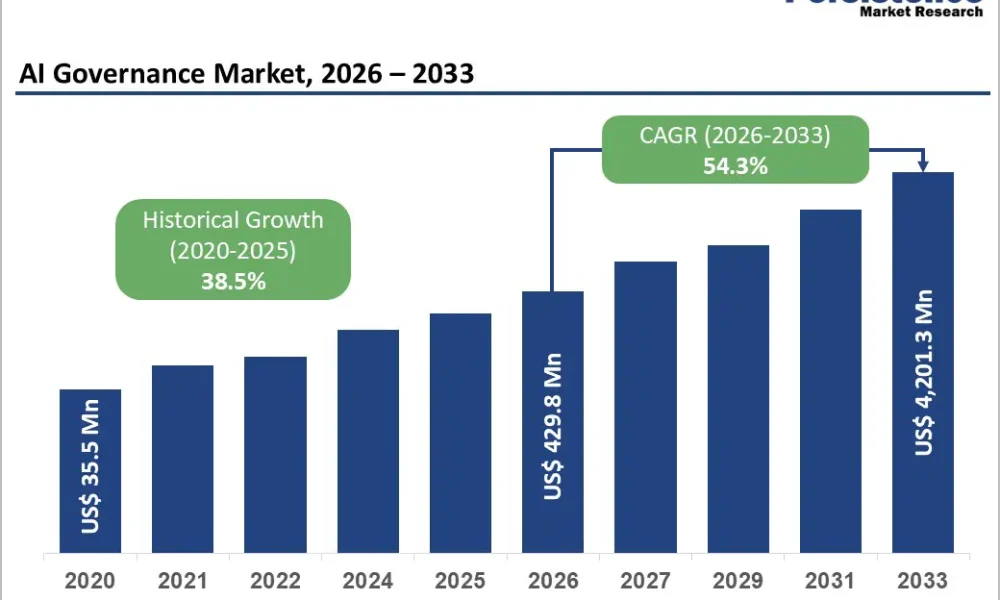
The global AI governance market is projected to grow from US$ 429.8 million in 2026 to US$ 4,201.3 million by 2033, expanding at an exceptional compound annual growth rate (CAGR) of 38.5% during the forecast period. This rapid growth reflects the accelerating maturity of AI governance frameworks across enterprises and governments worldwide.
Key factors driving the expansion include rising regulatory mandates, growing enterprise adoption of AI technologies, and the increasing complexity of autonomous AI systems. Regulations such as the EU AI Act are forcing organizations to adopt governance platforms that ensure compliance, transparency, and accountability in AI decision-making.
As AI becomes embedded in financial services, healthcare, manufacturing, and public sector operations, governance solutions are becoming essential for managing risk, monitoring AI behavior, and ensuring regulatory compliance across multiple jurisdictions.
Rising Regulatory Requirements Driving Governance Adoption
One of the most powerful drivers behind the growth of the AI governance market is the rapid expansion of regulatory frameworks governing AI development and deployment.
The European Union has taken a leading role in shaping global AI governance through the EU AI Act, which became enforceable in 2025. The regulation introduces strict risk classifications for AI systems and imposes heavy penalties—up to €35 million or 7% of global annual turnover—for violations. As a result, enterprises operating in Europe must implement robust governance infrastructure to monitor AI systems and ensure compliance.
In the United States, policymakers are also advancing legislation such as the Artificial Intelligence Research, Innovation, and Accountability Act, which proposes federal oversight and civil penalties for non-compliant AI systems.
Several Asian countries are also establishing governance frameworks. For example, Japan has introduced national AI business guidelines, while South Korea has implemented principles under its Digital Bill of Rights to guide responsible AI deployment. These initiatives emphasize transparency, accountability, and human-centric AI systems.
The emergence of multiple regulatory regimes across regions has created complex compliance requirements for multinational enterprises. As a result, organizations are investing in AI governance platforms capable of monitoring regulatory obligations across different jurisdictions simultaneously.
Growing Enterprise AI Adoption Increases Governance Complexity
Enterprise AI adoption has expanded dramatically over the past few years. Surveys show that nearly 87% of large organizations have already implemented AI technologies, and many companies invest millions of dollars annually in AI initiatives.
These deployments span a wide range of applications, including predictive analytics, customer service automation, fraud detection, supply chain optimization, and personalized marketing. The rise of generative AI and autonomous AI agents has further expanded AI’s role in enterprise operations.
However, the increasing complexity of AI systems has created new governance challenges. Autonomous agents can make decisions without human intervention, making it essential to monitor model performance, detect bias, and ensure ethical decision-making.
Research from the IBM Institute for Business Value highlights that companies leading in AI adoption often establish centralized governance frameworks and appoint Chief AI Officers responsible for overseeing AI deployment and risk management.
AI governance solutions provide capabilities such as model lifecycle management, bias detection, performance monitoring, and automated compliance reporting. These tools enable organizations to scale AI deployments safely while maintaining accountability and transparency.
High Implementation Costs Remain a Barrier
Despite strong demand, the AI governance market faces certain adoption challenges. Implementing comprehensive governance frameworks requires significant financial investment and organizational commitment.
Organizations must deploy specialized governance platforms, hire or train AI governance professionals, establish internal oversight committees, and integrate governance systems with existing IT infrastructure. These requirements can make implementation expensive and complex.
Studies suggest that only around 43% of organizations currently have formal AI governance policies in place. Many companies delay governance initiatives due to budget limitations, uncertain return on investment, and competing digital transformation priorities.
Small and mid-sized enterprises are particularly affected by these challenges. Unlike large corporations with dedicated AI teams, smaller organizations may lack the technical expertise required to build comprehensive governance frameworks.
As governance platforms mature and become more integrated with enterprise software ecosystems, implementation costs are expected to decrease, allowing wider adoption across organizations of all sizes.
Elevate your business strategy with comprehensive market data. Request a sample report now: https://www.persistencemarketresearch.com/samples/32076
Sovereign Cloud and Data Residency Create New Opportunities
The rise of data sovereignty requirements has created significant growth opportunities for the AI governance market. Governments around the world are increasingly requiring that sensitive data be stored and processed within national or regional boundaries.
European initiatives aimed at strengthening technological independence have introduced infrastructure projects under the EuroHPC Joint Undertaking, which aims to develop large-scale AI computing infrastructure within the region.
Technology companies are responding by developing sovereign cloud solutions that allow organizations to deploy AI systems while maintaining compliance with data residency requirements. For example, SAP SE launched its EU AI Cloud framework to ensure that European enterprises can deploy AI applications within compliant and secure environments.
These solutions allow organizations to maintain control over sensitive data while benefiting from advanced AI capabilities. As data sovereignty regulations continue to expand globally, governance platforms that support controlled AI deployment will become increasingly important.
Integration of Governance Into Enterprise Platforms
Another important trend shaping the AI governance market is the integration of governance capabilities directly into enterprise software platforms.
Instead of implementing standalone governance systems, organizations increasingly prefer solutions embedded within their existing enterprise applications, development environments, and data platforms. This approach simplifies implementation and reduces operational complexity.
Technology companies such as IBM Corporation, Microsoft Corporation, and Google LLC are integrating governance features directly into their AI development platforms. These solutions allow developers to evaluate model risks, check regulatory compliance, and monitor algorithm performance during the development process.
Similarly, enterprise software providers such as Salesforce Inc. and SAS Institute are embedding governance capabilities into customer relationship management and analytics platforms.
This integration enables organizations to monitor AI systems throughout their lifecycle—from development and deployment to ongoing monitoring and auditing—ensuring compliance without disrupting existing workflows.
Risk Management and Compliance Dominate Governance Solutions
Among different governance components, risk management and regulatory compliance solutions represent the largest segment of the AI governance market, accounting for approximately 26% of market share in 2026.
These tools help organizations assess potential risks associated with AI models, ensure compliance with regulatory frameworks, and maintain audit trails for regulatory inspections. Features typically include compliance monitoring, automated reporting, and policy enforcement mechanisms.
Financial institutions, healthcare providers, and government agencies are the primary adopters of these solutions because they operate in highly regulated environments where governance failures can lead to severe financial penalties.
Meanwhile, transparency and explainability solutions are emerging as the fastest-growing segment of the market. As AI systems increasingly influence decisions that affect customers, employees, and citizens, organizations must ensure that AI decision-making processes can be explained and audited.
Explainable AI technologies help organizations understand how algorithms reach decisions, identify potential biases, and demonstrate accountability to regulators and stakeholders.
Financial Services Leads Industry Adoption
The Banking, Financial Services, and Insurance (BFSI) sector represents the largest industry segment within the AI governance market, accounting for around 28% of global revenue.
Financial institutions rely heavily on AI technologies for applications such as credit scoring, fraud detection, algorithmic trading, and customer service automation. However, these activities are subject to strict regulatory oversight from financial regulators.
Governance solutions enable financial institutions to monitor AI systems for fairness, detect potential biases in lending decisions, and ensure compliance with regulations such as data protection and anti-money laundering laws.
Healthcare and life sciences represent the fastest-growing sector in the AI governance market. Hospitals and research institutions increasingly use AI for medical imaging analysis, disease diagnosis, and drug discovery.
However, these applications require strict validation and oversight to ensure patient safety. Governance platforms help healthcare organizations monitor AI models, validate clinical performance, and comply with medical device regulations.
Regional Market Trends
North America
North America holds the largest share of the global AI governance market, accounting for approximately 38% of revenue. The region benefits from strong enterprise AI adoption, significant regulatory activity, and the presence of major technology companies such as IBM Corporation, Microsoft Corporation, and Google LLC.
U.S. regulatory agencies such as the Federal Trade Commission are actively shaping governance requirements for AI systems, encouraging organizations to adopt governance frameworks to mitigate regulatory risks.
Europe
Europe represents approximately 28% of the global market and has one of the most advanced AI regulatory environments in the world. The EU AI Act has established strict compliance obligations that require enterprises to implement comprehensive governance frameworks.
European companies are increasingly adopting governance solutions to ensure transparency, ethical AI use, and regulatory compliance across AI-powered operations.
East Asia
East Asia accounts for about 15% of the global market and is rapidly developing its AI governance ecosystem. Countries such as China, Japan, and South Korea are establishing national governance frameworks and encouraging responsible AI deployment.
China has introduced its Artificial Intelligence Global Governance Action Plan, while Japan continues advancing governance standards through national business guidelines for AI deployment.
These initiatives are expected to drive strong demand for governance solutions across the region’s rapidly expanding AI sector.
Competitive Landscape
The AI governance market is characterized by an oligopolistic structure, with a small number of large technology companies dominating the industry through integrated governance platforms and extensive enterprise relationships.
Leading companies include:
- IBM Corporation
- Microsoft Corporation
- Google LLC
- SAP SE
- Salesforce Inc.
- SAS Institute
In addition to these industry leaders, specialized companies such as DataRobot Inc., Credo AI Inc., and Arthur AI are developing niche governance solutions focused on explainability, monitoring, and model validation.
Future Outlook
The future of the AI governance market will be shaped by the continued expansion of AI technologies and the growing need for responsible innovation. As governments introduce stricter regulations and enterprises deploy increasingly complex AI systems, governance solutions will become a fundamental component of digital transformation strategies.
Technologies such as explainable AI, automated compliance monitoring, and AI lifecycle management will play a critical role in enabling organizations to scale AI responsibly.
With global market value projected to surpass US$ 4.2 billion by 2033, the AI governance market is poised to become one of the most critical segments within the broader artificial intelligence ecosystem, ensuring that AI innovation remains transparent, ethical, and aligned with regulatory requirements worldwide.
Related Reports:




