
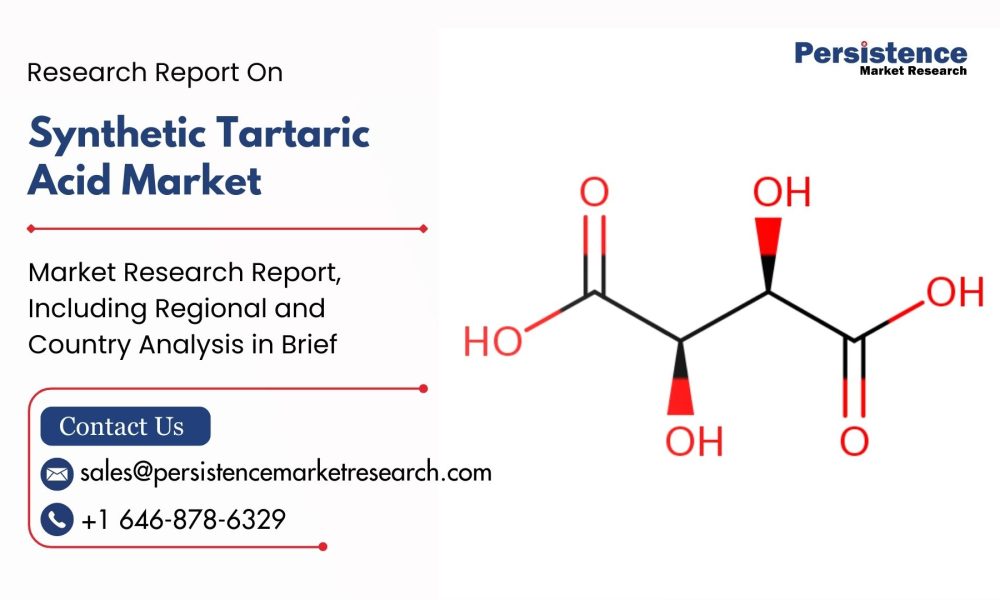
Synthetic Tartaric Acid Market
The synthetic tartaric acid market is experiencing steady growth due to increasing demand from food processing, pharmaceuticals, and construction industries. Synthetic tartaric acid is produced mainly from maleic anhydride, offering a reliable and cost-effective alternative to naturally derived tartaric acid obtained from grapes. This synthetic production route ensures consistent supply, stable pricing, and higher purity levels, which are critical for industrial and pharmaceutical applications.
According to industry estimates, the global synthetic tartaric acid market is projected to reach US$ 758.5 million in 2026 and expand to US$ 1,096.1 million by 2033, registering a CAGR of 5.4% between 2026 and 2033.
Get Your FREE Sample Report Instantly – Click Now: https://www.persistencemarketresearch.com/samples/26014
Market Overview
Synthetic tartaric acid is widely used as an acidulant, stabilizer, chelating agent, and pH regulator in multiple industries. In food and beverages, it enhances flavor and controls acidity, particularly in beverages, confectionery, and bakery products. In pharmaceuticals, it is used for drug salt formation and solubility enhancement, while in construction it acts as a retarder in gypsum and cement formulations.
The market is benefiting from the increasing demand for stable and scalable chemical production processes that are not dependent on agricultural raw materials. Unlike natural tartaric acid derived from grapes or wine residues, synthetic variants offer year-round availability and consistent quality, making them attractive for large-scale manufacturing sectors.
Key Trends Driving the Synthetic Tartaric Acid Market
Rising Demand from Construction and Infrastructure Development
One of the primary growth drivers of the synthetic tartaric acid market is its increasing application in the construction industry. Synthetic DL-tartaric acid acts as an effective setting-time retarder in gypsum-based and cement-based materials. This property is particularly useful in modern construction techniques such as drywall systems, self-leveling floor screeds, and plaster molding.
By slowing down the hydration process of gypsum and cement, tartaric acid allows contractors to improve workability, application time, and final structural strength. This capability is crucial in large-scale urban infrastructure projects where construction efficiency and material performance are essential.
The rapid expansion of urban infrastructure across developing economies, particularly in Asia-Pacific and the Middle East, has significantly increased demand for construction chemicals. As infrastructure projects grow in scale and complexity, manufacturers are increasingly adopting chemical additives like synthetic tartaric acid to enhance building material performance. Consequently, construction-related applications are expected to remain a major contributor to market growth over the coming years.
Stable Supply Chain Through Maleic Anhydride-Based Production
Traditional tartaric acid production depends heavily on the wine industry and grape harvests, making it vulnerable to seasonal fluctuations and climate variability. Synthetic tartaric acid addresses this challenge by using maleic anhydride, a petrochemical derivative, as its primary raw material.
This chemical synthesis method allows manufacturers to produce tartaric acid continuously throughout the year without relying on agricultural yields. As a result, synthetic tartaric acid offers a more stable supply chain, predictable pricing, and scalable production capacity.
Large multinational food and pharmaceutical companies increasingly prefer synthetic sources because they ensure consistent raw material supply for long-term contracts. Furthermore, advancements in catalytic and enzymatic synthesis technologies are improving production efficiency and reducing environmental impact.
These advantages have led to a gradual shift in several industries toward synthetic tartaric acid, especially in industrial and chemical applications where supply stability is critical.
Growing Applications in the Food and Beverage Industry
The food and beverage sector represents the largest end-user segment of the synthetic tartaric acid market. This compound functions as an acidulant, flavor enhancer, preservative, and pH regulator in various food products.
It is widely used in soft drinks, bakery products, confectionery, fruit juices, and processed foods. Synthetic tartaric acid enhances fruit flavors—particularly grape and citrus flavors—and helps maintain the desired acidity level in beverages.
In baking applications, tartaric acid is used in baking powders and emulsifiers, playing a critical role in dough stability and texture improvement. With the global expansion of the processed food industry and increasing consumer demand for convenience foods, the need for food-grade tartaric acid continues to grow.
Additionally, synthetic tartaric acid offers advantages such as consistent purity and cost efficiency, which make it suitable for large-scale food manufacturing. As global food processing industries expand, this application segment is expected to maintain its dominant position in the market.
Expanding Pharmaceutical Applications
The pharmaceutical industry represents one of the fastest-growing markets for high-purity synthetic tartaric acid. In drug manufacturing, tartaric acid is used to form tartrate salts with active pharmaceutical ingredients (APIs).
These salts improve the solubility, stability, and bioavailability of drugs, making them essential in modern pharmaceutical formulations. Synthetic tartaric acid is particularly advantageous because it offers a controlled impurity profile and absence of agricultural contaminants, such as pesticide residues.
Beyond salt formation, tartaric acid derivatives are also used in chiral resolution, biodegradable polymers, and controlled drug delivery systems. These advanced pharmaceutical applications are gaining traction as the pharmaceutical industry focuses on developing complex drug molecules.
As pharmaceutical companies invest in innovative drug delivery technologies and regulatory-compliant ingredients, the demand for pharmaceutical-grade synthetic tartaric acid is expected to rise significantly in the coming years.
Asia-Pacific Emerging as the Fastest Growing Market
The Asia-Pacific region is expected to witness the highest growth in the synthetic tartaric acid market. Countries such as China and India have become major production hubs due to their strong petrochemical infrastructure and large-scale manufacturing capabilities.
China, in particular, hosts several leading producers and accounts for a significant share of global production and exports. The region also benefits from lower manufacturing costs, integrated chemical industrial parks, and abundant raw material availability.
In addition to production advantages, domestic demand in Asia-Pacific is growing rapidly. Rising urbanization, expanding pharmaceutical manufacturing, and increasing consumption of processed foods are all contributing to regional market expansion.
With governments supporting industrial development and chemical manufacturing investments, Asia-Pacific is expected to remain both the largest production center and the fastest-growing consumer market for synthetic tartaric acid.
Technological Advancements in Biochemo-Enzymatic Production
Recent technological developments are transforming the production of synthetic tartaric acid. Manufacturers are increasingly adopting biochemo-enzymatic synthesis technologies, which combine chemical processes with enzymatic conversion.
These advanced methods can produce high-purity L(+)-tartaric acid, which closely matches the optical properties of naturally derived tartaric acid. The process operates under milder conditions, reduces energy consumption, and minimizes unwanted by-products.
Such innovations align with the principles of green chemistry, helping manufacturers reduce environmental impact while improving production efficiency. These technologies also enable synthetic producers to compete in premium markets where natural tartaric acid has traditionally dominated.
As sustainability becomes a critical factor in chemical manufacturing, biotechnological advancements are expected to create significant growth opportunities for synthetic tartaric acid producers.
Regulatory Challenges in Premium Food Markets
Despite its advantages, synthetic tartaric acid faces certain regulatory challenges, particularly in developed markets. For example, stricter regulations in the European Union have introduced specific limits for tartaric acid usage in food products.
Authorities have also established acceptable daily intake (ADI) limits, requiring manufacturers to reformulate some food products to comply with safety standards. These regulations can increase compliance costs and slow the adoption of synthetic tartaric acid in premium food segments.
Additionally, the growing consumer preference for natural and clean-label ingredients in certain markets can favor naturally derived tartaric acid over synthetic alternatives.
However, improvements in synthetic production technology and stricter quality control standards are helping manufacturers address these regulatory challenges. Companies that can demonstrate high purity and regulatory compliance will be better positioned to capture opportunities in regulated markets.
Market Segmentation
By Grade
- Food Grade
- Pharmaceutical Grade
- Industrial Grade
- Cosmetic Grade
By Form
- Anhydrous Powder
- Crystalline Powder
- Granules
- Liquid
By Purity
- ≥99.5%
- 99.0–99.4%
- 95.0–98.9%
- <95%
By End User
- Food & Beverages
- Pharmaceuticals
- Cosmetics & Personal Care
- Chemical Intermediates
- Detergents & Cleaners
Get a Customized Market View in One Click: https://www.persistencemarketresearch.com/request-customization/26014
Competitive Landscape
The synthetic tartaric acid market is moderately fragmented, with a strong presence of Asian manufacturers. Major companies focus on improving production technologies, expanding capacity, and strengthening global distribution networks.
Key companies include:
- Hangzhou Bioking Biochemical Engineering Co., Ltd.
- Changmao Biochemical Engineering Company Limited
- Sagar Chemicals
- Yantai Taroke Bio-engineering Co., Ltd.
Conclusion
The synthetic tartaric acid market is poised for steady growth driven by expanding industrial applications, increasing pharmaceutical demand, and advancements in chemical synthesis technologies. With Asia-Pacific emerging as a key production hub and innovations improving sustainability and purity, synthetic tartaric acid is expected to play a critical role in the global specialty chemicals industry.
About Persistence Market Research:
Persistence Market Research delivers strategic research solutions that drive business growth. Founded in 2012 and registered in England and Wales in 2023 as Persistence Research & Consultancy Services Ltd., we have completed 3,600+ custom and syndicated studies and supported 2,700+ projects for leading research firms. Combining traditional methodologies with modern tools, we provide actionable insights to multinational corporations, consultants, investors, and government bodies, earning strong trust through long-term client relationships.
Contact Us:
Persistence Market Research
Second Floor, 150 Fleet Street,
London, EC4A 2DQ, United Kingdom
USA Phone: +1 646-878-6329
UK Phone: +44 203-837-5656
Email: [email protected]
Web: https://www.persistencemarketresearch.com




