
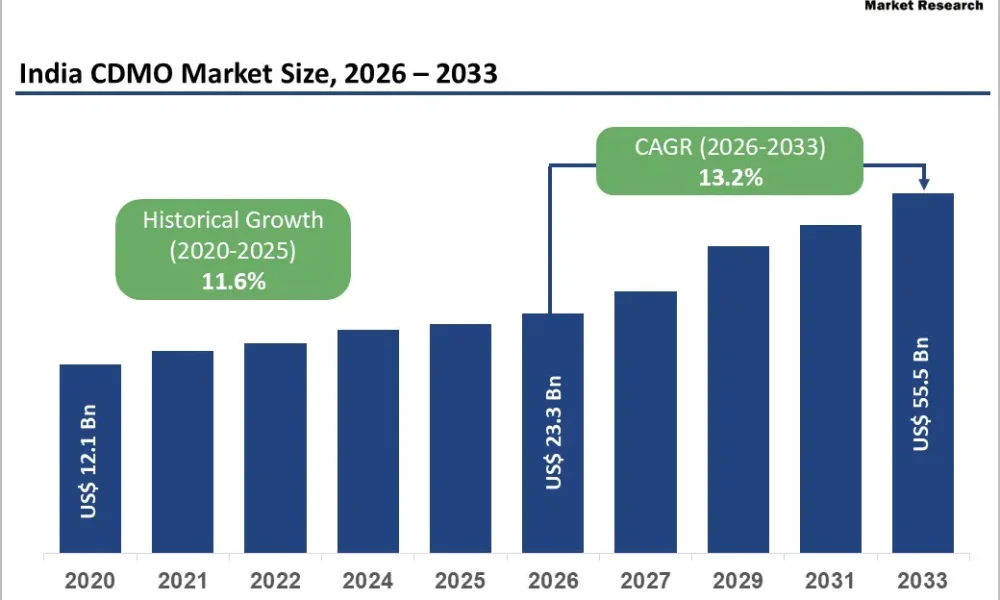
The India Contract Development and Manufacturing Organization (CDMO) market has emerged as a critical segment within the global pharmaceutical landscape, driven by India’s cost-efficient manufacturing capabilities, skilled workforce, and robust infrastructure. Valued at an estimated US$ 23.3 billion in 2026, the market is projected to reach US$ 55.5 billion by 2033, registering a CAGR of 13.2% during the forecast period. The growth trajectory reflects the increasing global reliance on India for pharmaceutical outsourcing, particularly in generics, biosimilars, and complex biologics. Favorable government initiatives, such as the Make in India campaign and Production-Linked Incentive (PLI) schemes, have further accelerated investments in the sector. Moreover, Indian CDMOs are recognized for their adherence to stringent international regulatory standards, enabling them to offer end-to-end solutions from drug discovery to commercial-scale manufacturing.
The leading segment in the India CDMO market is contract manufacturing services, which dominates due to India’s established infrastructure for high-volume production of small molecules, Active Pharmaceutical Ingredients (APIs), and finished dosage forms (FDFs). Small molecules, in particular, remain the most prominent product type due to the country’s expertise in generics and cost-effective production. Geographically, Southern India, with hubs like Hyderabad, Bengaluru, and Visakhapatnam, is the focal point for market activity. These regions host biotech parks and clusters that provide state-of-the-art facilities and easy access to a skilled pharmaceutical workforce, making them the preferred locations for both domestic and international clients seeking outsourcing solutions.
Download Your Free Sample & Explore Key Insights: https://www.persistencemarketresearch.com/samples/34955
Key Highlights from the Report
• India CDMO market projected to reach US$ 55.5 billion by 2033 with a CAGR of 13.2% from 2026 to 2033.
• Contract manufacturing services lead the market due to cost efficiency and high-volume production capabilities.
• Small molecules dominate the product segment owing to India’s robust API and generic drug manufacturing expertise.
• Rising demand for generics and biosimilars drives India’s strategic position in global pharmaceutical outsourcing.
• Favorable government policies, including Make in India and PLI schemes, have boosted CDMO sector investments.
• Southern India is the leading regional hub due to its infrastructure, biotech clusters, and skilled workforce availability.
Market Segmentation
The India CDMO market can be segmented based on service type, product type, and therapeutic area. By service type, contract manufacturing services dominate due to India’s extensive infrastructure for large-scale production, regulatory compliance, and cost advantages. Contract development services, although growing, lag behind in comparison due to the high complexity and specialized expertise required. In terms of product type, small molecules are the most significant contributor, supported by India’s established capabilities in APIs and generic drugs. Biologics, biosimilars, and vaccines are witnessing rapid growth but require more sophisticated infrastructure and technological capabilities. Therapeutically, segments such as oncology, cardiovascular, and infectious diseases are attracting increasing attention due to global demand for affordable, high-quality treatments. CDMOs are offering integrated solutions that cover discovery, formulation development, clinical trials, and commercial-scale manufacturing, reflecting the trend toward end-to-end outsourcing.
Regional Insights
Regional dynamics within the India CDMO market show clear concentration in Southern India, particularly in Hyderabad, Bengaluru, and Visakhapatnam, which account for a significant share of manufacturing and R&D activities. Hyderabad’s Genome Valley serves as a biotech hub for both domestic and international players, offering state-of-the-art facilities for small molecules, biologics, and biosimilars. Western India, including Mumbai and Ahmedabad, supports large-scale API production and serves as a logistical and export hub. Northern India, including Delhi NCR and Chandigarh, is emerging as a center for R&D and formulation development, with several CDMOs establishing pilot and clinical trial facilities. The regional segmentation highlights how India’s geographical diversity supports different stages of drug development and manufacturing, creating a comprehensive ecosystem for global pharmaceutical outsourcing.
Get Custom Insights Designed for Your Business: https://www.persistencemarketresearch.com/request-customization/34955
Market Drivers
The India CDMO market is primarily driven by cost efficiency and competitive advantage. India offers lower operational and labor costs, while maintaining high-quality manufacturing standards, making it a preferred outsourcing destination. This affordability is complemented by economies of scale and a skilled workforce capable of producing small molecules, APIs, FDFs, and complex biologics at competitive prices. Additionally, the rising global demand for generics and biosimilars contributes to market expansion. As patents for blockbuster drugs expire, the need for affordable alternatives increases, positioning India as the world’s leading supplier of generics. The ability of Indian CDMOs to offer end-to-end services—from research and development to large-scale manufacturing—further strengthens their global appeal, allowing pharmaceutical companies to optimize cost, efficiency, and speed to market.
Market Restraints
Despite its advantages, the India CDMO market faces certain constraints. Infrastructure and technology gaps in advanced segments, such as biologics, cell and gene therapies, and other high-complexity therapeutics, pose challenges. While India has a well-established pharmaceutical manufacturing base, specialized facilities, equipment, and expertise required for high-end biologics production are limited. These gaps restrict India’s ability to fully compete with markets in the United States and Europe that offer more advanced technological capabilities. As demand for biosimilars, monoclonal antibodies, and other complex biologics grows, CDMOs must invest heavily in upgrading facilities and processes to maintain competitiveness. Without addressing these challenges, the market’s potential in advanced therapeutics could be constrained despite strong growth in small molecules and generics.
Market Opportunities
The rise of global outsourcing presents a significant opportunity for the India CDMO market. Pharmaceutical companies are increasingly seeking cost-effective solutions while focusing on core competencies such as research and commercialization. India’s competitive advantages—including skilled talent, regulatory compliance, and end-to-end manufacturing capabilities—make it a strategic partner for these companies. This trend allows Indian CDMOs to secure long-term partnerships and expand their global footprint. Furthermore, the growing interest in biologics, biosimilars, and vaccines opens avenues for investment in specialized facilities, advanced manufacturing technologies, and innovative services. Companies that can offer comprehensive solutions encompassing discovery, development, clinical trials, and large-scale production are well-positioned to capture emerging opportunities.
Checkout Now & Download Complete Market Report: https://www.persistencemarketresearch.com/checkout/34955
Company Insights
• Piramal Pharma Solutions – Offers end-to-end CDMO services for small molecules, APIs, and biologics.
• Syngene International – Specializes in integrated drug discovery, development, and manufacturing services.
• Dr. Reddy’s Laboratories – Provides contract manufacturing and biosimilar development solutions.
• Divi’s Laboratories – Focuses on high-quality API production and generic manufacturing.
• Lupin Limited – Entered the CDMO space via Lupin Manufacturing Solutions for contract development and manufacturing.
• Sun Pharmaceutical Industries Ltd. – Engaged in API and finished dosage form manufacturing for global clients.
• Aurobindo Pharma – Offers large-scale contract manufacturing of APIs and generics.
• Jubilant Pharmova (Jubilant Biosys & Jubilant Generics) – Focused on integrated CDMO services.
• Glenmark Pharmaceuticals – Provides APIs, FDFs, and contract development services.
• Capsule Pharma – Specialized in small molecule and formulation development.
• Laurus Labs – Focused on API production and high-quality generics.
• Strides Pharma Science – Offers comprehensive contract development and manufacturing solutions.
• Aurigene Pharmaceutical – Expanding into biologics and therapeutic proteins production.
Recent Developments:
In March 2025, Shilpa Medicare launched a full-service hybrid CDMO, offering small molecules, large molecules, and peptides with a strong oncology focus.
In June 2024, Lupin entered the CDMO business through its subsidiary, Lupin Manufacturing Solutions (LMS), appointing Abdelaziz Toumi as CEO to drive strategic expansion in the sector.
Conclusion
The India CDMO market is positioned for strong growth, driven by cost efficiency, skilled talent, and robust infrastructure that caters to global pharmaceutical outsourcing needs. With contract manufacturing services and small molecules leading the market, India continues to solidify its role as a preferred destination for affordable and high-quality pharmaceutical production. Southern India remains the dominant region due to its established biotech clusters and manufacturing facilities. While technology gaps in biologics and advanced therapeutics pose challenges, the rise in global outsourcing and demand for generics, biosimilars, and complex biologics presents significant growth opportunities. Leading players, including Piramal Pharma Solutions, Syngene International, and Dr. Reddy’s Laboratories, are investing strategically to enhance capabilities and expand global reach, ensuring that India remains at the forefront of the CDMO industry.




