
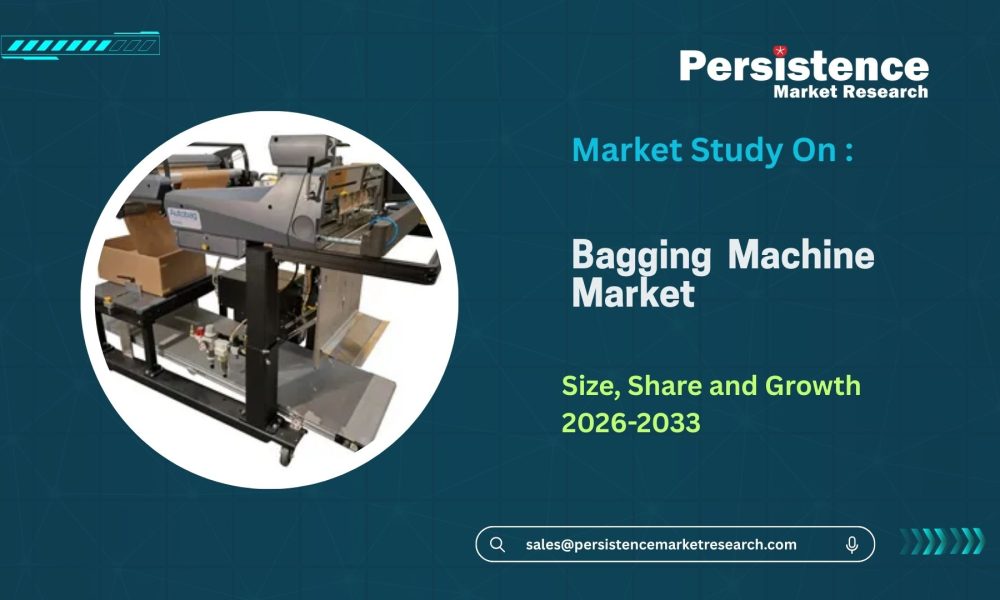
The Bagging Machine Market is entering a sustained growth phase, supported by rising automation across industrial packaging lines and increasing demand for high-speed material handling systems. According to Persistence Market Research, the global bagging machine market size is likely to be valued at US$5.9 billion in 2026 and is expected to reach US$9.4 billion by 2033, expanding at a CAGR of 6.9% between 2026 and 2033. This growth reflects the growing integration of automated bagging equipment in food processing, agriculture, chemicals, and construction materials industries. Manufacturers are focusing on efficiency, accuracy, and labor cost optimization, making advanced bagging systems a critical component of modern packaging infrastructure.
Accelerated throughput requirements in food and construction sectors are significantly influencing adoption rates. In addition, increased manufacturing capital expenditure in Asia Pacific and other emerging regions is strengthening demand for fully and semi-automatic bagging machines. The leading segment within the market is automated bagging systems, driven by their ability to enhance speed, reduce wastage, and ensure consistent filling accuracy. Geographically, Asia Pacific dominates the bagging machine market due to rapid industrialization, expanding food processing capacity, and rising investments in infrastructure and bulk material packaging solutions.
Download Your Free Sample & Explore Key Insights : https://www.persistencemarketresearch.com/samples/36159
Key Highlights from the Report
➤ The Bagging Machine Market is projected to grow from US$5.9 billion in 2026 to US$9.4 billion by 2033 at a CAGR of 6.9%.
➤ Automation in packaging lines is accelerating demand for high-speed and precision bagging equipment.
➤ Rising throughput requirements in food and construction sectors are strengthening equipment upgrades.
➤ Asia Pacific remains the leading regional market due to expanding manufacturing investments.
➤ Increased capital expenditure in emerging economies is driving modernization of packaging facilities.
➤ Automated bagging systems are emerging as the dominant product segment across industries.
Market Segmentation
The Bagging Machine Market is segmented based on product type, including automatic, semi-automatic, and manual bagging machines. Among these, automatic bagging machines hold the leading share due to their integration with conveyor systems, robotic palletizers, and digital control interfaces. These systems reduce human intervention while improving packaging accuracy and output consistency. Semi-automatic systems are preferred by small and mid-sized enterprises seeking cost-effective automation upgrades. Manual systems continue to serve niche applications where production volumes are relatively low.
From an end-user perspective, the market serves food and beverage, agriculture, chemicals, construction materials, and other industrial sectors. The food and beverage industry represents a leading end-user segment due to rising packaged food demand and strict hygiene standards. The construction materials segment is also witnessing strong adoption, driven by bulk packaging of cement, sand, and aggregates. Agricultural applications, including grains and fertilizers, contribute significantly to overall demand for high-capacity bagging solutions.
Customize This Report for Your Exact Requirements : https://www.persistencemarketresearch.com/request-customization/36159
Regional Insights
Asia Pacific leads the global Bagging Machine Market, supported by rapid industrial growth and expanding food processing facilities. Increasing manufacturing investments and infrastructure development projects are fueling demand for bulk packaging equipment. Countries in the region are witnessing modernization of production lines, with manufacturers investing in automated packaging systems to enhance operational efficiency and reduce labor dependency.
North America and Europe continue to demonstrate stable growth, driven by technological advancements and replacement demand for older machinery. These regions are characterized by high adoption of smart bagging solutions integrated with data monitoring systems. Meanwhile, emerging markets in Latin America and the Middle East are experiencing gradual growth due to expanding construction activities and agricultural exports requiring reliable packaging systems.
Market Drivers
The primary driver of the Bagging Machine Market is accelerated automation across packaging lines. As industries face increasing labor costs and productivity pressures, automated bagging equipment provides measurable improvements in efficiency. These systems enable faster filling, sealing, and labeling processes while minimizing errors. Companies are prioritizing digitalized manufacturing environments, and bagging machines integrated with sensors and control software are becoming essential assets in smart factories.
Another major growth driver is rising throughput requirements in food and construction sectors. The demand for packaged food products continues to expand, necessitating high-capacity bagging systems that ensure consistency and hygiene. Similarly, infrastructure development projects require efficient bulk packaging of construction materials. Increased manufacturing capital expenditure in Asia Pacific and emerging regions further strengthens market growth, as companies invest in advanced packaging technologies to remain competitive.
Market Restraints
Despite positive growth prospects, the Bagging Machine Market faces certain challenges. High initial investment costs associated with fully automated bagging systems may deter small manufacturers from adopting advanced solutions. Capital-intensive machinery requires significant upfront spending, which can limit penetration in cost-sensitive markets. Additionally, installation and integration with existing production lines may involve technical complexities.
Maintenance requirements and the need for skilled operators also pose constraints. Automated bagging machines require periodic servicing and calibration to maintain performance standards. In regions with limited technical expertise, operational inefficiencies may arise. Furthermore, fluctuating raw material prices and supply chain disruptions can indirectly impact purchasing decisions for new packaging equipment.
Market Opportunities
The Bagging Machine Market presents substantial opportunities through technological innovation and digital integration. Smart bagging systems equipped with real-time monitoring and predictive maintenance capabilities are gaining traction. Manufacturers investing in Industry 4.0-compatible solutions can enhance productivity while reducing downtime. The integration of robotics and advanced control systems offers new avenues for efficiency improvements.
Emerging economies represent another significant opportunity area. As manufacturing sectors expand in Asia Pacific and other developing regions, demand for modern packaging equipment is expected to rise. Government initiatives supporting industrial growth and infrastructure development create favorable conditions for market expansion. Customization of bagging machines for diverse product types and materials further opens new growth avenues across multiple industries.
Unlock Complete Insights – Buy the Full Report : https://www.persistencemarketresearch.com/checkout/36159
Company Insights
Key players operating in the Bagging Machine Market include:
- Premier Tech
- Haver & Boecker
- Bosch Packaging Technology
- WOLF Verpackungsmaschinen GmbH
- Barry-Wehmiller Companies
Recent Developments:
- January 2024: A leading manufacturer introduced an upgraded high-speed automatic bagging system designed for improved throughput in food processing applications.
- September 2023: A major industry participant expanded its manufacturing facility in Asia Pacific to strengthen regional production capacity.
Future Opportunities and Growth Prospects
The future of the Bagging Machine Market remains promising as automation, digitalization, and industrial expansion continue to reshape packaging operations. With the market projected to grow from US$5.9 billion in 2026 to US$9.4 billion by 2033 at a CAGR of 6.9%, manufacturers are expected to prioritize innovation, efficiency, and sustainability. Continued investments in high-speed, intelligent bagging systems will define the competitive landscape, ensuring steady growth across global industrial sectors.




