
The global microencapsulation market has emerged as a cornerstone technology across a wide array of industries — from pharmaceuticals and food to agrochemicals, cosmetics, and beyond. At its core, microencapsulation enables the entrapment of active substances within protective shells to achieve controlled release, enhanced stability, targeted delivery and improved performance. This blog explores the current landscape, driving forces, key applications, challenges, regional trends, and future growth prospects of the microencapsulation market.
What Is Microencapsulation?
Microencapsulation refers to processes by which tiny particles or droplets are surrounded by a coating to create small capsules — often on the micrometer scale — that encase active ingredients. These coated microcapsules protect core components from environmental degradation, control release over time or in response to specific triggers, and facilitate efficient handling and delivery. Applications of this technology span multiple sectors, including pharmaceuticals, food & beverages, agrochemicals, personal care, textiles, and industrial materials.
Get Your FREE Sample Report Instantly – Click Now: https://www.persistencemarketresearch.com/samples/23638
Market Size and Growth Projections
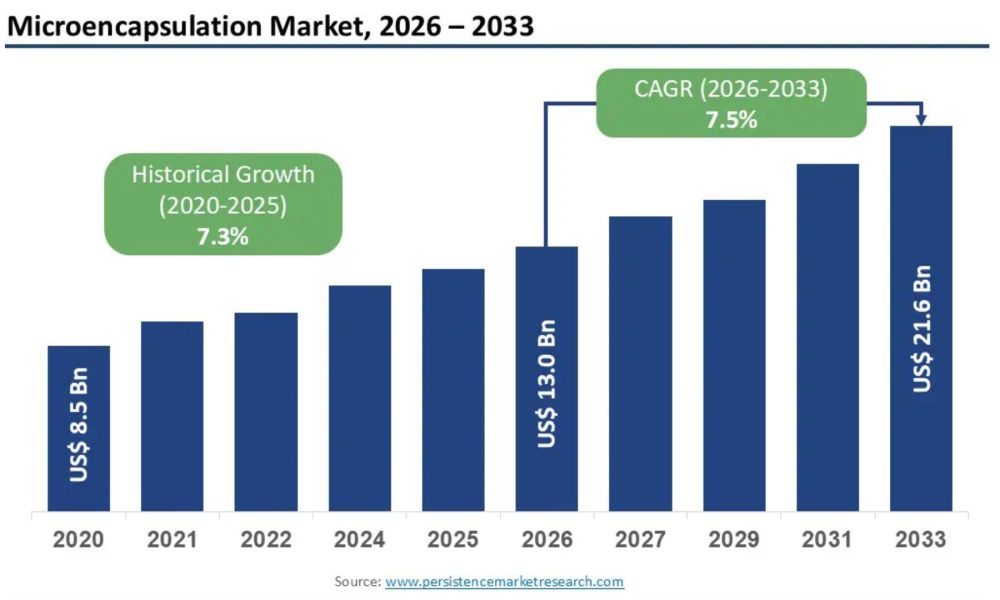
According to Persistence Market Research, the global microencapsulation market was valued at approximately US $13.0 billion in 2026 and is forecasted to reach US $21.6 billion by 2033, expanding at a compound annual growth rate (CAGR) of about 7.5% during the period from 2026 to 2033.
This sustained growth reflects expanding demand for controlled-release technologies and stable ingredient solutions across diverse applications — particularly in pharmaceuticals and food sectors where performance and reliability are key.
Key Market Drivers
- Explosive Pharmaceutical Demand
The pharmaceutical and healthcare segment is one of the largest and fastest-growing drivers of the microencapsulation market. Microencapsulation enables controlled drug release, improved bioavailability, taste masking, and targeted delivery systems — all of which enhance therapeutic outcomes and patient adherence. This is critically important for complex formulations, biologics, vaccines, and advanced drug delivery solutions.
- Expanding Food & Beverage Applications
The food and beverage industry increasingly relies on microencapsulation to protect flavors, nutrients, probiotics and other bioactive ingredients. As functional foods and fortified products gain popularity, microencapsulation helps preserve sensitive components against heat, oxidation, and moisture — improving shelf life and product quality.
- Agrochemical and Sustainable Farming Needs
In agriculture, microencapsulation plays a role in developing controlled-release fertilizers and pesticides, which improve efficacy while reducing environmental impact. Precision farming practices are driving demand for these smart formulations, which help optimize nutrient delivery and reduce chemical runoff.
- Growth in Personal Care and Industrial Uses
The cosmetics and personal care industry uses microencapsulation for fragrance delivery, moisturizing agents, and anti-aging actives, enhancing both product efficacy and consumer experience. Other industries, such as textiles and construction, also use microencapsulation for antimicrobial finishes, controlled fragrance release, and protective coatings.
Technology and Materials
Spray Technologies Dominate
Among encapsulation technologies, spray drying and spray technologies are prominent due to their cost-effectiveness, scalability, and ability to produce uniform microcapsules. These techniques are widely used in food, pharmaceutical, and chemical manufacturing for high-throughput production.
Coating Materials: Polymers and More
Polymers remain the leading coating material due to their versatility and ability to create robust protective shells. However, the market is also witnessing growth in biodegradable and natural materials — such as carbohydrates, gums, proteins and lipids — aligning with the global push toward sustainability and clean-label products.
Advanced Encapsulation Innovations
Emerging research in intelligent and stimuli-responsive microcapsules — which release contents in response to pH, temperature or humidity changes — is opening up new possibilities in pharmaceuticals, textiles, and specialty applications. Nanotechnology and micro-nano hybrid systems are further enhancing the precision and efficacy of encapsulation.
Regional Market Insights
North America Leading the Pack
North America is a major microencapsulation market, driven by advanced pharmaceutical research infrastructure, high adoption rates of functional foods, and strong innovation ecosystems. The U.S. in particular has significant demand due to intensive R&D and regulatory frameworks that support new controlled-release technologies.
Rapid Growth in Asia Pacific
The Asia Pacific region — including markets like China, India and Japan — is poised for rapid expansion. Rising industrialization, burgeoning food processing sectors, increasing pharmaceutical production, and strong agricultural demand all contribute to dynamic market growth.
Europe and Emerging Markets
Europe continues to show solid growth, supported by sustainability initiatives and consumer demand for high-quality encapsulated products. Emerging markets in Latin America, Africa and the Middle East are gradually increasing uptake as food processing and pharmaceutical industries expand.
Challenges and Market Restraints
High Development Costs
Developing advanced microencapsulation systems — including multi-core delivery platforms and bio-based polymers — can be cost-intensive. Extensive R&D, specialized equipment and quality testing add to manufacturing expenses, potentially limiting rapid scalability for smaller players.
Regulatory Complexities
Different regions enforce stringent regulations for drug delivery systems, food safety, and chemical coatings. Compliance with diverse regulatory standards — especially in pharmaceuticals and food — can lengthen product development cycles and introduce additional costs.
Competitive Landscape
The microencapsulation market is competitive with both established chemicals giants and specialty technology providers innovating in materials and delivery systems. Key players include global enterprises offering encapsulation technologies, coatings and processing solutions for pharma, food, agrochemical and industrial applications.
Get a Customized Market View in One Click: https://www.persistencemarketresearch.com/request-customization/23638
Future Outlook
The future of the microencapsulation market is promising — characterized by technological innovation, expanding application breadth and sustainable materials development. Key trends to watch include:
- Hybrid and smart delivery systems for highly controlled release
- Green and biodegradable encapsulation materials gaining preference
- Precision medicine and personalized formulations rising in pharma
- Functional and fortified food ingredients demanding greater protection
- Sustainable agriculture solutions enhancing crop efficiency
These trends point toward continued growth, cross-industry adoption, and deeper integration of microencapsulation technologies in everyday products.
Conclusion
The microencapsulation market is a vibrant and dynamic segment shaping how active ingredients are formulated, protected, and delivered across industries. With strong growth prospects — from pharmaceuticals to food, cosmetics and agriculture — microencapsulation is central to innovation in controlled release, ingredient stability and enhanced product performance. While challenges remain, ongoing advancements in materials science, process technologies, and regulatory harmonization are set to fuel sustained expansion through 2033 and beyond.
About Persistence Market Research:
Persistence Market Research delivers strategic research solutions that drive business growth. Founded in 2012 and registered in England and Wales in 2023 as Persistence Research & Consultancy Services Ltd., we have completed 3,600+ custom and syndicated studies and supported 2,700+ projects for leading research firms. Combining traditional methodologies with modern tools, we provide actionable insights to multinational corporations, consultants, investors, and government bodies, earning strong trust through long-term client relationships.
Contact Us:
Persistence Market Research
Second Floor, 150 Fleet Street,
London, EC4A 2DQ, United Kingdom
USA Phone: +1 646-878-6329
UK Phone: +44 203-837-5656
Email: [email protected]
Web: https://www.persistencemarketresearch.com




