
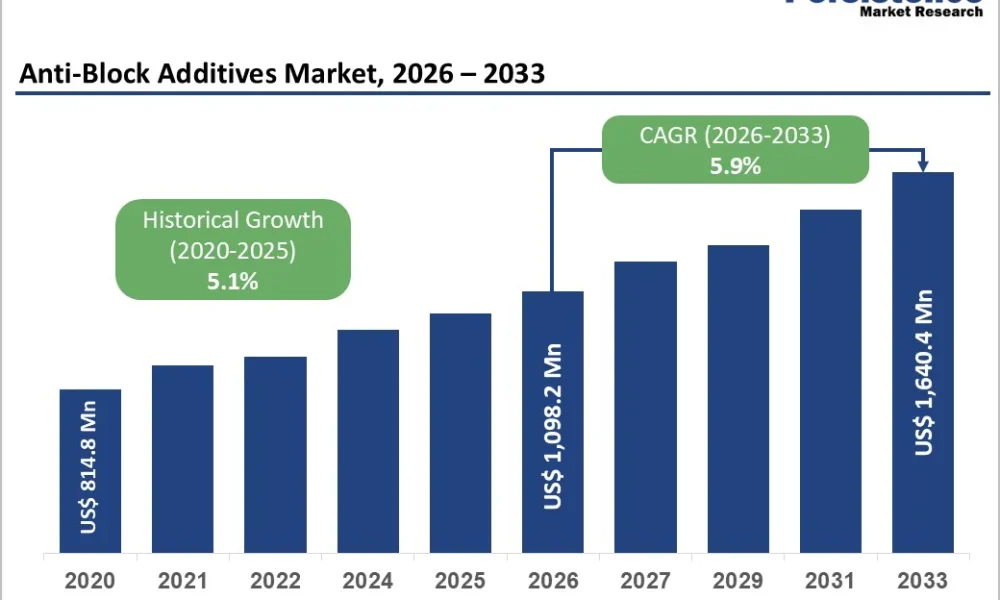
The anti-block additives market plays a crucial role in the plastics and polymer industry by enhancing the processing and performance of polymer films. Anti-block additives are incorporated into plastic films to prevent layers from sticking together, ensuring smooth handling, packaging efficiency, and improved productivity. These additives are widely used in polyethylene, polypropylene, and other polymer-based films across packaging, agriculture, and industrial sectors. The growing demand for flexible packaging solutions, particularly in food and consumer goods industries, is strengthening the market landscape. Rising emphasis on improved film clarity, durability, and machinability is further fueling demand. According to Persistence Market Research, the global anti-block additives market size is likely to be valued at US$ 1,098.2 million in 2026. The expanding use of high-performance films across various industries continues to support stable growth prospects.
The market is expected to reach US$ 1,640.4 million by 2033, growing at a CAGR of 5.9% during the forecast period from 2026 to 2033. This steady expansion reflects increasing consumption of packaged products, rapid industrialization, and technological advancements in polymer processing. The leading segment in the anti-block additives market is silica-based additives, owing to their superior anti-blocking efficiency and compatibility with a wide range of polymers. Among end users, the packaging industry remains dominant due to its extensive use of flexible films. Geographically, Asia Pacific leads the market, driven by robust manufacturing activities, rising urbanization, and growing demand for consumer goods packaging. Expanding production capacities and infrastructure development in emerging economies are reinforcing regional growth momentum.
Discover Exclusive Data – Request Your Free Sample : https://www.persistencemarketresearch.com/samples/16261
Key Highlights from the Report
➤ The anti-block additives market is projected to grow from US$ 1,098.2 million in 2026 to US$ 1,640.4 million by 2033.
➤ The market is expected to expand at a CAGR of 5.9% during the forecast period from 2026 to 2033.
➤ Silica-based anti-block additives dominate due to high efficiency and compatibility with polymer films.
➤ Packaging remains the leading end-use segment driven by rising demand for flexible plastic films.
➤ Asia Pacific accounts for the largest share owing to strong industrial and manufacturing growth.
➤ Increasing demand for high-performance and sustainable film solutions is shaping innovation strategies.
Market Segmentation
The anti-block additives market is segmented based on product type, including silica-based additives, synthetic anti-block additives, and other specialty materials. Silica-based additives hold a significant share due to their consistent particle size distribution and excellent anti-blocking performance. Synthetic additives are also gaining attention as manufacturers seek tailored solutions to meet specific film processing requirements. The choice of additive largely depends on polymer compatibility, processing temperature, and end-use application. Growing advancements in additive formulation are enabling improved dispersion and reduced haze in films. These innovations are helping manufacturers enhance film transparency while maintaining anti-blocking efficiency.
By end-user industry, the market is segmented into packaging, agriculture, industrial, and others. The packaging segment leads the anti-block additives market due to extensive usage in food packaging films, shrink wraps, and protective layers. Agricultural applications include greenhouse films and mulch films that require anti-blocking properties for durability and ease of handling. Industrial applications cover protective films and liners used in manufacturing and logistics. Rising consumption of packaged food and beverages continues to support demand in the packaging segment. The increasing need for efficient film processing across industries further drives adoption across diverse applications.
Your Market, Your Way – Click for Custom Version : https://www.persistencemarketresearch.com/request-customization/16261
Regional Insights
Asia Pacific dominates the anti-block additives market, supported by expanding plastic manufacturing hubs and growing consumer demand. Rapid industrialization and urban population growth have significantly increased the consumption of packaged goods. Countries in this region are investing heavily in polymer production capacities and packaging infrastructure. The presence of numerous film manufacturers and raw material suppliers strengthens regional supply chains. Rising exports of packaged products further enhance market growth. Continuous industrial expansion ensures sustained demand for anti-block additives across sectors.
North America and Europe also represent significant markets driven by advanced packaging technologies and established polymer industries. These regions emphasize quality standards and product innovation in film manufacturing. Demand for high-performance additives is supported by the need for efficient production and reduced downtime. The presence of major market players contributes to technological advancements and product development. Steady consumption across food, healthcare, and consumer goods packaging maintains regional growth stability.
Market Drivers
Growing demand for flexible packaging solutions is a primary driver of the anti-block additives market. The shift toward lightweight and cost-effective packaging materials has increased reliance on polymer films. Anti-block additives enhance film functionality by preventing adhesion between layers, improving processing efficiency. Rising consumer preference for convenience packaging further boosts film production volumes. Expansion of e-commerce and retail distribution networks also increases the need for protective packaging films. Continuous innovation in film manufacturing supports consistent additive demand.
Industrial expansion and increasing polymer production capacity further strengthen market growth. As plastic processing technologies advance, manufacturers require additives that improve film performance without compromising clarity. Enhanced automation in packaging lines demands consistent anti-blocking performance to minimize operational disruptions. The agriculture sector’s growing use of protective films also contributes to demand. Overall, technological improvements and expanding industrial activities support steady market expansion.
Market Restraints
Fluctuations in raw material prices pose challenges to the anti-block additives market. Variability in input costs can impact production margins and pricing strategies. Manufacturers often face pressure to maintain competitive pricing while ensuring product quality. Environmental concerns related to plastic usage may also affect overall demand growth. Increasing regulatory scrutiny on plastics could indirectly influence additive consumption. These factors may limit rapid market expansion in certain regions.
Another restraint includes the availability of alternative processing solutions that reduce the need for specific additives. Some film producers invest in advanced machinery to minimize blocking issues without additional additives. Technical limitations in achieving optimal dispersion can also affect product performance. Market competition among additive suppliers may create pricing pressure. Balancing cost efficiency with performance remains a critical challenge for manufacturers.
Market Opportunities
The growing focus on sustainable and high-performance packaging materials presents new opportunities for the anti-block additives market. Manufacturers are developing advanced formulations that improve efficiency while supporting sustainability goals. Innovations in additive technology aim to enhance film clarity and reduce processing defects. Rising demand for premium packaging solutions in food and healthcare sectors opens additional growth avenues. Increasing investments in research and development further strengthen product innovation.
Emerging economies offer significant untapped potential due to rapid industrialization and expanding consumer markets. Expansion of polymer production facilities in developing regions increases demand for performance-enhancing additives. Collaboration between additive manufacturers and film producers can lead to customized solutions. Technological integration and improved supply chain networks enhance market accessibility. These factors collectively create long-term growth opportunities across global markets.
Exclusive Data Awaits – Continue to Checkout : https://www.persistencemarketresearch.com/checkout/16261
Company Insights
Key players operating in the anti-block additives market include:
- Evonik Industries
- W. R. Grace & Co.
- Imerys
- Honeywell International Inc.
- Croda International Plc
- Ampacet Corporation
- Clariant AG
Recent Developments
- January 2024 – A leading additive manufacturer expanded its production capacity for silica-based anti-block additives to meet growing packaging demand.
- September 2023 – A major market participant introduced an advanced anti-block additive formulation designed to improve film clarity and processing efficiency.
Future Opportunities and Growth Prospects
The anti-block additives market is positioned for steady expansion, supported by growing polymer film production and rising demand for efficient packaging solutions. Continuous advancements in additive technology and expanding industrial applications are expected to strengthen market dynamics. As industries increasingly prioritize performance, efficiency, and innovation, the market is anticipated to witness sustainable long-term growth through 2033.




