
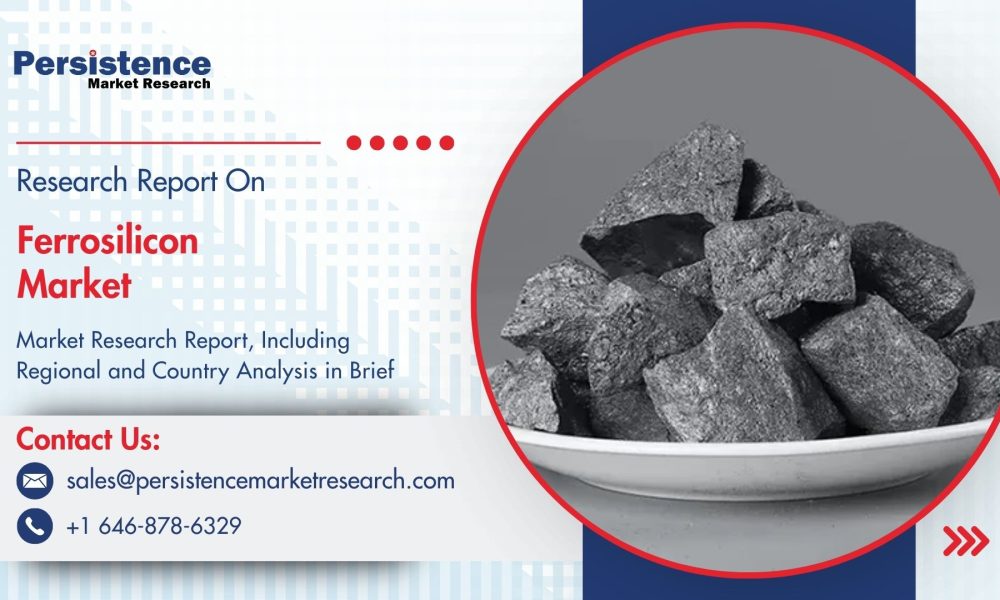
Ferrosilicon Market Share and Trends Analysis
The global ferrosilicon market is set to witness steady growth over the coming years, supported by expanding steel production and rising demand for high-performance alloys. The market is projected to be valued at US$ 15.7 billion in 2026 and is expected to reach approximately US$ 20.9 billion by 2033, growing at a compound annual growth rate (CAGR) of 4.2% between 2026 and 2033. This upward trajectory is closely linked to persistent gains in global steel output, increasing adoption of electric arc furnace (EAF) technology, and growing demand for specialty and alloy steels across construction, automotive, and energy sectors.
Understanding Ferrosilicon and Its Industrial Role
Ferrosilicon is an alloy of iron and silicon, typically containing between 15% and 90% silicon. It plays a crucial role in steelmaking as a deoxidizer and alloying agent. By removing oxygen from molten steel, ferrosilicon enhances the strength, durability, and corrosion resistance of finished products. It is also widely used in the production of cast iron, stainless steel, electrical steel, and specialty alloys.
Beyond steelmaking, ferrosilicon finds applications in magnesium production, inoculation of cast iron, and as a reducing agent in metallurgical processes. Its versatility makes it an indispensable material in modern industrial manufacturing.
Get Your FREE Sample Report Instantly – Click Now: https://www.persistencemarketresearch.com/samples/18454
Key Growth Drivers
- Persistent Growth in Global Steel Production
Steel remains one of the most widely used materials in construction, transportation, and infrastructure. As urbanization accelerates and infrastructure modernization projects expand globally, steel output continues to rise. Ferrosilicon demand directly correlates with steel production volumes, as it is essential for improving mechanical properties and ensuring consistent quality.
Emerging economies in Asia-Pacific, Latin America, and the Middle East are investing heavily in infrastructure development, driving sustained demand for structural steel grades. These projects require predictable tensile strength, weldability, and durability—qualities enhanced through ferrosilicon alloying.
- Accelerating Adoption of Electric Arc Furnace (EAF) Technology
The growing shift toward electric arc furnace (EAF) steelmaking is another critical growth factor. EAF technology, which relies on recycled scrap steel rather than iron ore, is gaining traction due to its lower carbon footprint and energy efficiency compared to traditional blast furnace methods.
Ferrosilicon is extensively used in EAF processes as a deoxidizer and alloying additive. As steelmakers transition toward greener production technologies to meet sustainability goals and emission regulations, EAF capacity expansions are expected to boost ferrosilicon consumption over the forecast period.
- Rising Demand for Alloy and Specialty Steels
Modern industries increasingly require advanced steel grades tailored to specific performance standards. Automotive manufacturers, for example, are using advanced high-strength steels (AHSS) to reduce vehicle weight while maintaining structural integrity and crash safety. Ferrosilicon contributes to improved strength, elasticity, and oxidation resistance in these materials.
Similarly, energy infrastructure—including oil and gas pipelines, wind turbines, and power transmission equipment—demands corrosion-resistant and high-durability steel. The use of specialty alloys in these sectors supports steady ferrosilicon demand.
Sectoral Demand Analysis
Construction Industry
The construction sector remains the largest consumer of steel and, by extension, ferrosilicon. Rapid urban development, housing projects, commercial real estate expansion, and government-backed infrastructure programs all contribute to rising steel requirements. Structural beams, reinforcement bars, and prefabricated steel components depend on alloying materials to ensure consistent mechanical properties and long service life.
As global infrastructure ages, renovation and retrofitting activities also support steel demand, indirectly strengthening the ferrosilicon market.
Automotive Industry
Automotive manufacturers are under pressure to enhance fuel efficiency and reduce emissions. Lightweighting strategies rely on stronger yet lighter steel grades, which often require precise alloying compositions. Ferrosilicon plays a role in producing these advanced materials.
The transition toward electric vehicles (EVs) further stimulates demand for specialty steel components in battery housings, structural reinforcements, and drivetrain systems.
Energy and Industrial Applications
Energy infrastructure projects—ranging from renewable energy installations to conventional oil and gas facilities—require materials that can withstand harsh environmental conditions. Ferrosilicon-enhanced steel improves corrosion resistance and structural integrity, making it suitable for pipelines, offshore platforms, and transmission towers.
In addition, industrial machinery and heavy equipment manufacturing depend on durable castings and steel components, reinforcing steady demand.
Get a Customized Market View in One Click: https://www.persistencemarketresearch.com/request-customization/18454
Regional Market Trends
Asia-Pacific: Dominant Market Share
Asia-Pacific holds the largest share of the global ferrosilicon market, driven by high steel production in countries such as China and India. Rapid industrialization, urban infrastructure expansion, and growing manufacturing output support sustained alloy demand.
Government initiatives focused on infrastructure modernization and manufacturing growth continue to strengthen regional consumption patterns.
North America and Europe: Sustainability and EAF Expansion
North America and Europe are witnessing increased adoption of EAF-based steelmaking as part of decarbonization strategies. Stricter environmental regulations and corporate sustainability commitments are encouraging steel producers to invest in lower-emission production technologies.
As EAF facilities expand, ferrosilicon demand in these regions is expected to remain stable, supported by automotive and energy sector requirements.
Middle East & Africa and Latin America
Emerging markets in these regions are gradually expanding steel production capacity to meet infrastructure and industrial growth needs. Investments in construction and energy projects provide incremental opportunities for ferrosilicon suppliers.
Market Challenges
Despite positive growth prospects, the ferrosilicon market faces several challenges. Volatility in raw material prices, particularly silicon metal and electricity costs, can impact production margins. Ferrosilicon manufacturing is energy-intensive, making producers sensitive to fluctuations in power prices and regulatory policies related to emissions.
Additionally, global trade dynamics, tariffs, and supply chain disruptions can influence market stability and pricing trends.
Environmental concerns regarding carbon emissions from metallurgical processes also pose long-term challenges. Producers may need to invest in cleaner technologies and energy-efficient furnaces to align with global sustainability targets.
Emerging Trends and Opportunities
Focus on Low-Carbon Production
Sustainability is becoming central to metallurgical industries. Companies are exploring renewable energy integration, carbon capture technologies, and process optimization to reduce emissions associated with ferrosilicon production.
Low-carbon ferrosilicon could emerge as a competitive differentiator in markets where green steel initiatives are gaining traction.
Technological Advancements in Steelmaking
Advancements in alloy design and metallurgical research are driving the development of next-generation steels with enhanced mechanical and thermal properties. These innovations may increase demand for precisely engineered ferrosilicon grades.
Automation and digital monitoring in smelting operations are also improving efficiency and product consistency, enhancing market competitiveness.
Competitive Landscape
The ferrosilicon market is moderately consolidated, with key players focusing on capacity expansion, strategic partnerships, and technological upgrades. Producers are investing in energy-efficient smelting technologies and supply chain optimization to remain competitive amid fluctuating raw material costs.
Regional manufacturers often compete on price and logistics advantages, while larger multinational companies differentiate themselves through product quality, scale, and global distribution networks.
For In-Depth Competitive Analysis, Buy Now: https://www.persistencemarketresearch.com/checkout/18454
Future Outlook
The global ferrosilicon market is expected to maintain stable and sustainable growth through 2033. Rising steel output, expansion of EAF technology, and increasing demand for alloy and specialty steels across construction, automotive, and energy sectors will remain the primary growth drivers.
With the market projected to grow from US$ 15.7 billion in 2026 to US$ 20.9 billion by 2033, ferrosilicon will continue to serve as a foundational material in industrial development. While cost volatility and environmental pressures present challenges, ongoing technological innovation and the global push for infrastructure modernization ensure a resilient and promising future for the ferrosilicon industry.
About Persistence Market Research:
Persistence Market Research delivers strategic research solutions that drive business growth. Founded in 2012 and registered in England and Wales in 2023 as Persistence Research & Consultancy Services Ltd., we have completed 3,600+ custom and syndicated studies and supported 2,700+ projects for leading research firms. Combining traditional methodologies with modern tools, we provide actionable insights to multinational corporations, consultants, investors, and government bodies, earning strong trust through long-term client relationships.
Contact Us:
Persistence Market Research
Second Floor, 150 Fleet Street,
London, EC4A 2DQ, United Kingdom
USA Phone: +1 646-878-6329
UK Phone: +44 203-837-5656
Email: [email protected]
Web: https://www.persistencemarketresearch.com




