
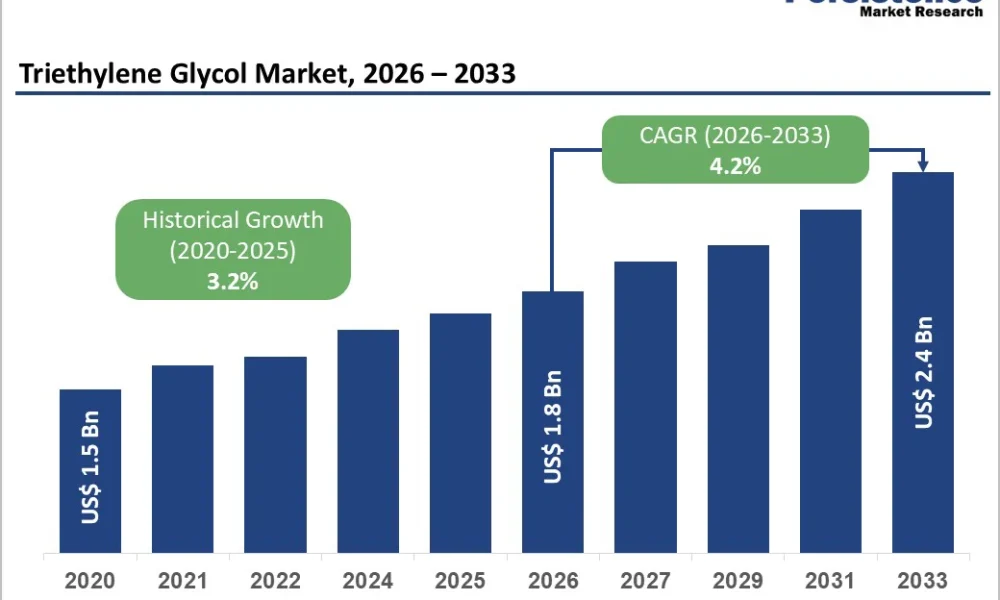
The global Triethylene Glycol Market is poised for steady expansion, supported by consistent demand from oil & gas, automotive, and textile industries. According to Persistence Market Research, the global triethylene glycol market size is likely to be valued at US$1.8 billion in 2026, and is expected to reach US$2.4 billion by 2033, growing at a CAGR of 4.2% during the forecast period from 2026 to 2033. The increasing prevalence of natural gas processing demands continues to drive consumption of triethylene glycol as a vital dehydration agent.
Triethylene glycol plays a critical role in moisture-absorbing solvents used across oil & gas operations, particularly for gas dehydration processes. In addition, advancements in polyester resin formulations have expanded its relevance in manufacturing performance-based materials. Rising demand for non-toxic triethylene glycol in automotive and textiles is further strengthening market prospects. Improved humectant and plasticizer grades, combined with its contribution to energy-efficient industrial processes, are collectively supporting sustained growth momentum across global markets.
Download Your Free Sample & Explore Key Insights : https://www.persistencemarketresearch.com/samples/17374
Key Highlights from the Report
➤ The global triethylene glycol market is projected to grow from US$1.8 billion in 2026 to US$2.4 billion by 2033 at a CAGR of 4.2%.
➤ Increasing natural gas processing demand is a primary growth driver for triethylene glycol consumption worldwide.
➤ Rising need for moisture-absorbing solvents in oil & gas applications is accelerating product adoption.
➤ Advancements in polyester resin formulations are expanding industrial usage.
➤ Growing demand for non-toxic triethylene glycol in automotive and textile industries is strengthening market penetration.
➤ Improved humectant and plasticizer grades are enhancing product performance and energy-efficient processing benefits.
Market Segmentation
The Triethylene Glycol Market can be segmented based on application and end-user industries. By application, triethylene glycol is widely used as a dehydration agent in natural gas processing, as a solvent, and as a humectant and plasticizer. Among these, natural gas dehydration represents a leading segment due to the increasing prevalence of natural gas processing demands globally. Its ability to efficiently remove water vapor from gas streams ensures pipeline safety and operational efficiency, making it indispensable in upstream and midstream energy operations.
In terms of end-user industries, oil & gas accounts for a significant share owing to the rising need for moisture-absorbing solvents. Automotive and textile industries are also emerging as strong growth contributors due to increasing adoption of non-toxic triethylene glycol in manufacturing processes. Furthermore, polyester resin production is gaining traction as advancements in resin formulations enhance durability and performance characteristics. These diverse end-use applications collectively strengthen the market’s structural resilience.
Get Custom Insights Designed for Your Business : https://www.persistencemarketresearch.com/request-customization/17374
Regional Insights
Regions with strong oil & gas exploration and natural gas processing infrastructure are witnessing consistent demand for triethylene glycol. The growing emphasis on efficient gas dehydration technologies is supporting market expansion in these areas. Energy-intensive economies are particularly benefiting from the compound’s role in ensuring safe and efficient pipeline operations.
Additionally, regions experiencing rapid industrialization in automotive and textiles are emerging as important growth hubs. Rising awareness regarding non-toxic chemical formulations and energy-efficient processing methods is contributing to steady adoption. Expanding polyester resin applications further support regional growth dynamics, reinforcing the global market outlook.
Market Drivers
The primary driver of the Triethylene Glycol Market is the increasing prevalence of natural gas processing demands. As natural gas continues to serve as a critical energy source, efficient dehydration processes are essential to prevent corrosion and hydrate formation in pipelines. Triethylene glycol remains a preferred solution due to its high hygroscopicity and operational reliability. This consistent requirement across gas processing facilities ensures stable long-term demand.
Another significant driver is the rising need for moisture-absorbing solvents in oil & gas operations. Triethylene glycol’s superior performance characteristics make it suitable for high-volume industrial applications. Additionally, advancements in polyester resin formulations are broadening its industrial footprint. The growing preference for non-toxic variants in automotive and textiles, along with improved humectant and plasticizer grades, further reinforces its adoption in energy-efficient and sustainable processes.
Market Restraints
Despite steady growth prospects, the Triethylene Glycol Market faces certain restraints. Market expansion can be influenced by fluctuations in upstream oil & gas activities, which directly affect demand for dehydration agents. Any slowdown in exploration or processing activities may temporarily impact consumption levels.
Additionally, competition from alternative chemical formulations used in specific solvent and plasticizer applications may limit broader penetration. While triethylene glycol is widely accepted for its performance and non-toxic profile, end-user industries often evaluate cost-effectiveness and compatibility with evolving regulatory standards. These factors can moderate short-term growth trajectories.
Market Opportunities
Significant opportunities lie in the continued evolution of polyester resin technologies. As manufacturers seek improved durability and performance in industrial materials, triethylene glycol is expected to gain expanded usage. Its compatibility with advanced resin formulations offers strong potential for diversified application development.
The growing emphasis on non-toxic and energy-efficient chemical solutions also presents substantial growth avenues. Automotive and textile manufacturers are increasingly prioritizing safer chemical inputs, positioning triethylene glycol as a preferred alternative. Furthermore, the compound’s role in enhancing humectant and plasticizer performance creates additional opportunities for innovation-driven market expansion during the forecast period.
Get Instant Access – Complete Your Purchase : https://www.persistencemarketresearch.com/checkout/17374
Company Insights
Key players operating in the Triethylene Glycol Market include:
- Dow
- Exxon Mobil Corporation.
- BASF
- Huntsman International LLC.
- LyondellBasell Industries Holdings B.V.
- SABIC
- Eastman Chemical Company
- India Glycols Limited
- LOTTE Chemical Corporation
- PTT Global Chemical Public Company Limited
- Muby Chem Private Limited
Recent Developments:
- January 2024 – Expansion initiatives focused on enhancing production efficiency of glycol-based solutions.
- September 2023 – Strategic investments aimed at strengthening polyester resin formulation capabilities.
Future Opportunities and Growth Prospects
The Triethylene Glycol Market is expected to maintain steady growth through 2033, supported by expanding natural gas processing infrastructure and continuous advancements in polyester resin technologies. Increasing demand for non-toxic and high-performance solvents across automotive and textile industries will further reinforce its industrial relevance.
With sustained innovation in humectant and plasticizer grades and rising emphasis on energy-efficient processes, triethylene glycol is well-positioned to deliver consistent value across diverse end-use industries, ensuring balanced and resilient market expansion over the forecast period.




