
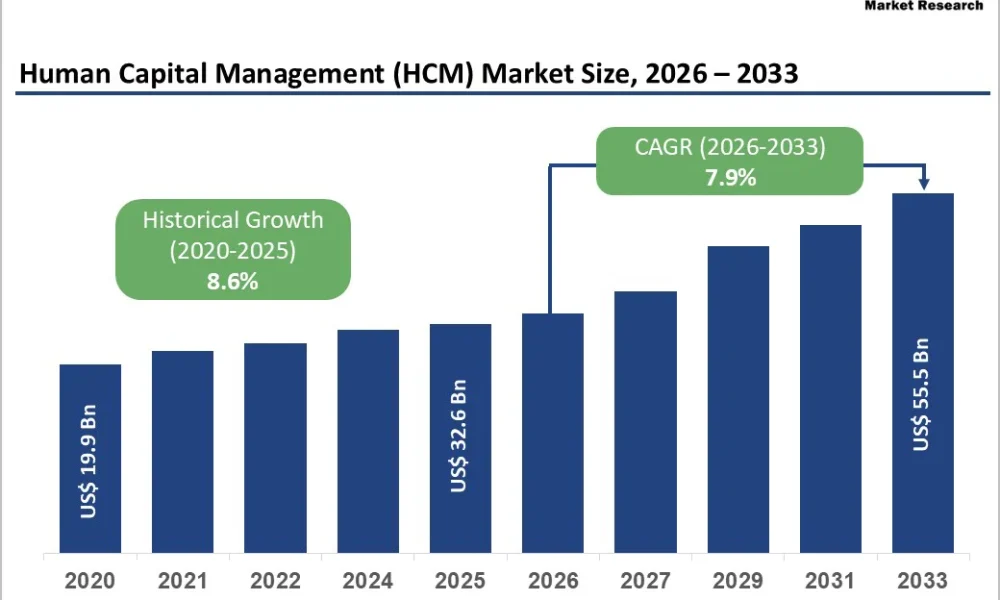
The global Human Capital Management (HCM) market is entering a transformative growth phase, fueled by rapid digital modernization, artificial intelligence integration, and evolving workforce models. The market is projected to grow from US$ 32.6 billion in 2026 to US$ 55.5 billion by 2033, registering a CAGR of 7.9% between 2026 and 2033. This growth trajectory reflects the rising importance of strategic workforce management in an increasingly competitive, digital-first business landscape.
Organizations across industries are reimagining HR functions from administrative back-office operations to strategic, data-driven talent engines. Cloud-native architectures, AI-powered analytics, and employee experience platforms are redefining how enterprises attract, retain, and optimize talent.
Market Overview and Growth Snapshot
- Market Size (2026E): US$ 32.6 Billion
- Market Forecast (2033F): US$ 55.5 Billion
- CAGR (2026–2033): 7.9%
- Historical CAGR (2020–2025): 8.6%
- Leading Region: North America (38% market share in 2025)
- Fastest Growing Region: Asia Pacific (11.2% CAGR)
- Dominating Segment: Integrated HCM Suites (58% share)
- Cloud Revenue Share (2024): 76%
Key Market Drivers
- Cloud Migration and Enterprise Digital Transformation
Cloud-based HCM adoption is the single most influential growth catalyst in the market. In 2024, cloud solutions accounted for approximately 76% of total HCM revenue, signaling a structural shift away from legacy on-premise systems.
Organizations are migrating to cloud-native platforms to:
- Reduce total cost of ownership
- Improve payroll centralization
- Simplify multi-region workforce management
- Enhance compliance automation
- Access real-time workforce analytics
Cloud platforms provide scalable licensing models, rapid implementation cycles, and seamless updates. Enterprises now prioritize outcome-driven metrics such as talent agility, employee growth, and workforce experience rather than feature comparisons.
Major vendors like Oracle Corporation, Workday, Inc., SAP SE, and Microsoft Corporation are leading this transformation by delivering AI-native cloud HCM ecosystems.
- AI and Machine Learning Integration
Artificial intelligence is fundamentally reshaping HCM systems. Modern platforms are transitioning from reactive HR administration tools to proactive workforce intelligence engines.
Key AI-driven capabilities include:
- Automated resume screening
- Predictive attrition modeling
- Skills gap identification
- Personalized learning recommendations
- Chatbot-enabled employee support
- Workforce scenario planning
According to Gartner, 33% of enterprise applications are expected to incorporate agentic AI by 2028. AI enhances recruitment speed, reduces bias, and supports strategic workforce planning through predictive analytics.
Generative AI tools now automate policy drafting, HR communications, and employee journey workflows, improving operational efficiency and decision-making quality.
Market Restraints
Implementation Complexity
Despite its benefits, HCM deployment presents technical and organizational challenges. Data migration from legacy systems often proves more complex than anticipated, requiring cleansing, restructuring, and validation.
Integration difficulties with:
- Payroll systems
- ERP platforms
- Third-party applications
- Industry-specific compliance tools
can increase implementation budgets by 15–30% above initial estimates.
User Adoption Challenges
Successful HCM transformation depends heavily on change management. Insufficient training, poor communication, and inadequate process redesign frequently limit ROI realization.
Organizations that invest in structured onboarding, executive sponsorship, and continuous training programs experience significantly better adoption rates.
Compliance and Multi-System Complexity
Operating across jurisdictions introduces regulatory challenges. GDPR compliance in Europe requires strict data residency and privacy controls, with penalties reaching 4% of global turnover for violations.
Industries such as BFSI, healthcare, and government require:
- Advanced audit trails
- Segregation of duties
- Compensation transparency
- Employment verification controls
These requirements increase implementation complexity but also create opportunities for vendors offering specialized compliance capabilities.
Emerging Opportunities
Employee Experience and Wellness Platforms
Employee engagement is now a measurable business priority. Research indicates that engaged employees deliver 18% higher productivity and 23% greater profitability.
HCM vendors are expanding into:
- Wellness programs
- Feedback and recognition systems
- Career path mapping
- Skills tracking dashboards
- AI-driven mentorship matching
Personalized employee journeys powered by analytics are becoming a competitive differentiator.
SME Market Expansion
Small and Medium Enterprises represent a massive untapped opportunity. In the Asia Pacific region, SMEs account for 60–80% of total employment.
Cloud-based HCM solutions enable SMEs to:
- Avoid infrastructure costs
- Automate compliance tasks
- Simplify payroll operations
- Improve hiring efficiency
Emerging Indian HCM providers such as Darwin Box, People Strong, Zing HR, and Hono HR are capitalizing on localized SME demand.
Elevate your business strategy with comprehensive market data. Request a sample report now: https://www.persistencemarketresearch.com/samples/33033
Category-wise Analysis
Component Insights
Integrated HCM suites dominate the market with a 58% share in 2025. Organizations increasingly prefer unified platforms covering:
- Recruitment
- Payroll
- Performance management
- Learning and development
- Compensation management
Integrated systems reduce data duplication, improve analytics accuracy, and streamline governance.
Solutions such as Oracle Fusion Cloud HCM, Workday HCM, and SAP SuccessFactors continue to expand feature sets and AI capabilities.
Deployment Insights
Cloud deployment holds approximately 76% market share. Benefits include:
- Automatic updates
- Lower capital expenditure
- Scalability
- Mobile accessibility
- Global compliance frameworks
Cloud HCM is expected to grow at 7.5% CAGR through 2032, driven largely by SME adoption and distributed workforce requirements.
Enterprise Size Insights
Large enterprises account for 62% of market share due to:
- Complex workforce structures
- Multi-country payroll requirements
- Advanced analytics needs
- Merger and acquisition integration
However, SMEs represent the fastest-growing adoption base, driven by affordability and ease of deployment.
Industry Insights
IT & Telecom
The IT & Telecom sector leads adoption with 21% market share. Talent competition, rapid upskilling requirements, and global hiring drive HCM investments.
BFSI
The BFSI sector is the fastest-growing vertical with 8.9% CAGR. Financial institutions leverage HCM platforms for regulatory compliance, workforce optimization, and customer-facing talent development.
Regional Analysis
North America
North America leads with 38% share in 2025. Advanced digital maturity, strong IT budgets, and competitive talent markets drive adoption.
Enterprises emphasize:
- Diversity & inclusion tracking
- Workforce analytics
- Hybrid workforce management
- Employee engagement optimization
Europe
Europe accounts for 28% of global share. GDPR compliance, employee rights protections, and work-life balance initiatives shape regional HCM requirements.
Countries such as Germany, the UK, and France prioritize localized payroll and benefits administration.
Asia Pacific
Asia Pacific is the fastest-growing region at 11.2% CAGR. Rapid digitalization across India, China, Japan, and Southeast Asia is driving expansion.
India, in particular, represents a high-growth market due to IT services expansion and enterprise modernization initiatives.
Competitive Landscape
The HCM market is moderately consolidated, with leading vendors controlling more than two-thirds of global revenue.
Key players include:
- Oracle Corporation
- Workday, Inc.
- SAP SE
- Microsoft Corporation
- ADP Global
- Cornerstone OnDemand
- Paychex
Competitive differentiation increasingly revolves around:
- AI-native architecture
- Agent-based automation
- Implementation efficiency
- Outcome-based pricing
- Modular SaaS services
Key Market Developments
- February 2025: Workday, Inc. launched its Agent System of Record and AI marketplace enabling HR task automation.
- September 2024: Oracle Corporation released Cloud HCM 24B update with enhanced automation and UI modernization.
- October 2024: SAP SE expanded AI integration in SuccessFactors for skills-based workforce planning.
Future Outlook
The HCM market is shifting toward intelligent workforce ecosystems powered by AI, predictive analytics, and autonomous decision support.
Future growth will be shaped by:
- Agentic AI adoption
- Skills-based workforce planning
- Real-time workforce intelligence
- Cross-system integration
- Outcome-based HR metrics
By 2033, HCM platforms will evolve beyond HR tools into enterprise-wide workforce orchestration systems, directly influencing organizational productivity, profitability, and strategic growth.
Conclusion
The global Human Capital Management market is poised for sustained expansion, reaching US$ 55.5 billion by 2033 at a CAGR of 7.9%. Cloud transformation, AI innovation, and shifting workforce dynamics are redefining HR strategies worldwide.
As enterprises prioritize agility, employee experience, and data-driven talent management, HCM platforms will remain central to digital transformation strategies across industries and geographies. Organizations that strategically invest in intelligent, scalable HCM systems will gain measurable competitive advantages in workforce optimization and long-term growth.
Related Reports:




