
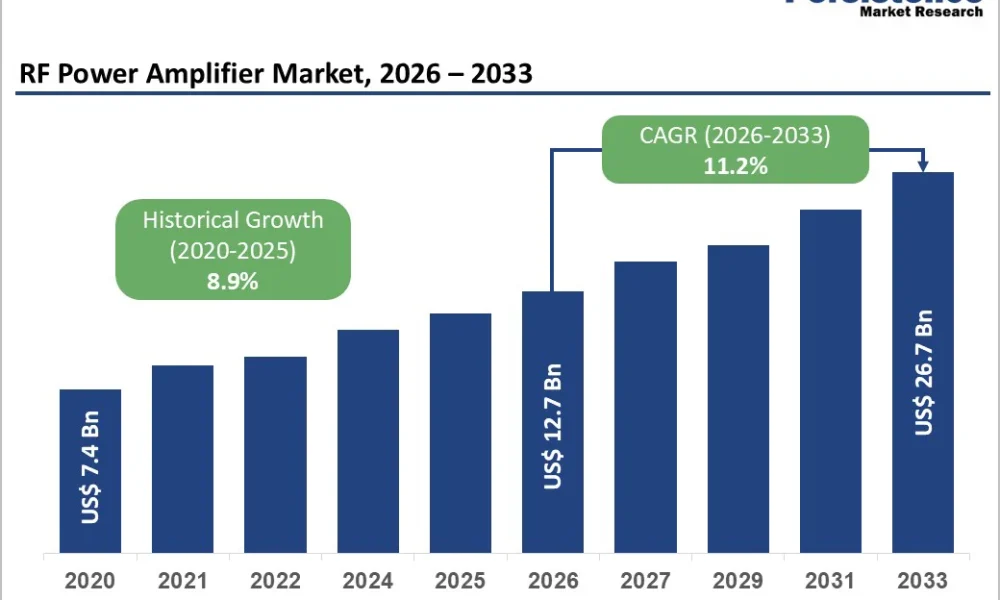
The global RF Power Amplifier (RFPA) market is poised for significant expansion, projected to grow from US$ 12.7 billion in 2026 to US$ 26.7 billion by 2033, registering a strong CAGR of 11.2% between 2026 and 2033. This growth reflects sustained demand across telecommunications, aerospace & defense, satellite communications, and emerging automotive radar systems.
Structural market catalysts include global 5G infrastructure expansion, modernization of defense radar systems, the proliferation of Low Earth Orbit (LEO) satellite constellations, and the increasing integration of high-frequency communication systems across industries. The convergence of broadband, mid-band, and millimeter-wave technologies is reshaping RF amplifier architectures, with Gallium Nitride (GaN) and Silicon Carbide (SiC) materials leading performance innovation.
Market Overview and Key Highlights
- Market Size (2026E): US$ 12.7 Billion
- Market Forecast (2033F): US$ 26.7 Billion
- Projected CAGR (2026–2033): 11.2%
- Leading Region (2025): North America (~32%)
- Fastest Growing Region: East Asia (~28% share in 2025)
- Dominant Frequency Band: Mid Frequency (1–6 GHz) – 46% share
- Fastest Growing Frequency Band: Millimeter Wave (>30 GHz)
- Leading End-User: Telecommunications Service Providers (48%)
- Fastest Growing End-User: Defense
Understanding RF Power Amplifiers
RF power amplifiers are critical components in wireless communication systems, responsible for boosting low-power radio frequency signals to higher power levels suitable for transmission over long distances. They are widely deployed in:
- 5G base stations
- Satellite communication terminals
- Radar systems
- Electronic warfare platforms
- Automotive radar
- Industrial wireless systems
Modern RFPA designs increasingly rely on GaN and GaN-on-SiC technologies to achieve higher efficiency, power density, and thermal performance.
Key Growth Drivers
- Global 5G Infrastructure Deployment
Telecommunications infrastructure remains the dominant revenue driver, accounting for nearly 48% of total end-user demand in 2025.
The global rollout of sub-6 GHz 5G networks, massive MIMO architectures, and Open-RAN hardware upgrades has significantly increased demand for high-efficiency RF power amplifiers. Companies such as Qualcomm and Broadcom Inc. continue to integrate advanced RF front-end modules into 5G infrastructure equipment.
Mid-band spectrum (1–6 GHz) dominates deployments globally due to optimal coverage and capacity balance, contributing 46% market share in 2025.
Energy efficiency is becoming a critical differentiator, as operators seek to reduce power consumption in dense urban deployments. High-efficiency GaN-based amplifiers are replacing traditional LDMOS technologies in many base station designs.
- Defense Modernization and Radar Advancements
Defense is the fastest-growing end-user segment, driven by rising geopolitical tensions and increased global military budgets.
GaN-on-SiC RF amplifiers are increasingly used in:
- X-band radar systems
- Electronic warfare (EW) platforms
- Phased-array radars
- Secure battlefield communications
Leading defense contractors such as Lockheed Martin Corporation and Raytheon Technologies are incorporating high-power RF amplifiers into next-generation air defense and surveillance systems.
The shift toward active electronically scanned array (AESA) radars further accelerates demand for compact, high-power, thermally efficient RF amplifier modules.
- Expansion of Satellite Communications (SATCOM)
The rapid deployment of LEO satellite constellations is creating strong demand for millimeter-wave RF power amplifiers.
Companies such as SpaceX and OneWeb are expanding satellite broadband networks, requiring high-frequency amplification solutions for both ground terminals and space-based payloads.
Millimeter-wave frequencies above 30 GHz represent the fastest-growing frequency band, driven by:
- LEO satellite broadband
- High-throughput satellite systems
- Defense communication networks
These applications require amplifiers capable of handling higher bandwidth and maintaining signal integrity over extended ranges.
- Automotive Radar and Autonomous Systems
The automotive sector is emerging as a strong growth contributor, particularly in 76–81 GHz radar applications used in advanced driver-assistance systems (ADAS) and autonomous vehicles.
High-frequency RF power amplifiers are integral to enabling:
- Adaptive cruise control
- Blind spot detection
- Collision avoidance systems
Premium automotive manufacturers are accelerating radar integration, increasing the demand for compact and efficient mmWave amplifiers.
Elevate your business strategy with comprehensive market data. Request a sample report now: https://www.persistencemarketresearch.com/samples/33431
Regional Insights
North America – Market Leader (~32% Share)
North America leads the RF Power Amplifier market due to:
- Strong U.S. defense spending
- Rapid 5G mid-band deployments
- Expanding SATCOM infrastructure
- Robust semiconductor ecosystem
Major semiconductor innovators like Qorvo and Skyworks Solutions are headquartered in the region, reinforcing technological leadership.
Government-backed defense modernization programs and homeland security initiatives continue to drive high-power amplifier demand.
East Asia – Fastest Growing Region (~28% Share)
East Asia stands as the fastest-growing region, supported by:
- China’s large-scale 5G base-station rollout
- Expanding GaN fabrication capacity
- Semiconductor innovation in Japan and South Korea
Manufacturers such as Samsung Electronics are actively investing in next-generation RF front-end technologies.
China’s domestic semiconductor push and large telecom infrastructure upgrades are further accelerating regional market growth.
Europe – Strategic and Policy-Driven Growth (~24% Share)
Europe maintains a 24% market share in 2025, driven by:
- Harmonized spectrum allocation policies
- NATO-aligned defense modernization
- Cybersecurity compliance mandates
- 5G standalone network deployments
Defense manufacturers and telecom infrastructure vendors across Germany, France, and the UK continue to modernize radar and communications systems.
Frequency Band Analysis
Mid Frequency (1–6 GHz) – Dominant Segment
The mid-frequency band leads the market due to its widespread adoption in:
- Sub-6 GHz 5G networks
- Commercial wireless infrastructure
- Government communications
Massive MIMO deployments require efficient RF amplification to handle multiple antenna arrays simultaneously.
Millimeter Wave (>30 GHz) – Fastest Growing
Millimeter-wave frequencies are witnessing rapid growth, driven by:
- LEO satellite expansion
- Automotive radar integration
- High-capacity urban 5G deployments
The complexity of mmWave amplifier design requires advanced semiconductor materials such as GaN and SiGe, offering high-frequency performance and reduced signal loss.
Competitive Landscape
The RF Power Amplifier market is moderately consolidated, with major semiconductor and defense players controlling a significant portion of global revenue.
Key participants include:
- Qorvo
- Skyworks Solutions
- Broadcom Inc.
- Qualcomm
- Lockheed Martin Corporation
- Raytheon Technologies
Competitive strategies focus on:
- GaN-on-SiC material innovation
- Vertical integration of RF front-end modules
- Partnerships with telecom OEMs
- Defense contract expansion
- Investment in mmWave R&D
Emerging Trends Shaping the Market
- GaN Technology Mainstreaming: Transition from LDMOS to GaN amplifiers for improved efficiency and higher output power.
- Energy-Efficient Networks: Telecom operators prioritizing low power consumption amplifiers.
- Open-RAN Ecosystem: Modular hardware upgrades increasing amplifier demand.
- AI-Optimized RF Architectures: Adaptive signal processing to enhance performance.
- Miniaturization and Integration: Compact RF front-end modules for space-constrained applications.
Future Outlook
By 2033, the RF Power Amplifier market will be shaped by next-generation wireless connectivity, aerospace-defense modernization, and automotive radar proliferation. The convergence of telecommunications and defense-grade technologies is creating a unified high-performance RF ecosystem.
The increasing adoption of GaN-on-SiC architectures, mmWave communications, and satellite broadband systems will sustain double-digit growth throughout the forecast period.
As the market approaches US$ 26.7 billion by 2033, companies investing in high-frequency innovation, energy-efficient architectures, and advanced semiconductor fabrication will capture the largest share of emerging opportunities.
The RF Power Amplifier industry is no longer confined to traditional telecom applications—it is becoming a foundational pillar of global digital infrastructure, aerospace security, and autonomous mobility systems worldwide.
Related Reports:




