
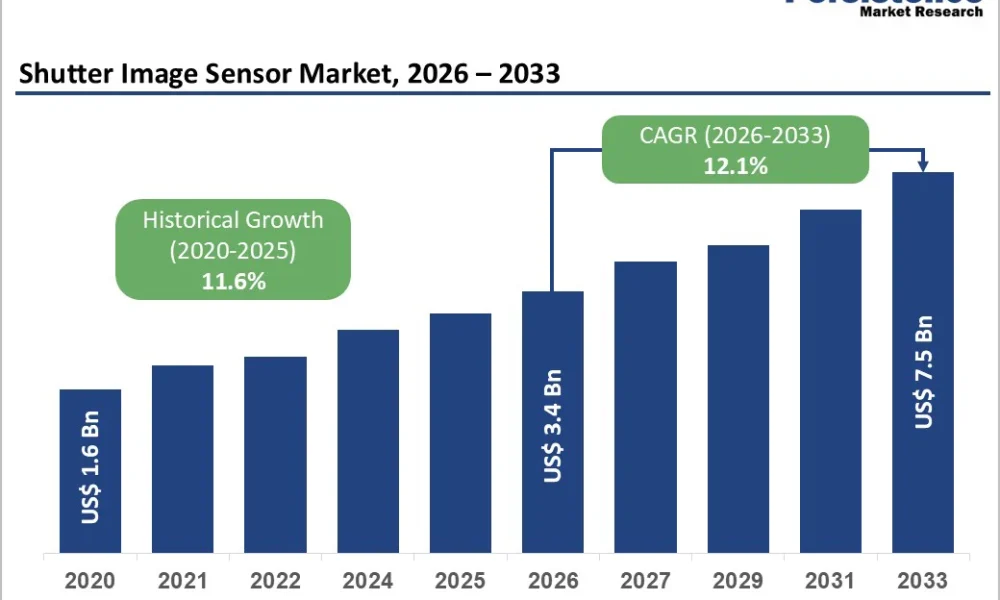
The global shutter image sensor market is poised for strong growth, expanding from US$ 3.4 billion in 2026 to US$ 7.5 billion by 2033, registering a CAGR of 12.1% between 2026 and 2033. This growth is fueled by multi-camera smartphone innovation, rapid expansion of autonomous vehicles, increasing deployment of advanced driver assistance systems (ADAS), and rising demand for industrial and scientific imaging solutions.
Shutter image sensors, including global and rolling shutter architectures, are becoming central to high-speed image capture, depth sensing, automotive perception systems, robotics, and edge AI-enabled vision systems. As imaging technology converges with artificial intelligence and high-performance computing, sensor innovation is accelerating across consumer and industrial domains.
Market Overview and Key Highlights
- Market Size (2026E): US$ 3.4 Billion
- Market Forecast (2033F): US$ 7.5 Billion
- Projected CAGR (2026–2033): 12.1%
- Leading Technology: CMOS (47.3% share)
- Fastest Growing Technology: CCD (14% CAGR)
- Dominant Processing Type: 3D Image Sensors (38.4% share)
- Fastest Growing Processing Type: 4D Image Sensors (20% CAGR)
- Leading End-user: Consumer Electronics (38.4%)
- Fastest Growing End-user: Automotive (18% CAGR)
- Top 10 Suppliers Control: ~60% market share
Understanding Shutter Image Sensors
Shutter image sensors are electronic devices that capture light and convert it into digital signals. They are widely used in:
- Smartphones
- Automotive ADAS systems
- Industrial inspection
- Robotics
- Surveillance
- Medical imaging
- Aerospace and defense
Two major shutter architectures dominate:
- Global shutter: Captures all pixels simultaneously, ideal for fast-moving objects.
- Rolling shutter: Captures images sequentially line-by-line, common in consumer electronics due to cost efficiency.
Global shutter technology is especially critical for automotive vision, robotics, and high-speed machine vision systems where motion distortion must be minimized.
Key Market Growth Drivers
- Smartphone Multi-Camera Proliferation
Consumer electronics remain the largest end-user segment, accounting for 38.4% market share in 2025. Smartphone manufacturers are integrating:
- Ultra-high-resolution sensors (200+ MP)
- Depth-sensing cameras
- AI-powered image processing
- Computational photography features
Leading manufacturers such as Sony Group Corporation and Samsung Electronics continue to advance CMOS sensor performance with improved dynamic range, low-light capabilities, and pixel miniaturization.
The increasing integration of on-chip AI processing is enabling real-time HDR rendering, object recognition, and edge analytics without relying on cloud computing.
- Autonomous Vehicles and ADAS Mandates
The automotive sector is the fastest-growing end-user segment, projected to grow at 18% CAGR. Regulatory mandates in North America, Europe, and Asia are accelerating ADAS adoption, including:
- Lane departure warning
- Automatic emergency braking
- Blind-spot detection
- Surround-view systems
High-speed global shutter sensors are critical for accurate object detection and motion tracking.
Companies such as OmniVision Technologies and ON Semiconductor are developing automotive-grade sensors optimized for:
- Wide temperature tolerance
- Low-latency response
- High dynamic range
- Weather-resilient performance
The integration of 4D imaging radar and camera fusion systems is further strengthening demand for advanced shutter image sensors in autonomous driving stacks.
- Rise of 3D and 4D Imaging Technologies
3D image sensors dominate with 38.4% share due to their applicability in depth sensing and facial recognition. These sensors enable:
- Structured light systems
- Time-of-flight (ToF) imaging
- Biometric authentication
- AR/VR spatial mapping
Meanwhile, 4D image sensors are the fastest-growing category at 20% CAGR. These sensors integrate spatial, temporal, and velocity data, making them highly suitable for:
- Autonomous vehicle perception
- Industrial automation
- Smart city surveillance
4D imaging enhances object tracking accuracy even under adverse weather conditions such as rain, fog, or snow.
- Scientific and Industrial Imaging Demand
While CMOS dominates with 47.3% share due to low power consumption and system integration benefits, CCD sensors are experiencing a niche resurgence with a 14% CAGR.
CCD sensors remain preferred in:
- Scientific research
- Astronomy
- Medical imaging
- High-precision inspection
Their superior image uniformity and noise performance maintain relevance in specialized applications despite CMOS dominance.
Elevate your business strategy with comprehensive market data. Request a sample report now: https://www.persistencemarketresearch.com/samples/33596
Regional Insights
North America – Innovation Hub (25% Share)
North America maintains approximately 25% global market share, driven by:
- Strong automotive innovation
- Consumer electronics R&D
- Defense imaging systems
- AI hardware development
Technology companies such as Apple Inc. are pushing imaging performance standards in smartphones and wearables.
The region also benefits from advanced semiconductor fabrication capabilities and strong venture investment in machine vision startups.
Asia-Pacific – Fastest Growing Region
Asia-Pacific demonstrates the fastest regional growth at 16% CAGR and is expected to expand from 35% current share to 52% by 2033.
Growth drivers include:
- Smartphone manufacturing dominance in China and South Korea
- Automotive production expansion in Japan and China
- Rapid industrial automation
- Semiconductor fabrication ecosystem
Major players such as Sony Group Corporation and Samsung Electronics anchor the region’s supply chain strength.
China’s growing domestic semiconductor initiatives are further accelerating regional expansion.
Europe – Automotive-Centric Growth
Europe remains strategically positioned due to strong automotive manufacturing across Germany and France. ADAS mandates and EV expansion are increasing camera and sensor deployment per vehicle.
European OEMs are integrating multi-sensor fusion systems combining cameras, LiDAR, and radar to enhance safety compliance.
Competitive Landscape
The shutter image sensor market is moderately consolidated, with the top 10 suppliers controlling approximately 60% of total market share.
Key players include:
- Sony Group Corporation
- Samsung Electronics
- OmniVision Technologies
- ON Semiconductor
Competitive strategies focus on:
- Ultra-high-resolution sensor innovation
- On-chip AI integration
- Automotive-grade reliability certification
- 3D and 4D imaging development
- Strategic partnerships with automotive OEMs
Technology Innovation Trends
- Ultra-High-Resolution Sensors
Sensor resolution continues to expand beyond 200 megapixels, improving digital zoom, detail capture, and computational photography.
- On-Chip AI Integration
Edge-based AI processing reduces latency and enhances privacy by enabling image analytics directly on the sensor.
- Sensor Fusion Architectures
Camera systems increasingly integrate with radar and LiDAR to support autonomous vehicle perception stacks.
- Miniaturization and Power Efficiency
Advanced pixel stacking and backside illumination (BSI) technologies enhance light sensitivity while reducing module size.
Future Outlook
By 2033, the shutter image sensor market will be shaped by the convergence of imaging, artificial intelligence, automotive autonomy, and immersive consumer technologies.
The expansion of 4D imaging, AI-enabled edge processing, and automotive sensor mandates will drive sustained double-digit growth. Asia-Pacific is expected to emerge as the dominant manufacturing and demand hub, while North America continues leading innovation.
As the market approaches US$ 7.5 billion by 2033, companies that invest in AI-integrated sensors, high-dynamic-range imaging, and automotive-grade reliability will secure long-term competitive advantage.
Shutter image sensors are no longer limited to capturing images—they are becoming the foundational technology enabling machine vision, autonomous mobility, and next-generation intelligent devices worldwide.
Related Reports:




