
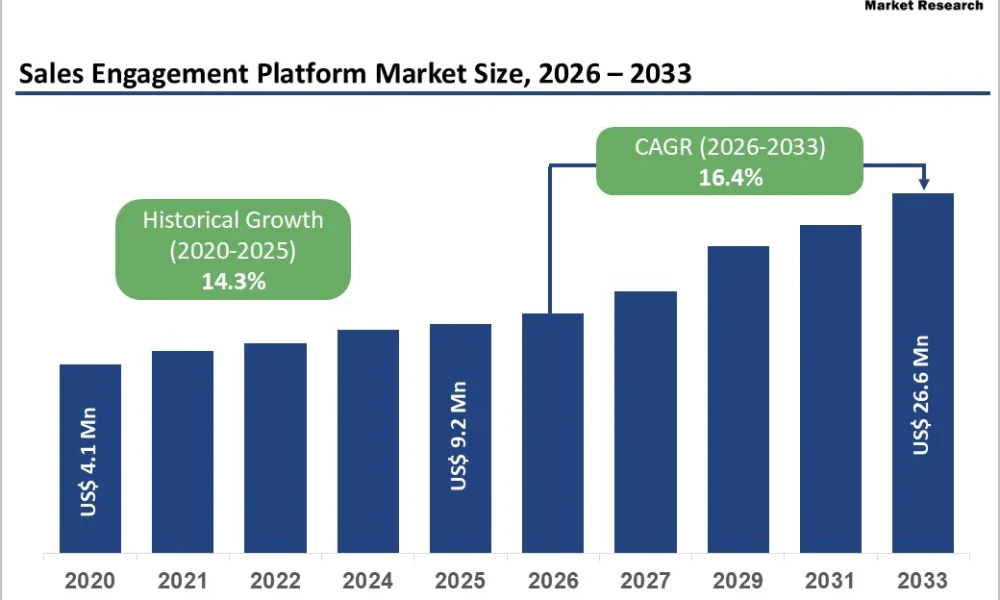
The global Sales Engagement Platform Market is poised for rapid expansion as organizations modernize revenue operations and embrace AI-driven sales strategies. The market is likely to be valued at US$ 9.2 billion in 2026 and is projected to reach US$ 26.6 billion by 2033, growing at a robust CAGR of 16.4% between 2026 and 2033.
This accelerated growth reflects a broader transformation in how enterprises approach customer acquisition, lead nurturing, and revenue generation. In an increasingly digital-first environment, traditional sales workflows are being replaced by intelligent automation platforms that combine communication tools, CRM integration, analytics, and artificial intelligence to drive measurable productivity gains.
With 75% of sales teams already utilizing sales engagement technologies—and companies reporting a 25% average increase in productivity and 15% revenue growth—the adoption curve continues to steepen across industries.
What Is a Sales Engagement Platform?
A sales engagement platform (SEP) is a technology solution designed to streamline, automate, and optimize interactions between sales teams and prospects across multiple communication channels.
Core capabilities include:
- Automated email sequencing
- Call tracking and analytics
- CRM synchronization
- Workflow automation
- AI-powered lead scoring
- Performance analytics dashboards
- Omnichannel engagement (email, phone, LinkedIn, SMS)
Unlike standalone CRM systems, SEPs focus specifically on outbound and inbound engagement execution, helping teams systematically manage outreach at scale while maintaining personalization.
Leading vendors such as Salesforce, HubSpot, and Outreach are expanding AI capabilities to enhance automation and customer insights.
Elevate your business strategy with comprehensive market data. Request a sample report now: https://www.persistencemarketresearch.com/samples/31562
Market Growth Drivers
- Rising Demand for Sales Automation
Organizations are under constant pressure to increase revenue without proportionally expanding headcount. Sales engagement platforms automate repetitive tasks such as:
- Email follow-ups
- Appointment scheduling
- Lead prioritization
- CRM updates
Automation reduces administrative workload and enables sales representatives to focus on relationship-building and closing deals.
Companies leveraging structured engagement tools report significant improvements in pipeline velocity and conversion rates.
- AI-Driven Personalization and Predictive Insights
Artificial intelligence is redefining sales execution. AI-enabled platforms analyze behavioral data, communication patterns, and engagement metrics to recommend optimal outreach timing and messaging.
By 2026, 60% of organizations are expected to adopt AI-enabled sales engagement solutions to improve:
- Predictive forecasting
- Personalized communication
- Next-best-action recommendations
- Deal risk identification
Platforms integrated with AI engines such as those offered by Microsoft and Google are enabling advanced analytics that improve targeting accuracy.
This shift toward intelligent selling is one of the strongest long-term growth catalysts.
- Digital Transformation Initiatives
Enterprises worldwide are investing heavily in digital transformation, including modernization of customer-facing operations. Government-backed digitalization programs in countries such as United States, India, and Singapore are accelerating adoption of cloud-based enterprise technologies.
Sales engagement platforms play a crucial role in:
- Standardizing sales workflows
- Ensuring data-driven decision-making
- Enabling remote and hybrid workforces
- Improving revenue predictability
In competitive markets, digitally empowered sales operations are becoming a strategic differentiator.
- Expansion of IT & Telecom Sector
The IT and telecommunications sector is expected to grow at a CAGR of 16.7% from 2026 to 2033, driving additional demand for advanced sales tools.
With 5G deployment, SaaS growth, and enterprise IT modernization, telecom and tech vendors require highly scalable sales automation to manage complex B2B pipelines.
Regional Analysis
North America: Market Leader
North America holds approximately 38% of the global market share in 2025, supported by:
- Early technology adoption
- Strong enterprise presence
- Active venture capital ecosystem
- High CRM penetration rates
The region benefits from established SaaS ecosystems and leading vendors headquartered in the United States.
The maturity of sales technology adoption and strong integration with CRM systems continue to sustain market leadership.
Asia Pacific: Fastest-Growing Region
Asia Pacific is projected to grow at a 17.2% CAGR through 2032, making it the fastest-growing region.
Growth drivers include:
- Rapid economic expansion
- Government-led digitalization programs
- Growing SME ecosystem
- Increased cloud adoption
Countries such as China, India, and Australia are witnessing increased adoption of cost-efficient, cloud-based sales engagement solutions.
SMEs in these regions are increasingly investing in scalable SaaS platforms to compete with established enterprises.
Europe
Europe’s growth is driven by rising SaaS penetration, GDPR-compliant cloud infrastructure, and expanding digital commerce ecosystems.
Industries such as fintech, e-commerce, and enterprise IT services are major contributors.
Segment Analysis
Deployment Model: Cloud Dominance
Cloud-based deployment leads with 58% market share in 2025, driven by:
- Scalability
- Lower upfront investment
- Seamless CRM integration
- Remote workforce compatibility
- Continuous feature upgrades
Cloud platforms reduce infrastructure complexity while enabling real-time collaboration across geographically distributed sales teams.
Organization Size: SMEs as Fastest-Growing Segment
Small and Medium Enterprises (SMEs) represent the fastest-growing user segment, projected to grow at an 18.5% CAGR through 2032.
Contributing factors include:
- Affordable subscription models
- User-friendly interfaces
- Managed implementation services
- Demonstrated revenue uplift
Cloud-native platforms eliminate the need for heavy IT infrastructure, making advanced sales automation accessible to mid-market and smaller firms.
Key Opportunity: Artificial Intelligence Integration
Artificial intelligence represents the most transformative opportunity in the market.
AI-enabled capabilities include:
- Real-time call sentiment analysis
- Automated content optimization
- Dynamic sequence adjustments
- Revenue forecasting enhancements
- Conversational intelligence
As predictive analytics improves, AI will shift sales engagement from reactive outreach to proactive, data-driven strategy.
The convergence of AI and engagement automation will redefine performance metrics across industries.
Competitive Landscape
The sales engagement platform market is highly competitive, characterized by:
- Continuous feature innovation
- Strategic acquisitions
- CRM ecosystem partnerships
- Expansion into adjacent revenue intelligence tools
Leading vendors are focusing on:
- Deep CRM integration
- Embedded analytics
- API extensibility
- Enhanced security compliance
Integration with platforms like LinkedIn and enterprise CRM ecosystems enhances omnichannel engagement capabilities.
Venture funding continues to support emerging startups focused on AI-driven differentiation.
Challenges and Market Restraints
Despite strong growth prospects, several challenges exist:
- Data privacy and compliance complexities
- Integration challenges with legacy systems
- User adoption and change management hurdles
- Rising competition and feature commoditization
However, continuous innovation and measurable ROI outcomes are expected to sustain demand momentum.
Future Outlook (2026–2033)
Over the forecast period, the market will be shaped by:
- Expansion of AI-native sales platforms
- Hyper-personalized engagement workflows
- Integration of conversational AI
- Increased automation across full revenue cycles
- Alignment of sales, marketing, and customer success systems
Organizations will increasingly view sales engagement platforms not merely as communication tools but as strategic revenue engines.
The convergence of CRM, AI, and workflow automation will define next-generation sales infrastructure.
Conclusion
The global sales engagement platform market is set to expand from US$ 9.2 billion in 2026 to US$ 26.6 billion by 2033, at a strong 16.4% CAGR.
North America leads in market share, while Asia Pacific emerges as the fastest-growing region. Cloud deployment dominates, and SMEs represent the most rapidly expanding user base.
Artificial intelligence integration stands out as the most significant growth opportunity, enabling predictive insights, workflow automation, and personalization at scale.
As organizations compete in digital-first business environments, sales engagement platforms are evolving into indispensable tools for productivity, revenue acceleration, and sustainable competitive advantage.
Related Reports:




