
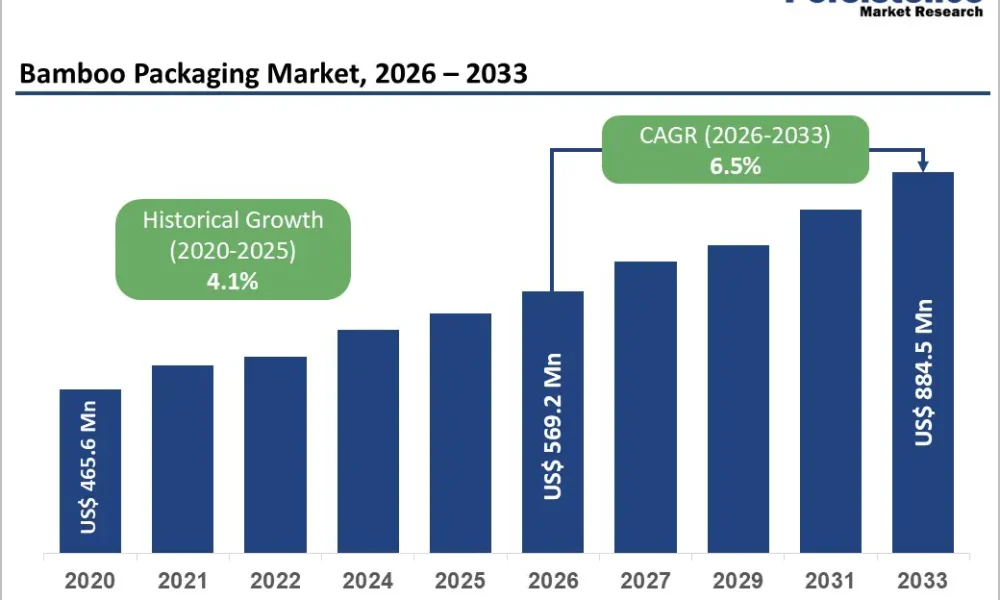
According to Persistence Market Research, the global Bamboo Packaging Market is projected to witness steady expansion, supported by the growing transition toward renewable and biodegradable packaging materials. The market size is likely to be valued at US$ 569.2 million in 2026 and is expected to reach US$ 884.5 million by 2033. This growth reflects the accelerating substitution of plastic based packaging with renewable fiber alternatives across food and beverage, cosmetics, electronics, and select industrial applications. The Bamboo Packaging Market is gaining traction as brands prioritize sustainability commitments and carbon footprint reduction strategies.
The market is anticipated to expand at a CAGR of 6.5% between 2026 and 2033, driven by increasing regulatory pressure against single use plastics and rising consumer awareness regarding eco friendly packaging solutions. Bamboo packaging offers durability, biodegradability, and renewability, making it an attractive alternative to petroleum based materials. Food and beverage companies represent a leading segment due to demand for compostable trays, containers, and wraps, while Asia Pacific remains a prominent geographical region owing to abundant bamboo resources and established manufacturing ecosystems.
One Click to Access Your Free Sample Report : https://www.persistencemarketresearch.com/samples/36078
Key Highlights from the Report
➤ The Bamboo Packaging Market is forecast to grow from US$ 569.2 million in 2026 to US$ 884.5 million by 2033 at a CAGR of 6.5%.
➤ Rapid substitution of plastic based packaging with renewable fiber solutions is a major long term industry transformation trend.
➤ Food and beverage applications represent the leading segment due to demand for sustainable takeaway and retail packaging.
➤ Cosmetics and personal care brands are increasingly adopting bamboo packaging for premium sustainable positioning.
➤ Asia Pacific leads the global market owing to raw material availability and cost efficient processing capabilities.
➤ Increasing adoption across electronics and select industrial applications is expanding the application scope of bamboo packaging.
Market Segmentation
The Bamboo Packaging Market can be segmented based on product type and end use industry. In terms of product type, the market includes bamboo based trays, containers, boxes, wraps, and molded pulp solutions. Molded bamboo fiber products are witnessing notable growth due to their structural strength and compostable nature. Rigid bamboo packaging is widely used in cosmetics and electronics to enhance product aesthetics and sustainability credentials. Flexible bamboo based materials are gaining acceptance in food packaging where lightweight and biodegradable characteristics are prioritized.
Based on end user industries, the market is segmented into food and beverage, cosmetics and personal care, electronics, and industrial applications. The food and beverage segment leads due to strong demand for eco friendly takeaway containers and retail packaging formats. Cosmetics brands are integrating bamboo packaging to reinforce clean beauty narratives and environmentally responsible branding. Electronics manufacturers are also exploring bamboo based cushioning and protective packaging as part of broader sustainability strategies. Industrial applications are gradually adopting bamboo packaging for specialized uses where renewable materials are required.
Get Custom Insights Designed for Your Business : https://www.persistencemarketresearch.com/request-customization/36078
Regional Insights
Asia Pacific holds a dominant position in the Bamboo Packaging Market, supported by abundant bamboo cultivation and established supply chains. Countries within the region benefit from raw material proximity, lower production costs, and a growing domestic demand for sustainable packaging solutions. The presence of numerous small and medium enterprises engaged in bamboo processing further strengthens regional manufacturing capabilities. Increasing environmental regulations and export oriented packaging demand are contributing to sustained regional growth.
North America and Europe are also important markets driven by regulatory initiatives to reduce plastic waste and strong consumer preference for sustainable alternatives. Brands in these regions are integrating bamboo packaging to align with circular economy goals and corporate sustainability targets. Retailers are increasingly mandating environmentally responsible packaging standards, encouraging suppliers to transition toward renewable fiber solutions. Growing awareness about compostable packaging options is further supporting market expansion across developed economies.
Market Drivers
The primary driver of the Bamboo Packaging Market is the accelerating shift away from plastic based packaging materials. Governments worldwide are implementing regulations that restrict single use plastics, encouraging industries to adopt biodegradable and renewable alternatives. Bamboo, as a rapidly renewable resource, offers environmental advantages such as carbon sequestration and reduced reliance on fossil fuels. Companies are leveraging bamboo packaging to meet sustainability benchmarks and strengthen brand reputation. This regulatory and corporate alignment is significantly boosting demand.
Another key driver is rising consumer awareness regarding environmental sustainability. Modern consumers are increasingly evaluating packaging materials before making purchasing decisions, particularly in food, beverage, and personal care products. Brands adopting bamboo packaging gain competitive differentiation and premium positioning in eco conscious segments. Furthermore, bamboo based materials provide strength, lightweight properties, and aesthetic appeal, enhancing functional and visual value. Expanding applications across electronics and industrial sectors are further reinforcing demand growth.
Market Restraints
Despite positive growth prospects, the Bamboo Packaging Market faces certain restraints. One major challenge is the cost structure associated with bamboo processing and conversion into packaging materials. Compared to conventional plastic packaging, bamboo based solutions may involve higher production costs due to specialized manufacturing techniques. Small scale producers may struggle to achieve economies of scale, impacting price competitiveness in cost sensitive markets.
Another restraint relates to supply chain and raw material variability. Although bamboo is abundant in certain regions, supply inconsistencies and transportation logistics can affect global distribution. Additionally, standardization and quality consistency remain challenges, particularly in export oriented markets. Limited awareness in some developing regions regarding bamboo packaging performance characteristics may also slow adoption rates. Overcoming these operational and perception barriers is critical for sustained expansion.
Market Opportunities
The Bamboo Packaging Market presents significant opportunities in premium and luxury product segments. Cosmetics and personal care brands are increasingly integrating bamboo packaging to enhance eco friendly brand identity. Bamboo offers natural aesthetics and durability, making it suitable for high value packaging formats. As sustainability becomes central to brand storytelling, bamboo packaging can command higher margins and strengthen consumer loyalty. This premiumization trend creates new revenue streams.
Another major opportunity lies in technological innovation and product diversification. Advancements in molded fiber processing and composite material development can enhance performance characteristics of bamboo packaging. Expanding into electronics cushioning, industrial protective packaging, and customized solutions can broaden application areas. Growing collaboration between packaging manufacturers and global brands can accelerate market penetration. With a projected CAGR of 6.5% between 2026 and 2033, innovation driven expansion remains a strong growth avenue.
Checkout Now & Download Complete Market Report : https://www.persistencemarketresearch.com/checkout/36078
Company Insights
Key players operating in the Bamboo Packaging Market include
- Smurfit Kappa Group
- International Paper Company
- Amcor plc
- WestRock Company
- DS Smith plc
- Stora Enso Oyj
- Mondi plc
- Huhtamaki Oyj
- ProAmpac
- Sonoco Products Company
- Billerud AB
- Nippon Paper Industries Co., Ltd.
- Oji Holdings Corporation
- Georgia-Pacific LLC
- Nine Dragons Paper Holdings Limited
- MOSO International B.V.
- Bambrew
- EcoPlanet Bamboo
These companies focus on product innovation, sustainability certifications, and expansion of manufacturing capabilities to strengthen market presence.
Recent Developments
In March 2024, leading bamboo packaging manufacturers expanded production capacity to meet rising demand from food and beverage companies.
In October 2023, several market participants introduced advanced molded bamboo fiber packaging solutions targeting cosmetics and electronics applications.
Future Opportunities and Growth Prospects
The Bamboo Packaging Market is poised for sustained growth as industries intensify their transition toward renewable fiber alternatives. Rising demand from food and beverage, cosmetics, electronics, and industrial applications will continue to shape market dynamics. With a projected value of US$ 884.5 million by 2033 and steady expansion at a CAGR of 6.5%, the market reflects strong alignment with global sustainability trends. Strategic investments in innovation, supply chain efficiency, and regional expansion are expected to unlock new avenues for long term growth.




