
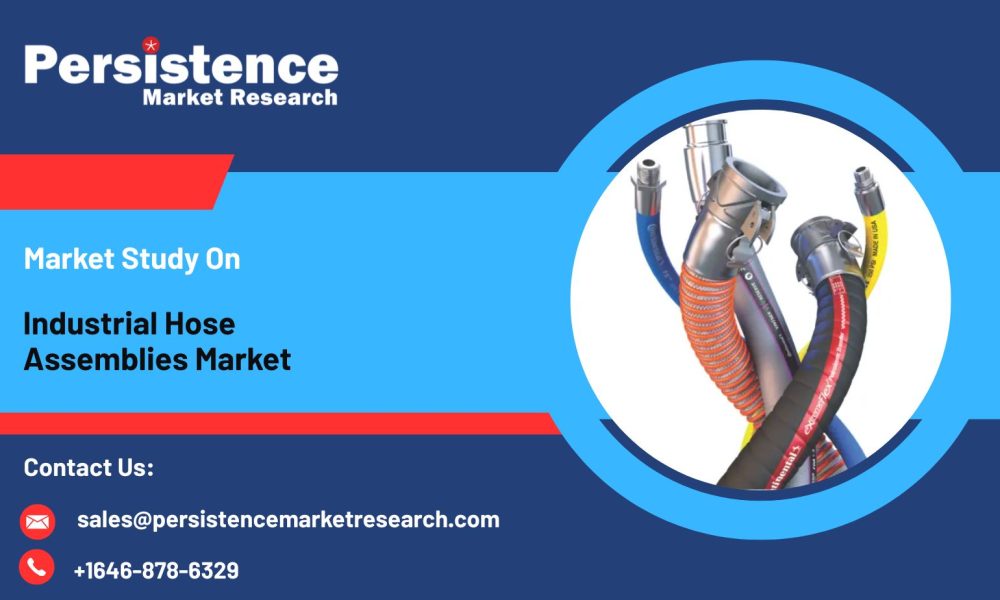
The global industrial hose assemblies market is on a steady growth trajectory, reflecting the expanding footprint of heavy industries and the increasing need for safe, reliable fluid transfer solutions. The market is likely to be valued at US$ 22.2 billion in 2025 and is projected to reach US$ 31.4 billion by 2032, registering a CAGR of 5.1% during the forecast period. Industrial hose assemblies—comprising hoses, fittings, couplings, and reinforcement layers—are critical components in fluid conveyance systems used for transferring liquids, gases, slurries, and granular materials under varying pressure and temperature conditions. These assemblies are widely deployed across oil & gas, chemical processing, construction, mining, food and beverage, pharmaceuticals, and automotive manufacturing sectors. Rising industrial output, infrastructure development, and modernization of process plants are key contributors to market expansion.
The leading segment in the industrial hose assemblies market is hydraulic hose assemblies, owing to their extensive application in heavy machinery, construction equipment, and industrial automation systems. Their ability to withstand high pressure, abrasion, and extreme temperatures makes them indispensable in demanding operational environments. Geographically, Asia Pacific dominates the market due to rapid industrialization, large-scale infrastructure projects, and expanding manufacturing capabilities in countries such as China, India, and Southeast Asian nations. Strong investments in oil refining, petrochemical complexes, and industrial automation technologies further reinforce regional demand. Meanwhile, North America and Europe continue to exhibit stable growth, supported by advanced manufacturing ecosystems and replacement demand for high-performance hose systems.
Key Highlights from the Report
• The industrial hose assemblies market is projected to grow from US$ 22.2 billion in 2025 to US$ 31.4 billion by 2032 at a CAGR of 5.1%.
• Hydraulic hose assemblies account for the largest revenue share due to widespread use in heavy equipment and industrial automation.
• Asia Pacific leads the global market, driven by rapid industrialization and infrastructure expansion.
• Oil & gas and chemical industries remain the primary end-users of high-performance hose assemblies.
• Advancements in abrasion-resistant and temperature-tolerant materials are enhancing product durability and lifespan.
• Growing emphasis on operational efficiency and safety compliance is accelerating adoption across industries.
𝐃𝐨𝐰𝐧𝐥𝐨𝐚𝐝 𝐅𝐫𝐞𝐞 𝐒𝐚𝐦𝐩𝐥𝐞 & 𝐂𝐡𝐞𝐜𝐤 𝐭𝐡𝐞 𝐋𝐚𝐭𝐞𝐬𝐭 𝐌𝐚𝐫𝐤𝐞𝐭 𝐀𝐧𝐚𝐥𝐲𝐬𝐢𝐬: https://www.persistencemarketresearch.com/samples/35882
Market Segmentation Analysis
The industrial hose assemblies market is segmented by product type, material type, pressure rating, end-use industry, and distribution channel. By product type, the market includes hydraulic hose assemblies, industrial hose assemblies for water and air transfer, chemical hose assemblies, steam hose assemblies, and specialty hoses designed for abrasive or corrosive materials. Hydraulic hose assemblies dominate the market due to their critical role in transmitting power within machinery and industrial equipment. Chemical hose assemblies are also witnessing growing demand as industries handle increasingly complex and hazardous substances requiring chemical-resistant linings.
Material-based segmentation includes rubber, thermoplastic, PTFE (polytetrafluoroethylene), silicone, and composite materials. Rubber hose assemblies continue to hold a substantial share due to flexibility, cost-effectiveness, and resilience under moderate pressure. However, thermoplastic and PTFE hoses are gaining traction in high-pressure and high-temperature applications where enhanced chemical resistance and low permeability are essential. The shift toward high-performance materials is enabling longer service life and reduced maintenance costs.
By pressure rating, hose assemblies are classified into low-pressure, medium-pressure, and high-pressure systems. High-pressure hose assemblies are particularly crucial in oil & gas drilling operations, mining, and heavy construction machinery. These systems must meet stringent safety standards and performance specifications to prevent leakage and operational downtime.
End-use segmentation includes oil & gas, chemicals, construction, mining, food and beverage, pharmaceuticals, automotive, agriculture, and power generation. The oil & gas sector remains the largest consumer due to its reliance on fluid transfer systems for exploration, drilling, refining, and transportation processes. The food and beverage industry also represents a growing segment, with increasing emphasis on sanitary hose assemblies that comply with hygiene and safety regulations.
Distribution channels are divided into direct sales and distributor networks. Large industrial clients often procure customized hose assemblies directly from manufacturers, while small and medium enterprises rely on regional distributors for standard configurations and quick replacements.
𝐆𝐞𝐭 𝐚 𝐂𝐮𝐬𝐭𝐨𝐦𝐢𝐳𝐞𝐝 𝐌𝐚𝐫𝐤𝐞𝐭 𝐕𝐢𝐞𝐰 𝐢𝐧 𝐎𝐧𝐞 𝐂𝐥𝐢𝐜𝐤 : https://www.persistencemarketresearch.com/request-customization/35882
Regional Insights
Asia Pacific leads the industrial hose assemblies market, supported by expanding industrial production and significant infrastructure development. China’s dominance in manufacturing and India’s growing construction and petrochemical sectors contribute substantially to regional demand. Government initiatives aimed at strengthening domestic manufacturing capabilities further stimulate the adoption of industrial fluid transfer systems.
North America represents a mature market characterized by technological advancements and strict regulatory standards. The United States remains a key contributor, driven by shale gas exploration, industrial automation upgrades, and strong presence of automotive manufacturing. Replacement demand and retrofitting of aging infrastructure also support market growth.
Europe holds a considerable market share due to advanced engineering capabilities and emphasis on safety compliance. Germany, France, and the United Kingdom are major consumers of industrial hose assemblies, particularly in chemical processing and automotive industries. Sustainability initiatives and energy efficiency measures are influencing product development trends in the region.
Latin America and the Middle East & Africa are emerging markets with promising growth prospects. Expansion of oil extraction activities in the Middle East and infrastructure development projects in Latin America are boosting demand for durable hose assemblies capable of operating in extreme environmental conditions.
Market Drivers
The primary driver of the industrial hose assemblies market is the increasing demand from oil & gas, chemical processing, and construction industries. These sectors rely heavily on safe and efficient fluid transfer systems to maintain operational continuity. Industrial hose assemblies are designed to handle high pressure, corrosive substances, and extreme temperatures, making them essential components in critical applications. Rising investments in industrial automation and process optimization are further fueling demand, as modern machinery requires reliable hydraulic and pneumatic systems.
Infrastructure development projects worldwide are another significant growth catalyst. Large-scale construction activities, mining operations, and agricultural modernization initiatives require heavy equipment equipped with advanced hose assemblies. Additionally, the push toward energy efficiency and emission reduction is encouraging industries to upgrade to high-performance hose systems that minimize leakage and improve system reliability.
Market Restraints
Despite steady growth, the industrial hose assemblies market faces certain challenges. Fluctuating raw material prices, particularly rubber and petroleum-based polymers, can impact manufacturing costs and profit margins. Volatility in oil prices also influences capital expenditure in the oil & gas sector, potentially affecting demand for new hose installations.
Stringent regulatory requirements and certification standards can increase compliance costs for manufacturers. Ensuring compatibility with various industrial chemicals and meeting safety standards requires continuous research and development investment. Additionally, competition from alternative fluid transfer solutions, such as rigid piping systems in certain applications, may limit growth in specific segments.
Maintenance and replacement cycles also pose operational challenges. Hose assemblies are subject to wear and tear due to pressure fluctuations and environmental exposure, necessitating periodic inspection and replacement. Failure to maintain systems can result in safety hazards and downtime, creating operational complexities for end-users.
Market Opportunities
The industrial hose assemblies market presents substantial opportunities through material innovation and customization. The development of lightweight, high-strength composite materials enhances performance while reducing overall system weight. Advanced reinforcement technologies, such as braided steel wire and synthetic fiber reinforcement, are improving pressure tolerance and durability.
Growth in renewable energy projects, including wind and solar installations, offers new application areas for specialized hose assemblies. Expansion of electric vehicle manufacturing also creates demand for advanced cooling and fluid management systems. Furthermore, the integration of smart monitoring technologies into hose assemblies allows real-time performance tracking and predictive maintenance, reducing downtime and improving safety.
Emerging markets with expanding industrial bases represent untapped growth potential. Investments in manufacturing hubs, logistics infrastructure, and energy projects in Asia, Africa, and Latin America are expected to generate sustained demand for industrial hose systems.
𝐁𝐮𝐲 𝐍𝐨𝐰 𝐭𝐡𝐞 𝐃𝐞𝐭𝐚𝐢𝐥𝐞𝐝 𝐑𝐞𝐩𝐨𝐫𝐭: https://www.persistencemarketresearch.com/checkout/35882
Company Insights
Key players operating in the global industrial hose assemblies market include:
• Parker Hannifin Corporation
• Eaton Corporation plc
• Gates Corporation
• Continental AG
• Trelleborg AB
• Kuriyama of America, Inc.
• Manuli Hydraulics
• RYCO Hydraulics
• Alfagomma S.p.A.
• Colex International Limited
These companies focus on product innovation, geographic expansion, and strategic partnerships to strengthen their competitive positions. Investment in advanced manufacturing techniques and digital integration is shaping the next generation of hose assemblies.
Recent developments in the market include the introduction of high-temperature-resistant hydraulic hose assemblies designed for extreme industrial environments. Additionally, several manufacturers have launched eco-friendly hose products incorporating recyclable materials to align with sustainability goals and reduce environmental impact.
Conclusion
The industrial hose assemblies market is positioned for stable and sustained growth through 2032, supported by rising demand from oil & gas, chemical, construction, and manufacturing sectors. With the market projected to grow from US$ 22.2 billion in 2025 to US$ 31.4 billion by 2032 at a CAGR of 5.1%, hose assemblies remain indispensable components in industrial fluid transfer systems. Hydraulic hose assemblies dominate the market due to their extensive use in heavy machinery and automation applications, while Asia Pacific leads geographically due to rapid industrial expansion. Although challenges such as raw material price volatility and regulatory compliance persist, opportunities in material innovation, smart monitoring technologies, and renewable energy projects provide strong growth prospects. As industries continue to prioritize safety, efficiency, and reliability, industrial hose assemblies will remain central to modern industrial infrastructure worldwide.




