
The North America Postal Services Market is undergoing structural transformation as evolving consumer habits reshape logistics demand and service delivery models. According to Persistence Market Research, postal operators are transitioning from traditional mail delivery toward integrated logistics and parcel-focused solutions. Digital substitution has reduced conventional letter volumes, while parcel delivery demand has accelerated due to online retail growth. Postal providers are now investing in automation, route optimization, and tracking technologies to maintain operational efficiency. These changes are redefining the role of postal organizations, positioning them as essential logistics partners supporting digital commerce. The market continues to balance legacy mail services with modern logistics innovations, ensuring continuity while adapting to rapidly shifting business and consumer requirements.
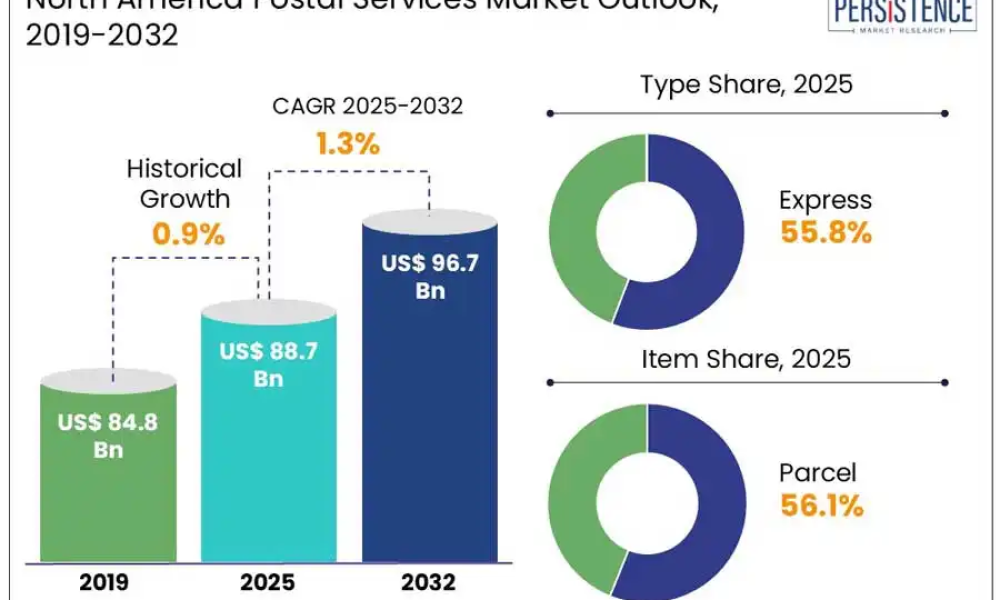
The North America postal services market size is projected to rise from US$ 88.7 bn in 2025 to US$ 96.7 bn by 2032, reflecting steady expansion despite structural shifts. The market is anticipated to witness a CAGR of 1.3% by 2032, driven primarily by parcel volume growth linked to e-commerce activity. The decline in traditional mail is partially offset by increased demand for reliable last-mile delivery solutions. Postal operators are leveraging their extensive delivery networks to remain competitive and relevant. Investments in automation, digital tracking systems, and logistics infrastructure are helping providers improve delivery accuracy and efficiency. The market’s growth trajectory reflects gradual adaptation rather than rapid expansion, emphasizing resilience and long-term sustainability across North America.
Get Your FREE Sample Report Instantly Click Now: https://www.persistencemarketresearch.com/samples/35254
The key players studied in the report include:
- USPS
- Canada Post Corporation
- UPS
- DHL
- FedEX
- Purolator
- Estafeta
- Correos de Mexico
- GLS
- APC Postal Logistics
- Paquetexpress
- Grenada Postal Corporation
- Santa Lucia Post
- Others
Key Highlights from the Report
➤ Rising parcel volumes are reshaping operational priorities across North America postal service providers
➤ E-commerce expansion continues driving demand for last-mile delivery and logistics integration solutions
➤ Digital communication trends are accelerating the decline of traditional mail service volumes
➤ Technology adoption is improving delivery efficiency, accuracy, and customer experience across networks
➤ Postal organizations are diversifying services to remain competitive in evolving logistics environments
➤ Integrated logistics and parcel delivery solutions are emerging as core revenue growth drivers
Market Segmentation
By Type
- Express
- Standard
By Item
- Letter
- Parcel
By Destination
- Domestic
- International
By Country
- U.S.
- Canada
Regional Insights
The United States dominates the North America Postal Services Market due to its extensive logistics infrastructure and strong e-commerce ecosystem. High consumer participation in online retail has significantly increased parcel delivery volumes nationwide. Postal providers benefit from established delivery routes, advanced sorting facilities, and large customer bases. Continuous investments in automation and digital delivery systems further enhance operational performance. The country’s vast geography and population density create consistent demand for efficient postal services. These factors collectively reinforce its leadership position within the regional postal services landscape.
Canada represents another important market driven by growing parcel demand and expanding logistics networks. Postal providers in Canada are adapting to changing consumer expectations and increasing digital commerce activity. Rural and remote delivery requirements create unique operational challenges, encouraging innovation and infrastructure development. Investments in technology and service diversification are improving delivery reliability and efficiency. Canada’s evolving logistics environment supports steady market growth while complementing broader North American postal services development and modernization efforts.
Customize This Report for Your Exact Requirements: https://www.persistencemarketresearch.com/request-customization/35254
Market Drivers
One of the primary drivers of the North America Postal Services Market is the rapid expansion of e-commerce, which has significantly increased parcel shipment volumes. Consumers increasingly prefer online shopping due to convenience, product variety, and competitive pricing. This shift has created strong demand for reliable last-mile delivery solutions. Postal operators benefit from established nationwide delivery networks capable of handling diverse logistics requirements. Their accessibility and coverage enable efficient delivery to urban and rural locations. E-commerce growth continues strengthening postal services relevance, ensuring sustained demand for parcel logistics solutions.
Another key driver is the adoption of advanced technologies aimed at improving operational efficiency and service quality. Postal providers are implementing automated sorting systems, digital tracking platforms, and route optimization tools. These innovations help reduce delivery times, enhance accuracy, and improve customer satisfaction. Technology integration also enables better resource allocation and cost management. By modernizing infrastructure and embracing digital transformation, postal operators enhance their competitiveness. This technological shift supports long-term operational sustainability and reinforces their role within the evolving logistics ecosystem.
Market Restraints
The decline in traditional mail volumes remains a major restraint affecting postal service providers. Digital communication methods, including email and electronic billing, have significantly reduced reliance on physical mail. Businesses and consumers increasingly prefer digital alternatives due to speed, convenience, and cost efficiency. This trend has weakened revenue streams associated with traditional mail delivery. Postal organizations must compensate for this decline by expanding parcel and logistics services. Adapting to changing communication habits remains essential for maintaining financial stability and operational relevance.
Operational cost pressures also present challenges for postal service providers across North America. Maintaining extensive delivery networks requires substantial investments in infrastructure, workforce, and transportation. Rising operational expenses can affect profitability, particularly in regions with lower delivery density. Postal organizations must balance service quality with cost efficiency. Strategic planning, process optimization, and technology adoption are necessary to address these challenges. Managing operational costs effectively is critical for ensuring long-term sustainability and competitiveness.
Market Opportunities
The growing demand for integrated logistics solutions presents significant opportunities for postal service providers. By expanding beyond traditional mail services, operators can offer value-added logistics capabilities such as warehousing and parcel management. This diversification helps strengthen revenue streams and improve customer retention. Postal providers can leverage their extensive delivery networks to offer comprehensive logistics support. These services enhance competitiveness and align with evolving market demands. Expanding logistics capabilities supports long-term growth and operational resilience.
Technology adoption also creates opportunities for improving efficiency and customer satisfaction. Automation, digital tracking, and data analytics enable postal providers to optimize operations and enhance delivery performance. These technologies support faster processing and accurate shipment tracking. Improved transparency enhances customer trust and service reliability. Continued investment in innovation enables postal operators to remain competitive. Technological advancements will play a central role in shaping future postal services market evolution.
Recent Developments
- In March 2024, United States Postal Service announced expanded automation initiatives to improve parcel sorting efficiency.
- In June 2024, Canada Post introduced enhanced parcel tracking solutions to strengthen delivery transparency and customer experience.
Ready to Dive Deep? Buy Full Report Today: https://www.persistencemarketresearch.com/checkout/35254
Frequently Asked Questions
➤ What are the main factors influencing the North America Postal Services Market growth?
➤ Which companies are the major sources in the North America Postal Services Market industry?
➤ What are the market’s opportunities, risks, and general structure in this sector?
➤ Which top North America Postal Services Market companies compare in terms of services and expansion?
➤ How are market types and applications influencing revenue in the North America Postal Services Market?
Future Opportunities and Growth Prospects
The future of the North America Postal Services Market will be shaped by logistics innovation, automation, and evolving consumer expectations. Postal providers are expected to strengthen parcel delivery capabilities while modernizing infrastructure. Continued growth in digital commerce will sustain demand for efficient logistics solutions. Service diversification, technology integration, and operational optimization will remain critical strategies. These factors will support steady growth, enhance service efficiency, and ensure long-term competitiveness across the regional postal services ecosystem.




