
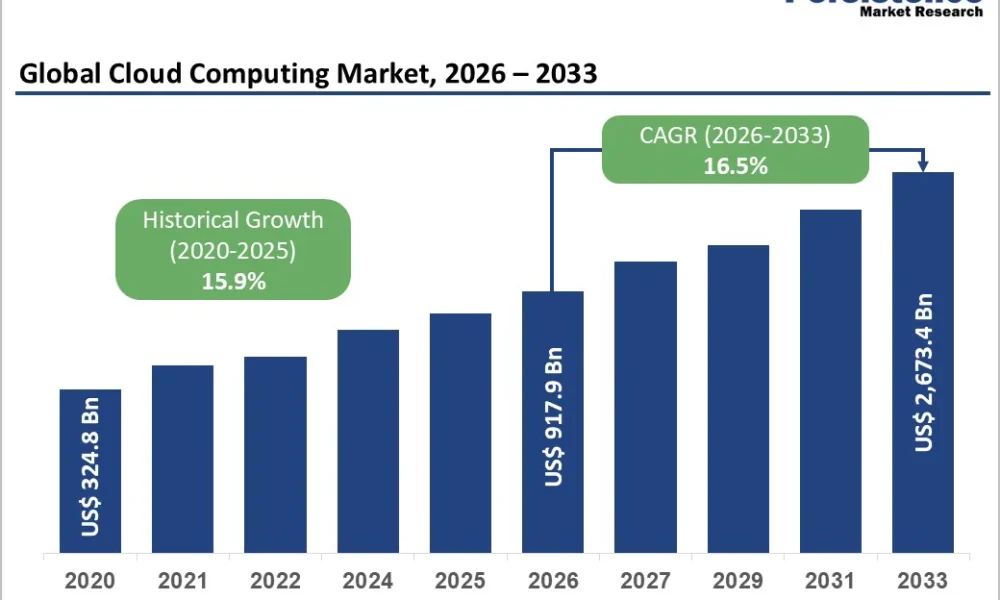
The global cloud computing market is entering a phase of unprecedented expansion. Valued at US$ 917.9 billion in 2026, the market is projected to reach US$ 2,673.4 billion by 2033, growing at a remarkable CAGR of 16.5% during the forecast period. This growth builds on a strong historical CAGR of 15.9% between 2020 and 2025, signaling sustained enterprise confidence in cloud-based infrastructure.
Cloud computing has evolved from a cost-optimization tool into the backbone of digital transformation. Enterprises across industries are re-architecting their IT ecosystems around public, private, and hybrid cloud environments to support artificial intelligence (AI), machine learning (ML), real-time analytics, and high-performance workloads.
From banking transactions and healthcare diagnostics to smart manufacturing and retail personalization, cloud infrastructure is now central to modern business operations.
Market Overview and Key Highlights
The rapid expansion of cloud computing is driven by enterprise modernization, legacy system migration, hybrid workforce enablement, and AI-driven workload acceleration.
Key Market Insights (2026–2033):
- Market Size (2026E): US$ 917.9 Billion
- Forecast Value (2033F): US$ 2,673.4 Billion
- Projected CAGR (2026–2033): 16.5%
- Leading Region (2026): North America (39% market share)
- Fastest-Growing Region: Asia Pacific
- Leading Deployment Type: Public Cloud (55% share)
- Leading Service Type: SaaS (54%+ revenue share)
- Leading End-user: BFSI (28% share)
Cloud is no longer optional infrastructure—it is strategic infrastructure.
Market Drivers: Digital Transformation and AI Acceleration
- Enterprise Digital Transformation
Organizations are replacing rigid on-premises infrastructure with agile cloud environments to improve scalability, performance, and cost efficiency.
Industries such as BFSI, IT & telecom, manufacturing, retail, and healthcare are migrating critical workloads to public and hybrid clouds to:
- Modernize legacy systems
- Enable remote and hybrid work
- Enhance customer experience
- Improve operational efficiency
- Support real-time analytics
The shift toward SaaS-based applications and cloud-native development is further accelerating adoption.
- AI and Machine Learning Integration
AI and ML workloads are resource-intensive, requiring scalable compute, GPU clusters, high-speed storage, and global data access—capabilities best delivered via cloud infrastructure.
Cloud providers now offer:
- Specialized AI chips and TPUs
- Managed ML platforms
- Generative AI environments
- Automated model training pipelines
Enterprises are deploying AI for:
- Fraud detection in BFSI
- Predictive maintenance in manufacturing
- Customer personalization in retail
- Diagnostics in healthcare
- Supply chain optimization
The surge in generative AI adoption is significantly expanding demand for IaaS and PaaS services.
Market Barriers: Security and Compliance Complexity
Despite rapid growth, the cloud computing market faces challenges.
Data Privacy and Security Risks
Organizations handling sensitive data must address:
- Unauthorized access risks
- Multi-cloud configuration errors
- API vulnerabilities
- Encryption management complexities
Highly regulated sectors such as BFSI and healthcare remain cautious about full-scale public cloud migration.
Regulatory Compliance
Global regulations including:
- GDPR (Europe)
- CCPA (United States)
- China’s Cybersecurity Law
- HIPAA (Healthcare)
- APAC data localization rules
add compliance burdens and increase deployment complexity.
SMEs particularly struggle due to limited cybersecurity expertise.
Growth Opportunity: Edge Computing and 5G Convergence
The convergence of edge computing and 5G is reshaping cloud architecture.
With expanding 5G networks across North America, Europe, and Asia Pacific, enterprises are deploying latency-sensitive workloads closer to data sources.
Applications benefiting from edge-cloud integration include:
- Autonomous systems
- Smart factories
- IoT ecosystems
- AR/VR applications
- Real-time fraud detection
Hyperscalers such as AWS, Microsoft Azure, Google Cloud, Alibaba, and Tencent are expanding multi-access edge computing (MEC) offerings.
Cloud is transitioning from centralized infrastructure to distributed intelligence.
Elevate your business strategy with comprehensive market data. Request a sample report now: https://www.persistencemarketresearch.com/samples/34660
Deployment Type Analysis
Public Cloud: Market Leader
Public cloud is projected to account for 55% of total revenue in 2026.
Key advantages include:
- Pay-as-you-go pricing
- Global availability zones
- 99.99% uptime guarantees
- Rapid AI tool integration
Industries like BFSI and retail rely heavily on public cloud for SaaS deployment and analytics.
For example, Capital One expanded its AWS footprint to enhance fraud detection and real-time processing capabilities.
Hybrid Cloud: Fastest Growing
Hybrid cloud is gaining momentum among governments, healthcare institutions, and manufacturers seeking balance between scalability and data sovereignty.
Benefits include:
- Sensitive data retention on private infrastructure
- Flexible workload orchestration
- Reduced IT costs (up to 25%)
- Improved compliance management
Walmart’s hybrid strategy combining Azure and private data centers illustrates how enterprises optimize performance and governance simultaneously.
Service Type Insights
Software as a Service (SaaS): Market Dominance
SaaS is expected to capture over 54% of market revenue in 2026.
Enterprises favor SaaS due to:
- Subscription-based pricing
- Minimal maintenance
- Automatic updates
- Rapid deployment
Popular SaaS applications include CRM, HR systems, productivity tools, and collaboration platforms.
Salesforce’s AI-enhanced CRM solutions demonstrate SaaS’s expanding strategic importance.
Platform as a Service (PaaS): Innovation Engine
PaaS is the fastest-growing segment.
It supports:
- Cloud-native application development
- Microservices architecture
- DevOps automation
- API integrations
Spotify’s use of Google Cloud PaaS for recommendation engines highlights how PaaS accelerates innovation while reducing operational complexity.
End-user Analysis
BFSI: Largest Market Share
The BFSI sector accounts for approximately 28% of revenue in 2026.
Cloud adoption supports:
- Real-time payments
- Fraud monitoring
- Regulatory compliance
- Digital banking services
Bank of America’s multi-cloud strategy showcases how financial institutions balance performance and security.
Healthcare: Fastest-Growing Sector
Healthcare is rapidly embracing cloud due to:
- Telemedicine expansion
- Electronic health records (EHRs)
- Remote patient monitoring
- AI-powered diagnostics
Mayo Clinic’s collaboration with Google Cloud for AI diagnostics illustrates cloud’s transformative impact on patient care.
Regional Analysis
North America: Market Leader (39% Share)
North America dominates due to:
- Early technology adoption
- Strong hyperscaler presence
- Advanced cybersecurity frameworks
- AI-driven innovation
AWS, Azure, and Google Cloud maintain strong infrastructure footprints.
AI integration and hybrid strategies are key growth drivers.
Europe: Compliance-Driven Adoption
Europe is witnessing steady growth driven by:
- GDPR compliance requirements
- Industry 4.0 initiatives
- Hybrid and sovereign cloud models
Siemens’ use of AWS for smart manufacturing demonstrates the region’s shift toward cloud-enabled automation.
Asia Pacific: Fastest Growing Region
Asia Pacific is expected to record the highest CAGR.
Growth factors include:
- Rapid 5G rollout
- Mobile penetration expansion
- Government digital initiatives
- Data localization laws
China, India, and Japan are leading adoption.
Alibaba Cloud and TCS’s Azure deployments reflect accelerating regional modernization.
SMEs are increasingly adopting SaaS due to affordability and scalability.
Competitive Landscape
The global cloud computing market is moderately fragmented but dominated by major hyperscalers.
Leading Players:
- Amazon Web Services (AWS)
- Microsoft Azure
- Google Cloud
- Alibaba Cloud
- Oracle Cloud
- IBM Cloud
- Tencent
- Salesforce
- VMware
- Rackspace
- DigitalOcean
Hyperscalers compete through:
- AI and ML integration
- Data center expansion
- Vertical-specific solutions
- Hybrid and multi-cloud capabilities
- Pricing innovation
High capital requirements create significant entry barriers.
Recent Industry Developments
- Google–Anthropic Deal (October 2025): Multi-billion-dollar agreement granting Anthropic access to up to one million Google TPUs, boosting AI compute capacity.
- Koog A2A Protocol Launch (October 2025): Enabled AI agents to communicate securely across platforms using Google Cloud’s Gemini models.
These developments highlight the intersection of AI innovation and cloud infrastructure expansion.
Future Outlook: Cloud as Strategic Infrastructure
The cloud computing market is transitioning into its next evolutionary phase. AI-native infrastructure, sovereign cloud strategies, sustainability-focused data centers, and edge integration will shape the next decade.
Key future trends include:
- Green cloud initiatives and carbon-neutral data centers
- AI-driven autonomous cloud operations
- Industry-specific cloud platforms
- Zero-trust security architectures
- Expansion of sovereign and localized cloud regions
By 2033, cloud computing will not merely support digital transformation—it will define it.
Conclusion
With a projected valuation of US$ 2.67 trillion by 2033, the global cloud computing market is positioned for transformative growth.
Public cloud continues to dominate, SaaS remains the leading service model, and BFSI drives sectoral demand. Meanwhile, hybrid cloud, edge computing, AI integration, and 5G convergence are unlocking new frontiers of innovation.
North America leads in market share, Europe advances through compliance-driven modernization, and Asia Pacific accelerates as the fastest-growing region.
As enterprises deepen digital transformation efforts, cloud infrastructure will remain the central enabler of scalability, intelligence, security, and innovation in the global digital economy.
The cloud era is not just expanding—it is redefining how the world builds, operates, and competes.
Related Reports:




