
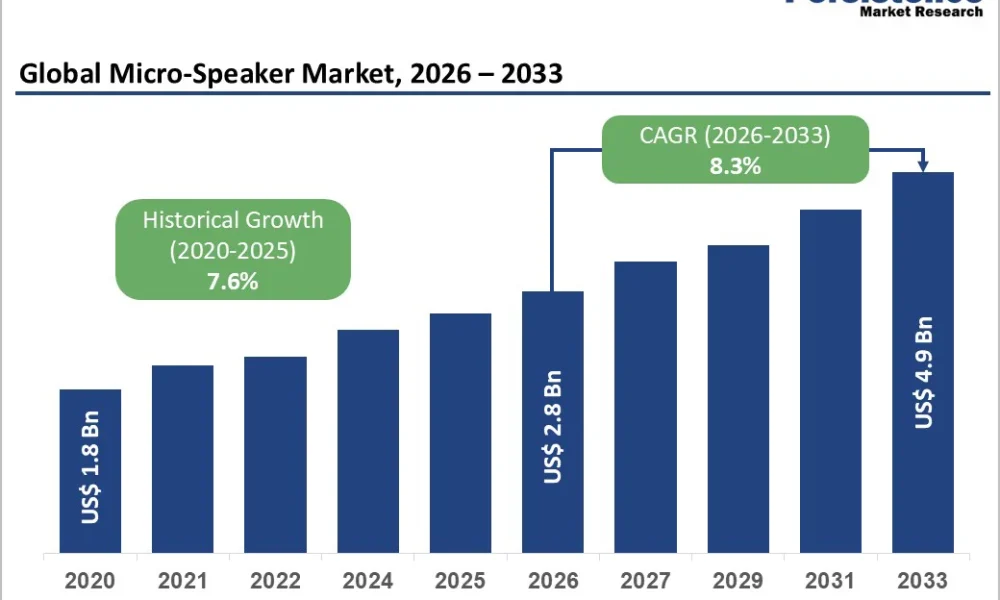
The global micro-speaker market is entering a strong growth trajectory, fueled by rapid advancements in consumer electronics, healthcare devices, and smart mobility systems. The market is projected to be valued at US$ 2.8 billion in 2026 and is expected to reach US$ 4.9 billion by 2033, expanding at a CAGR of 8.3% between 2026 and 2033. This growth follows a steady historical CAGR of 7.6% from 2020 to 2025, reflecting sustained demand for compact and high-performance acoustic components.
Micro-speakers, once limited to basic sound output in mobile phones, have evolved into precision-engineered components that power immersive audio in smartphones, wearables, medical hearing devices, automotive infotainment systems, and even aerospace communication modules. The growing emphasis on miniaturization, lightweight design, and high-fidelity sound is positioning micro-speakers as essential enablers of next-generation electronics.
Technological advancements in micro-electro-mechanical systems (MEMS), balanced armature engineering, and advanced diaphragm materials are further redefining product capabilities. As electronic devices shrink in size yet expand in functionality, the importance of compact acoustic solutions continues to intensify across both developed and emerging economies.
Market Dynamics
Proliferation of Smartphones and Wearables
The exponential growth of smartphones and wearable devices remains the primary driver of the micro-speaker market. Modern smartphones increasingly feature multi-speaker stereo systems, spatial audio capabilities, and enhanced voice clarity. Consumers now expect cinematic sound experiences from slim devices, pushing manufacturers to integrate multiple high-performance micro-speakers into each product.
With global smartphone users surpassing 5.6 billion in recent years, the scale of production required for micro-speakers is immense. Each device generation emphasizes slimmer designs, improved battery efficiency, and immersive audio performance. This constant innovation cycle ensures sustained procurement of advanced acoustic components.
Wearables further amplify this demand. Truly Wireless Stereo (TWS) earbuds, smartwatches, fitness trackers, and AR/VR headsets rely on ultra-compact micro-speakers capable of delivering high-fidelity sound within extremely limited space. The shift toward wireless ecosystems and hands-free communication strengthens long-term adoption.
Voice assistants, gaming, video streaming, and remote collaboration tools also elevate the need for crisp audio performance. Micro-speakers are no longer passive components—they are integral to user experience and brand differentiation strategies.
High Production Costs and Supply Chain Constraints
Despite favorable demand conditions, high production costs remain a critical barrier. Ultra-miniaturization requires precision engineering, advanced composite diaphragms, high-quality magnets, and MEMS fabrication processes. These technologies demand capital-intensive equipment and highly skilled labor, increasing operational costs.
Manufacturers must maintain tight tolerances and acoustic consistency, particularly in high-volume segments such as smartphones and TWS earbuds. Any deviation impacts device sound quality and brand reputation.
Supply chain concentration also introduces risk. The production of micro-components depends on limited suppliers for magnets, semiconductor wafers, and nano-coatings. Geopolitical tensions, logistics disruptions, and raw material price fluctuations can significantly affect delivery timelines.
To mitigate these risks, companies are diversifying sourcing networks and investing in automation. However, such strategies raise short-term expenditure and pressure margins, particularly in cost-sensitive consumer electronics markets.
Healthcare and Hearing Aid Applications: A Strategic Growth Avenue
Healthcare represents one of the most promising long-term opportunities for micro-speaker manufacturers. According to global health statistics, over 430 million people worldwide require rehabilitation for hearing loss. Aging populations and rising noise-induced hearing damage are accelerating demand for advanced hearing-assistance devices.
Modern hearing aids require micro-speakers capable of delivering clear, distortion-free sound in extremely compact form factors. Balanced armature and MEMS-based micro-speakers offer the precision and energy efficiency required for medical-grade applications.
Unlike consumer electronics, healthcare applications prioritize durability, reliability, and regulatory compliance. This creates opportunities for specialized manufacturers to command premium pricing.
The integration of AI-powered hearing enhancement systems and smart diagnostic tools further strengthens the need for high-performance micro-speakers tailored to medical standards.
Elevate your business strategy with comprehensive market data. Request a sample report now: https://www.persistencemarketresearch.com/samples/34150
Category-Wise Analysis
Product Type Insights
Dynamic Micro-Speakers Lead the Market
Dynamic micro-speakers are expected to account for over 45% of total revenue share in 2026, driven by their cost-effectiveness, reliability, and wide compatibility. These speakers are extensively used in smartphones, laptops, tablets, and portable audio devices.
Their proven acoustic performance and ease of large-scale production make them the preferred solution for mass-market applications. Manufacturers value their scalability and integration flexibility, ensuring dominance in mainstream consumer electronics.
MEMS Micro-Speakers Show Fastest Growth
MEMS micro-speakers are projected to register the fastest growth during 2026–2033. These solid-state speakers offer superior miniaturization, energy efficiency, and consistent acoustic output.
Their precision fabrication makes them ideal for wearables, industrial IoT devices, AR/VR headsets, and advanced medical equipment. As electronics continue shrinking in size, MEMS-based solutions are increasingly becoming the preferred option for premium and emerging applications.
Application Insights
Smartphones Remain the Primary Revenue Contributor
Smartphones are projected to hold approximately 35% of total market revenue share in 2026. Multi-speaker integration and immersive stereo sound systems drive consistent demand in this segment.
Consumers increasingly prioritize sound quality when purchasing devices. Features such as spatial audio, noise cancellation, and enhanced speaker clarity reinforce micro-speaker adoption in flagship and mid-tier smartphones alike.
Frequent device replacement cycles also ensure recurring demand for acoustic components.
Wearables to Witness Rapid Expansion
Wearables are forecasted to emerge as the fastest-growing application segment. TWS earbuds and smartwatches require compact, lightweight, and energy-efficient micro-speakers capable of delivering clear audio in small enclosures.
Technological advancements in MEMS engineering allow manufacturers to develop ultra-thin speakers optimized for wearable form factors. The expansion of health monitoring, fitness tracking, and AI-enabled voice interfaces further fuels demand in this segment.
End-User Insights
Consumer Electronics Dominate
Consumer electronics are expected to account for over 40% of the market share in 2026. High-volume production of smartphones, laptops, tablets, and personal audio devices ensures consistent integration of micro-speakers.
Continuous innovation, growing multimedia consumption, and rising expectations for immersive audio reinforce sustained demand in this segment.
Healthcare as the Fastest-Growing End User
Healthcare is projected to witness the fastest growth during the forecast period. Hearing aids, diagnostic equipment, and wearable medical monitors increasingly incorporate precision micro-speakers.
MEMS and balanced armature solutions provide reliable and energy-efficient sound performance essential for medical use. Regulatory advancements and the expansion of health-tech ecosystems further accelerate integration.
Regional Insights
Asia Pacific: The Manufacturing Powerhouse
Asia Pacific is expected to dominate the market with over 42% share in 2026. The region houses major electronics manufacturing hubs such as China, South Korea, Japan, and Taiwan.
Integrated supply chains, semiconductor fabrication capabilities, and access to raw materials enable large-scale production of micro-speakers. Strong domestic demand and rising disposable incomes further reinforce regional leadership.
Strategic partnerships between OEMs and component suppliers accelerate innovation cycles and reduce time-to-market.
North America: Fastest-Growing Innovation Hub
North America is anticipated to be the fastest-growing regional market between 2026 and 2033. Growth is driven by early adoption of wearable technologies, AR/VR devices, and AI-powered hearing aids.
Advanced R&D ecosystems and rapid prototyping capabilities allow companies to deploy next-generation MEMS and balanced armature solutions efficiently.
Healthcare technology expansion and immersive gaming markets also contribute significantly to regional demand.
Europe: Precision Engineering and Sustainability Focus
Europe represents a steadily growing market characterized by premium consumer electronics, automotive infotainment systems, and advanced healthcare technologies.
Stringent environmental policies encourage energy-efficient manufacturing and sustainable material usage. Automotive innovation further drives micro-speaker integration in infotainment and communication systems.
High-quality manufacturing standards position Europe as a key center for precision acoustic innovation.
Competitive Landscape
The global micro-speaker market is moderately fragmented, with leading players leveraging advanced manufacturing capabilities and long-term OEM partnerships.
Key companies include:
- Goertek Inc.
- AAC Technologies Holdings Inc.
- Knowles Corporation
- Sonion
- TDK Corporation
- Foster Electric Co. Ltd.
- Hosiden Corporation
- JVC Kenwood Corporation
- Visaton GmbH
Competition centers on acoustic performance, miniaturization, energy efficiency, and durability. MEMS innovation and balanced armature advancements are key differentiation strategies.
Automation, cost optimization, and strategic partnerships with smartphone and wearable manufacturers help companies maintain competitive positioning.
Key Industry Developments
In June 2025, Bose launched the second-generation SoundLink Micro Bluetooth speaker, emphasizing enhanced portability and improved audio output.
In May 2025, xMEMS Labs introduced the world’s thinnest micro-speaker designed for wrist-worn wearables, advancing solid-state speaker technology.
MISCO Speaker Company adopted collaborative robotics (cobots) in its production facilities, modernizing manufacturing processes to improve efficiency and scalability.
Future Outlook: Compact Sound, Expansive Possibilities
The micro-speaker market is poised for steady expansion through 2033. As devices continue shrinking while demanding superior performance, micro-speakers will remain critical to innovation across consumer electronics, healthcare, automotive, and industrial IoT applications.
MEMS-based architectures, sustainable manufacturing practices, and AI-integrated audio systems will define the next phase of growth. Asia Pacific will continue dominating production, while North America drives innovation and healthcare integration.
With market value projected to reach US$ 4.9 billion by 2033, micro-speakers are no longer mere components—they are strategic enablers of immersive, intelligent, and miniaturized digital ecosystems.
Related Reports:




