
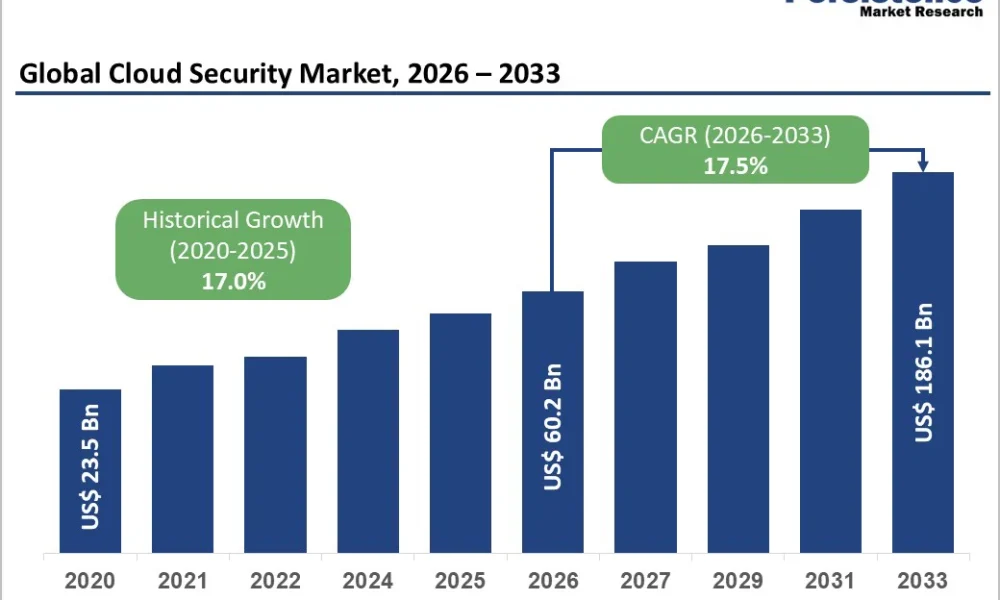
As enterprises accelerate cloud adoption, the importance of robust cloud security solutions has never been greater. The global cloud security market is projected to be valued at US$ 60.2 billion in 2026 and is expected to reach US$ 186.1 billion by 2033, expanding at a strong CAGR of 17.5% during the forecast period. This sustained growth builds upon a historical CAGR of 17.0% from 2020 to 2025, reflecting the rising urgency of cybersecurity investments.
With cyberattacks growing in frequency and sophistication, businesses across industries are prioritizing secure cloud architectures. Stringent data protection regulations such as GDPR, CCPA, HIPAA, and PCI DSS, combined with widespread digital transformation, are reshaping enterprise security strategies. Cloud security is no longer optional—it is mission-critical infrastructure for the digital economy.
Market Overview and Key Highlights
The rapid expansion of the cloud security market is fueled by escalating ransomware attacks, AI-powered cyber threats, and the growing complexity of hybrid and multi-cloud environments.
Key Market Insights (2026–2033):
- Market Size (2026E): US$ 60.2 Billion
- Market Forecast (2033F): US$ 186.1 Billion
- Projected CAGR (2026–2033): 17.5%
- Leading Region: North America (40% market share in 2026)
- Fastest-Growing Region: Asia Pacific
- Dominant Security Type: Identity & Access Management (IAM) – 35% share
- Leading Enterprise Size: Large Enterprises – 70%+ share
- Leading End-user: BFSI – 25% share
Cloud security solutions now extend beyond traditional firewalls, incorporating zero-trust frameworks, AI-driven detection, automation, and compliance management platforms.
Market Drivers: AI, DevSecOps, and Rising Cyber Threats
- AI and Machine Learning in Threat Detection
Artificial intelligence (AI) and machine learning (ML) are transforming cloud security. These technologies analyze vast datasets in real time, identifying unusual behavior patterns, insider threats, and emerging vulnerabilities before damage occurs.
AI-powered cloud security solutions offer:
- Predictive threat detection
- Automated risk scoring
- Real-time anomaly detection
- Faster incident response
- Reduced false positives
As cloud environments grow more dynamic and distributed, traditional security tools struggle to keep pace. AI-driven systems provide continuous visibility across workloads, containers, APIs, and virtual machines.
- DevSecOps Integration
The integration of DevSecOps into cloud-native development pipelines is another major growth driver. Security is embedded directly into continuous integration and continuous delivery (CI/CD) workflows.
DevSecOps enables:
- Automated code scanning
- Configuration validation
- Early vulnerability detection
- Secure application releases
This proactive approach reduces security bottlenecks while ensuring faster deployment cycles. As enterprises shift toward microservices, containers, and serverless architectures, DevSecOps becomes essential.
- Rising Ransomware and Zero-Trust Adoption
Ransomware attacks targeting cloud workloads have surged dramatically. This has accelerated adoption of zero-trust security models, which operate on the principle of “never trust, always verify.”
Zero-trust architectures enforce:
- Strict identity verification
- Continuous authentication
- Least-privilege access
- Micro-segmentation
IAM solutions play a foundational role in zero-trust strategies, driving their dominance in the market.
Market Restraints: Multi-Cloud and Hybrid Complexity
While cloud adoption grows rapidly, managing security across multiple cloud platforms presents significant challenges.
Multi-Cloud Complexity
Organizations often deploy workloads across AWS, Azure, Google Cloud, and private data centers. Each platform uses different APIs, configurations, and security tools, creating operational silos.
Challenges include:
- Lack of centralized visibility
- Configuration inconsistencies
- Fragmented policy enforcement
- Increased risk of misconfigurations
Misconfigurations remain one of the leading causes of cloud breaches.
Hybrid Environment Risks
Hybrid cloud setups require synchronization between on-premise infrastructure and public cloud workloads. Differences in identity systems, compliance requirements, and network architectures complicate security management.
Additionally, skilled cybersecurity professionals remain in short supply, increasing reliance on automation and managed security services.
Major Opportunity: AI-Driven Automation
The shortage of cybersecurity talent combined with growing threat volumes is fueling demand for AI-driven and automation-based cloud security solutions.
Automation supports:
- Continuous monitoring
- Automated patching
- Identity verification
- Rapid threat containment
- Log analysis
AI-powered automation reduces response times from hours to seconds, minimizing financial and reputational damage.
For SMEs, automation offers a scalable and cost-effective alternative to building in-house security teams.
Category-Wise Market Analysis
Security Type Insights
Identity and Access Management (IAM) – Market Leader
IAM is expected to capture 35% of the market share in 2026, making it the dominant segment.
IAM solutions:
- Enforce access control policies
- Support multi-factor authentication (MFA)
- Enable single sign-on (SSO)
- Manage user identities across hybrid environments
For example, Microsoft Azure Active Directory provides conditional access and secure authentication to prevent unauthorized entry into cloud systems.
As organizations adopt zero-trust frameworks, IAM demand continues to rise.
Data Loss Prevention (DLP) – Fastest Growing
DLP solutions are experiencing rapid growth due to increasing data breaches and regulatory scrutiny.
DLP capabilities include:
- Real-time data monitoring
- Content discovery
- Policy enforcement
- Prevention of data exfiltration
Solutions such as Symantec DLP help organizations protect sensitive financial records, healthcare data, and intellectual property.
Elevate your business strategy with comprehensive market data. Request a sample report now: https://www.persistencemarketresearch.com/samples/2704
Enterprise Size Analysis
Large Enterprises – Market Dominance (70% Share)
Large enterprises dominate cloud security investments due to:
- Complex IT infrastructures
- Large volumes of sensitive data
- Regulatory compliance mandates
- High exposure to cyber threats
IBM Cloud Security solutions help enterprises manage encryption, threat detection, and identity controls across hybrid and multi-cloud environments.
SMEs – Fastest Growing Segment
SMEs are rapidly adopting cloud security solutions as they migrate workloads to the cloud. With limited IT staff, SMEs prefer:
- Cloud-native security tools
- Subscription-based pricing
- Managed security services
- Easy deployment models
CrowdStrike Falcon offers lightweight, scalable endpoint protection tailored to SME requirements.
End-user Analysis
BFSI – Leading End-user (25% Share)
The BFSI sector leads the cloud security market due to:
- Digital banking expansion
- High transaction volumes
- Sensitive financial data
- Strict compliance standards
AWS Security Services help banks implement encryption, monitoring, and regulatory compliance frameworks.
Financial institutions are prime cyberattack targets, necessitating advanced protection.
Healthcare & Life Sciences – Fastest Growing
Healthcare organizations are rapidly adopting cloud-based EHRs, telemedicine platforms, and digital patient systems.
Given the sensitivity of patient data, healthcare providers require:
- HIPAA-compliant encryption
- Identity management
- Ransomware protection
- Continuous monitoring
Microsoft Azure for Healthcare provides secure storage and compliance management, enabling secure digital transformation.
Regional Insights
North America – Market Leader (40% Share)
North America dominates the cloud security market due to:
- Advanced cloud infrastructure
- High cybersecurity spending
- Early adoption of zero-trust frameworks
- Strong regulatory enforcement
AI-driven threat intelligence and cloud-native security solutions are widely implemented across BFSI, healthcare, retail, and government sectors.
The U.S. remains a global hub for cybersecurity innovation.
Europe – Compliance-Driven Growth
Europe’s growth is strongly influenced by GDPR and strict data protection regulations.
Key trends include:
- Adoption of IAM and DLP solutions
- Zero-trust implementation
- Encryption-based compliance tools
- Cloud workload protection platforms
Organizations are also integrating AI-driven analytics to enhance predictive threat detection.
Asia Pacific – Fastest Growing Region
Asia Pacific is witnessing rapid cloud adoption across India, China, Japan, and Southeast Asia.
Growth drivers include:
- Government digital initiatives
- SME cloud migration
- Expanding fintech sector
- Rising cybercrime
Data localization laws and cybersecurity regulations are encouraging investment in secure cloud infrastructure.
AI-enabled security platforms and zero-trust architectures are gaining strong traction in the region.
Competitive Landscape
The global cloud security market is highly competitive, featuring established cybersecurity leaders and innovative startups.
Key Companies Include:
- Trend Micro Incorporated
- Cisco Systems Inc.
- McAfee Inc.
- Palo Alto Networks Inc.
- Check Point Software Technologies
- Microsoft Corporation
- IBM Corporation
- Splunk Inc.
- Alphabet Inc.
These companies compete through:
- AI-driven threat intelligence
- Zero-trust architecture frameworks
- Cloud-native security platforms
- Strategic acquisitions
- Managed security services
Innovation remains the primary differentiator.
Recent Industry Developments
Palo Alto Networks (February 2025)
Launched Cortex® Cloud, integrating cloud detection and response (CDR) with CNAPP capabilities. The platform leverages AI and automation to deliver real-time threat prevention across cloud environments.
CrowdStrike (April 2025)
Introduced AI Model Scanning and Shadow AI detection within the Falcon® platform, expanding runtime protection and hybrid identity security capabilities.
These innovations highlight the shift toward intelligent, automated cloud defense systems.
Future Outlook: Intelligent and Autonomous Cloud Security
Looking ahead, the cloud security market will increasingly focus on:
- Autonomous security operations
- AI-native threat intelligence
- Unified multi-cloud dashboards
- Secure edge computing
- Container and serverless protection
- Zero-trust expansion
As enterprises adopt AI, IoT, and edge technologies, cloud security platforms will evolve into integrated, intelligent ecosystems capable of predictive defense.
By 2033, cloud security will be deeply embedded into enterprise strategy, not just IT operations.
Conclusion
The global cloud security market is on a strong growth trajectory, projected to reach US$ 186.1 billion by 2033 at a CAGR of 17.5%.
IAM remains the dominant security type, BFSI leads end-user adoption, and North America holds the largest regional share. Meanwhile, Asia Pacific emerges as the fastest-growing market fueled by digital transformation and regulatory expansion.
As cyber threats become more sophisticated, AI-driven automation, DevSecOps integration, and zero-trust architectures will define the next phase of cloud security evolution.
In an increasingly digital world, cloud security is no longer a defensive measure—it is a strategic enabler of innovation, trust, and sustainable growth.
Related Reports:




