
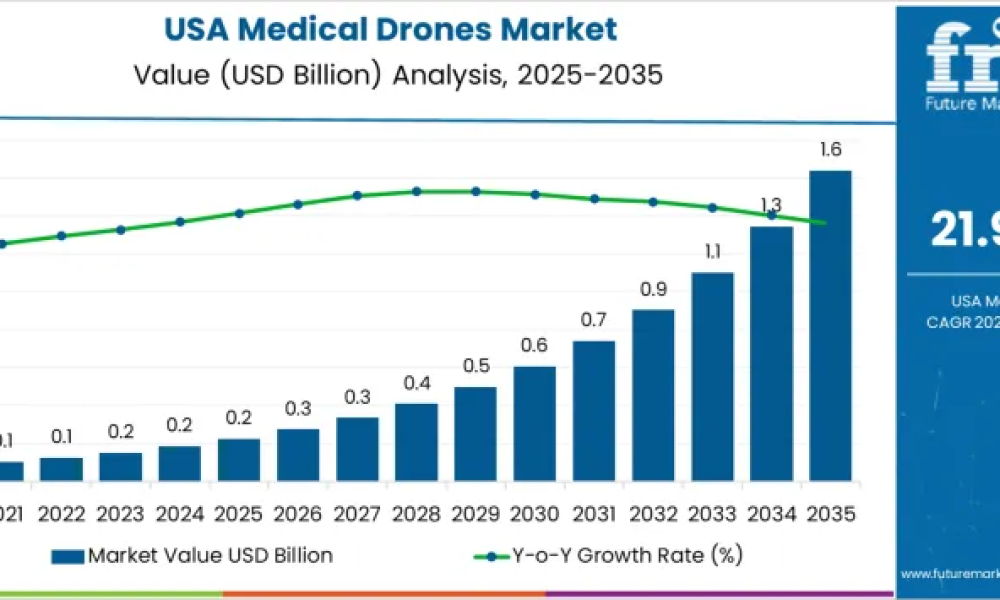
In an era where healthcare demands speed, precision, and resilience, the United States medical drones market is emerging as a transformative force in logistics and emergency response. According to a comprehensive analysis from Future Market Insights, this burgeoning sector is set to skyrocket from a valuation of $0.2 billion in 2025 to an impressive $1.6 billion by 2035, achieving a robust compound annual growth rate (CAGR) of 21.9%. This growth trajectory underscores the pivotal role of unmanned aerial vehicles (UAVs) in revolutionizing medical supply chains, particularly for time-sensitive deliveries of medications, vaccines, blood products, diagnostic samples, and emergency equipment.
As industry leaders navigate the complexities of modern healthcare, the adoption of medical drones addresses critical pain points such as rural access, urban congestion, and post-pandemic supply chain vulnerabilities. “The integration of drones into healthcare isn’t just about innovation—it’s about saving lives through efficiency,” said a hypothetical industry expert familiar with the market dynamics. By enabling contactless, rapid deliveries, drones are bridging gaps in traditional logistics, ensuring that critical supplies reach remote or disaster-stricken areas without delay.
Market Segmentation: Logistics and Emergency Services Lead the Charge
Delving into the market’s structure, segmentation reveals clear frontrunners poised to drive value creation. By product type, logistics drones command a dominant 52% market share in 2025, excelling in versatile transport of medical supplies to underserved regions. These drones stand out for their ability to handle diverse payloads, from vaccines to equipment, while bypassing ground infrastructure limitations. Complementary segments, including ambulance drones, pharmaceutical drones, and blood transport drones, round out the ecosystem, offering specialized solutions for urgent needs.
In terms of applications, Emergency Medical Services (EMS) takes the lead with a 41% share in 2025. Drones in this category are invaluable for delivering defibrillators, medications, and emergency kits to accident sites or isolated locations, dramatically reducing response times in traffic-heavy urban environments or vast rural expanses. Other applications, such as vaccination programs, blood transport, and organ transplantation, are gaining traction, fueled by the imperative for cold-chain preservation and swift handling of biologics to enhance treatment outcomes.
End-user analysis highlights hospitals and clinics as primary adopters, leveraging drones to streamline internal supply chains for medications, samples, and equipment. Blood banks emphasize temperature-controlled transport, while emergency services and government/humanitarian organizations focus on public health initiatives and disaster relief. This diverse end-user base illustrates the market’s broad applicability, from urban hospitals in New York to remote clinics in the Midwest.
Regionally, the West USA emerges as the growth epicenter, projecting a stellar CAGR of 25.2% from 2025 to 2035. States like California, Washington, and Oregon are at the forefront, benefiting from technological hubs, advanced healthcare systems, and supportive regulations that facilitate early adoption for rural deliveries. The South USA follows closely with a 22.6% CAGR, driven by population growth and logistical challenges in expansive states such as Texas, Florida, and Georgia. The Northeast, with a 20.2% CAGR, capitalizes on dense urban centers like Boston and New York for cost efficiencies, while the Midwest’s 17.6% CAGR reflects steady investments in rural access and infrastructure in areas like Illinois and Ohio.
Drivers of Growth: Technology Meets Urgent Healthcare Needs
The market’s ascent is propelled by a confluence of drivers that resonate with decision-makers in healthcare and technology sectors. Foremost is the pressing need for faster, more efficient delivery of critical supplies, circumventing road traffic and geographic barriers to serve aging populations and disaster-prone areas. The post-COVID-19 surge in last-mile delivery demands has accelerated this shift, promoting decentralized healthcare models that prioritize speed and contactless operations.
Technological advancements play a starring role, with innovations in autonomous navigation, extended flight times, enhanced payload capacities, and integrated cold-chain logistics enabling drones to handle sensitive items reliably. Regulatory evolution is another key enabler, as frameworks increasingly accommodate commercial drone operations in healthcare, fostering partnerships between providers, manufacturers, and authorities.
Moreover, the focus on supply chain resilience amid global disruptions positions drones as a strategic asset. Industry leaders are investing in drone infrastructure—such as dedicated landing zones and charging stations—to integrate these systems seamlessly into existing operations. Trends like AI-driven autonomous flights and real-time tracking via digital platforms are further enhancing efficiency, allowing for predictive resource management and compliance with stringent safety standards.
Navigating Challenges: Opportunities Amid Constraints
Despite its promise, the market faces hurdles that savvy executives must address for sustainable growth. Regulatory complexities around airspace management, privacy, and safety—especially in densely populated urban zones—remain significant barriers. High initial costs for drones, maintenance, and supporting infrastructure can deter smaller providers, particularly in rural settings where budgets are tight. Additionally, limited cargo capacities restrict applications for bulkier equipment, and lingering public skepticism regarding reliability and safety could slow widespread adoption.
Yet, these challenges present ripe opportunities for innovation and collaboration. Forward-thinking companies are developing scalable solutions, such as vertical takeoff and landing (VTOL) platforms and advanced software for logistics optimization. By focusing on proven performance in cold-chain maintenance and regulatory compliance, leaders can build trust and expand market penetration.
Competitive Landscape: Pioneers Shaping the Future
The competitive arena is dynamic, with specialized providers leading the charge. Zipline Inc. stands out for its large-scale operations in blood, medication, and vaccine deliveries, boasting reliable fleets and strategic partnerships across regions. Matternet excels in logistics integration, while SkyDrop (formerly Flirtey) and Flytrex emphasize remote reach, tracking software, and compliance tools. These players differentiate through drone reliability, medical-grade payloads, speed, and seamless hospital integrations.
Market structure favors those with robust ecosystems, as evidenced by competition dashboards and benchmarking analyses. As the sector matures, consolidation through partnerships and acquisitions is likely, creating opportunities for entrants to capture share in high-growth segments like EMS and logistics.
Subscribe for Year-Round Insights → Stay ahead with quarterly and annual data updates: https://www.futuremarketinsights.com/reports/brochure/rep-gb-29668
Request for Sample Report | Customize Report |purchase Full Report – https://www.futuremarketinsights.com/reports/sample/rep-gb-29668
Forward Outlook: A Decision-Grade Imperative
Looking ahead, the United States medical drones market offers a compelling narrative for industry leaders: a blend of technological prowess and humanitarian impact. With projections indicating steady acceleration—reaching $0.6 billion by 2030 and surging to $1.6 billion by 2035—decision-makers are urged to prioritize investments in drone-enabled logistics. Scenario forecasts, including optimistic, likely, and conservative outlooks, provide a roadmap for navigating demand fluctuations.
In a PESTLE context, political support for regulatory reforms, economic incentives for efficiency gains, social demands for equitable access, technological breakthroughs, legal frameworks for safety, and environmental benefits of reduced emissions all converge to favor expansion. As value chains evolve, from production to consumption, stakeholders must align on feasibility studies and infrastructure builds to capitalize on this absolute dollar opportunity.
This market isn’t merely growing—it’s redefining healthcare delivery. For executives charting the course, the time to act is now, harnessing drones to deliver not just supplies, but a healthier future for all.
About Future Market Insights (FMI)
Future Market Insights, Inc. (FMI) is an ESOMAR-certified, ISO 9001:2015 market research and consulting organization, trusted by Fortune 500 clients and global enterprises. With operations in the U.S., UK, India, and Dubai, FMI provides data-backed insights and strategic intelligence across 30+ industries and 1200 markets worldwide.
Why FMI: Decisions that Change Outcomes- https://www.futuremarketinsights.com/why-fmi
Contact Us:
Future Market Insights Inc.
Christiana Corporate, 200 Continental Drive,
Suite 401, Newark, Delaware – 19713, USA
T: +1-347-918-3531
Website: https://www.futuremarketinsights.com
LinkedIn| Twitter| Blogs | YouTube
Have a specific Requirements and Need Assistant on Report Pricing or Limited Budget please contact us – [email protected]



