
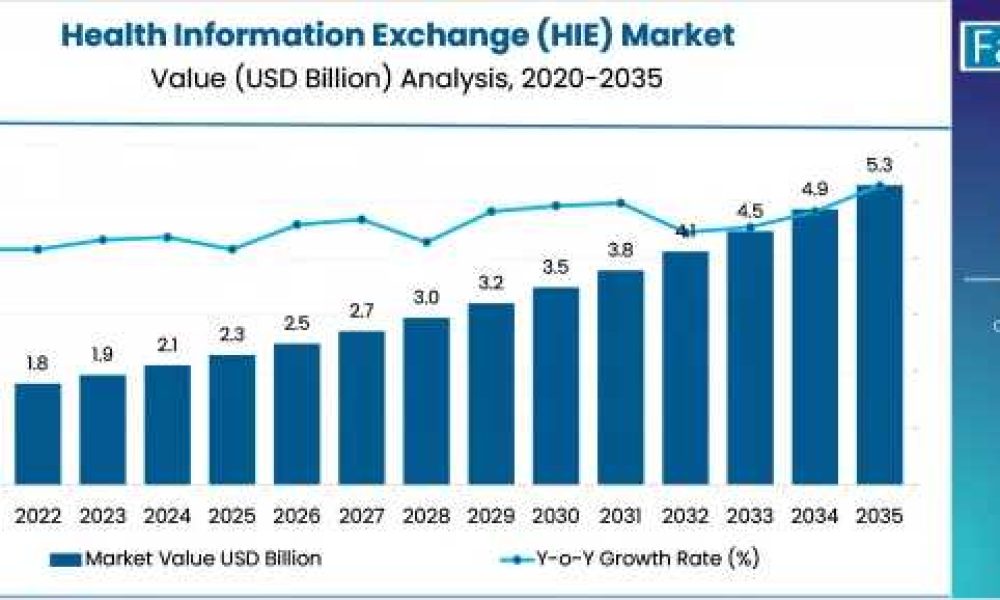
The global Health Information Exchange (HIE) sector has entered a definitive era of structural maturation, with market analysts projecting a trajectory of sustained growth through 2036. Driven by the critical transition from fee-for-service to value-based care and the rapid integration of Agentic AI, the HIE market is evolving from a simple data-sharing utility into the digital nervous system of modern healthcare.
Recent industry data indicates the HIE market, valued at approximately USD 2.49 billion in 2026, is poised to expand at a compound annual growth rate (CAGR) of nearly 10%, reaching an estimated USD 5.3 billion by 2035. This growth underscores a global shift where interoperability is no longer a technical elective but a foundational requirement for clinical safety and operational solvency.
Request for Sample Report | Customize Report |purchase Full Report – https://www.factmr.com/connectus/sample?flag=S&rep_id=11198
The 2026 Landscape: Solving the Interoperability Mandate
The Who, What, and Why of the HIE evolution focuses on the seamless movement of clinical data among disparate systems to improve patient outcomes.
Who: A diverse ecosystem comprising healthcare providers (hospitals and ambulatory centers), payers, public health agencies, and technology giants like Oracle, Epic Systems, and Microsoft.
What: The implementation of secure, modular platforms that enable the retrieval of longitudinal patient records—including lab results, medication history, and imaging—across different care settings.
When: The 2026–2036 forecast period marks the decline of siloed legacy architectures in favor of cloud-native, real-time data liquidity.
Where: While North America remains the largest regional market due to regulatory frameworks like TEFCA, the Asia-Pacific region is emerging as the fastest-growing sector, fueled by massive digitization in India and China.
Why: The primary catalyst is the global demand to reduce medical errors, eliminate duplicate testing, and alleviate the administrative time sinks that currently consume nearly two-thirds of clinical workflows.
Strategic Market Shifts: Hybrid Models and Agentic AI
The next decade of HIE is defined by two major technological convergences: the dominance of Hybrid Implementation Models and the rise of Intelligent Workflows.
1. The Dominance of Hybrid Architectures
Market data reveals that the Hybrid HIE model has become the preferred deployment strategy for large-scale health systems. By blending centralized data repositories with decentralized control, the hybrid model allows organizations to maintain local data sovereignty while adhering to national connectivity standards. This approach balances the rigorous security needs of 2026 with the flexibility required for cross-border data exchange.
2. From Data Exchange to Intelligent Workflows
In 2026, HIE is moving beyond moving data from point A to point B. The integration of Artificial Intelligence (AI) is transforming HIE platforms into predictive engines.
Event-Driven Design: Instead of static storage, modern HIEs now trigger immediate clinical responses. For example, an abnormal lab result can automatically alert a care team and suggest follow-up protocols.
Agentic AI: Autonomous agents are now being used to parse complex medical records and generate first-pass clinical summaries, allowing doctors to focus on decision-making rather than documentation.
Industry Relevance and Investor Outlook
For analysts and investors, the HIE market represents a critical infrastructure play. The pervasive digitization of health records and tougher regulatory penalty regimes are forcing a hard ROI on interoperability investments.
In the 2026–2036 horizon, HIE success is measured by operational outcomes: increased surgical throughput, reduced clinician burnout, and real-time predictive analytics at the point of care, says a leading industry analyst.
The market remains characterized by strategic consolidation. Major EHR vendors are increasingly acquiring specialized interoperability firms to build API-first ecosystems, ensuring they remain relevant in a landscape where data portability is a non-negotiable patient right.
About the HIE Forecast
The 2026-2036 Health Information Exchange forecast is based on comprehensive market intelligence tracking global regulatory trends, technological advancements in FHIR-enabled APIs, and the shift toward patient-centered care models.
Related Reports
About Fact.MR
Fact.MR is a global market research and consulting firm, trusted by Fortune 500 companies and emerging businesses for reliable insights and strategic intelligence. With a presence across the U.S., UK, India, and Dubai, we deliver data-driven research and tailored consulting solutions across 30+ industries and 1,000+ markets. Backed by deep expertise and advanced analytics, Fact.MR helps organizations uncover opportunities, reduce risks, and make informed decisions for sustainable growth.



