
The 3D Printed Packaging Market is steadily gaining traction as brands across food, cosmetics, and pharmaceuticals seek faster, more flexible, and highly customized packaging formats. Additive manufacturing enables on-demand production, reduced tooling costs, and rapid design iteration, making it well suited for low- to mid-volume packaging runs. According to Persistence Market Research, this market is driven by evolving consumer expectations for personalization, shorter product lifecycles, and the growing need for resilient supply chains. Continuous advances in printable materials, including biobased and recyclable feedstocks, are strengthening the commercial viability of 3D printed packaging solutions across multiple industries.
From a structural standpoint, the market remains concentrated among industrial 3D printer OEMs, advanced material formulators, and a widening network of contract manufacturers. These players support end users by offering scalable production capabilities and application-specific packaging designs. Sustainability mandates and regional regulations are also influencing adoption, as 3D printing reduces material waste and transportation dependencies. As industrialized 3D printing technologies mature, buyers are increasingly willing to pilot and scale these solutions, particularly for premium, functional, and customized packaging applications.
See What’s Inside the Report – Free Sample Available : https://www.persistencemarketresearch.com/samples/36024
Market Statistics and Growth Outlook
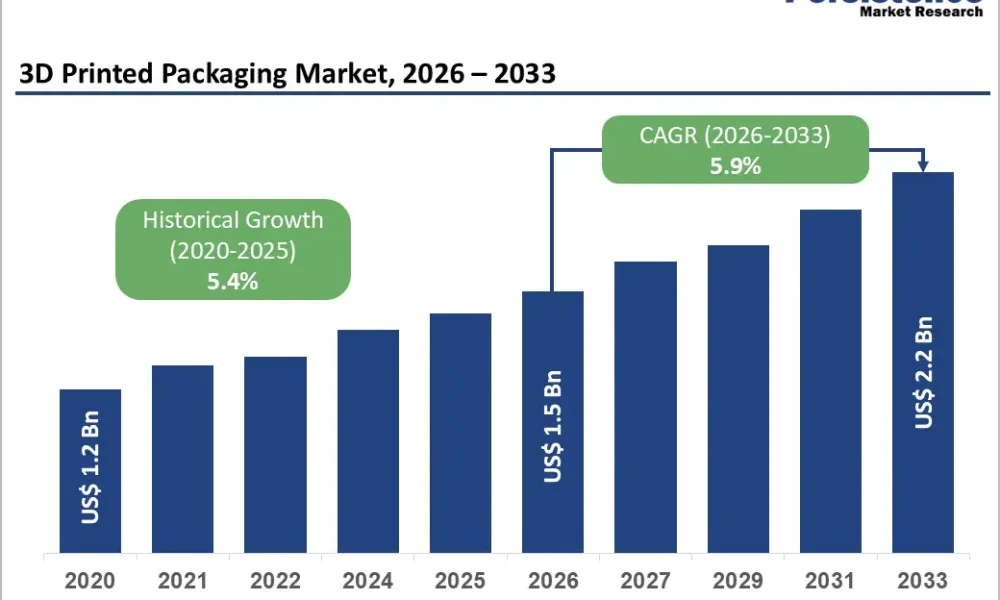
According to Persistence Market Research, the global 3D printed packaging market size is likely to be valued at US$1.5 billion in 2026 and is expected to reach US$2.2 billion by 2033, growing at a CAGR of 5.9% between 2026 and 2033. This growth trajectory reflects rising demand for on-demand packaging, improved production economics for limited volumes, and broader acceptance of additive manufacturing within industrial packaging workflows. Reduced per-unit costs and faster turnaround times are key enablers supporting market expansion.
Leading segments within the market are centered on customized and functional packaging formats, where design flexibility and rapid prototyping deliver measurable value. The food, cosmetics, and pharmaceutical sectors are emerging as primary end users due to their frequent product launches and strict quality requirements. Geographically, developed manufacturing regions lead adoption, supported by strong innovation ecosystems, early technology adoption, and sustainability-driven procurement strategies that favor waste-efficient packaging solutions.
Key Highlights from the Report
➤ Rising demand for on-demand and highly customized packaging solutions is accelerating adoption of 3D printed packaging technologies
➤ Continuous material innovation, including biobased and recyclable feedstocks, is expanding application scope
➤ Industrialization of select 3D printing technologies is reducing per-unit costs for low- to mid-volume production
➤ Supply-chain resilience strategies are increasing buyer willingness to pilot additive packaging solutions
➤ Sustainability mandates are encouraging brands to shift toward low-waste packaging manufacturing
➤ Market concentration remains high among industrial printer OEMs, material specialists, and contract manufacturers
Market Segmentation Analysis
The 3D Printed Packaging Market can be segmented by product type, encompassing containers, closures, inserts, and protective packaging components. Customized and functional packaging dominates this segmentation due to the ability of additive manufacturing to produce complex geometries and tailored designs without extensive tooling. These product types are increasingly used for premium packaging, promotional runs, and short product lifecycles where flexibility outweighs high-volume efficiency.
Based on end-user industries, food, cosmetics, and pharmaceuticals account for a significant share of market demand. These sectors value rapid design validation, regulatory compliance, and the ability to respond quickly to changing consumer preferences. Contract manufacturing plays a growing role in the value chain, enabling brands to access advanced printing technologies without large capital investments, thereby accelerating overall market penetration.
Your Market, Your Way – Click for Custom Version :
https://www.persistencemarketresearch.com/request-customization/36024
Regional Insights
In developed manufacturing regions, adoption of 3D printed packaging is supported by strong R&D infrastructure and early acceptance of additive manufacturing. Brands in these regions prioritize customization, sustainability, and supply-chain agility, creating favorable conditions for market growth. Industrial players actively collaborate with material innovators to commercialize recyclable and biobased packaging formats.
Emerging manufacturing hubs are gradually integrating 3D printed packaging through pilot projects and niche applications. While adoption remains selective, increasing focus on local production and reduced logistics dependence is strengthening regional interest. Over time, technology cost reductions and skill development are expected to expand regional participation in the market.
Market Drivers
One of the primary drivers of the 3D Printed Packaging Market is the growing demand for customization and personalization across consumer goods. Brands are increasingly leveraging unique packaging designs to differentiate products and enhance customer engagement. Additive manufacturing supports this trend by enabling rapid iteration without additional tooling costs.
Another critical driver is the focus on supply-chain resilience. On-demand production reduces dependency on long supply chains and minimizes inventory risks. This flexibility is particularly valuable for industries facing frequent demand fluctuations and regulatory changes.
Market Restraints
Despite its advantages, the market faces challenges related to production scalability. While suitable for low- to mid-volume runs, 3D printing still struggles to compete with conventional methods for large-scale packaging production. This limits adoption in high-volume applications.
Material qualification and regulatory compliance also pose restraints, especially in food and pharmaceutical packaging. Ensuring consistent quality and meeting stringent safety standards can slow commercialization and increase development costs for manufacturers.
Exclusive Data Awaits – Continue to Checkout : https://www.persistencemarketresearch.com/checkout/36024
Market Opportunities
Significant opportunities lie in sustainable packaging innovation. The development of biobased and recyclable feedstocks aligns with global sustainability mandates and brand commitments. This creates strong potential for differentiation and premium pricing.
Additionally, expanding contract manufacturing networks present growth avenues for smaller brands and startups. Access to industrial-grade printing capabilities without heavy capital expenditure is expected to broaden the customer base and support long-term market expansion.
Company Insights
Key players operating in the 3D Printed Packaging Market include
- HP Inc.
- Stratasys Ltd.
- 3D Systems Corporation
- Materialise NV
- EOS GmbH
- Carbon, Inc.
- Protolabs Inc.
- Formlabs, Inc.
- Desktop Metal, Inc.
- Markforged, Inc.
- Nexa3D
- BASF SE
- Evonik Industries AG
- Arkema S.A.
- SABIC
- GE Additive
- SLM Solutions Group AG
- Ricoh Company, Ltd.
Recent Developments
March 2024 Major industrial printer OEM expanded its packaging-focused additive manufacturing portfolio
September 2024 Advanced material supplier introduced recyclable feedstocks for packaging applications
Future Opportunities and Growth Prospects
The future of the 3D Printed Packaging Market is closely tied to material innovation, cost optimization, and broader industrial adoption. As technologies mature and sustainability pressures intensify, additive manufacturing is expected to transition from niche use cases to a strategic packaging solution. With steady growth projected through 2033, the market presents long-term opportunities for technology providers, material innovators, and brand owners seeking flexible and resilient packaging strategies.




