
The global gaming industry is undergoing a profound transformation, driven by evolving player expectations, advanced digital infrastructure, and innovative monetization models. Among the most influential of these models are in-game gambling mechanics and loot boxes, which blend entertainment with chance-based reward systems. These features have reshaped how games generate revenue, retain players, and create immersive, long-term engagement loops.
As gaming continues to move beyond traditional pay-to-play formats, the in-game gambling and loot boxes market has emerged as a high-growth segment at the intersection of gaming, digital commerce, and behavioral economics.
Market Overview and Growth Outlook
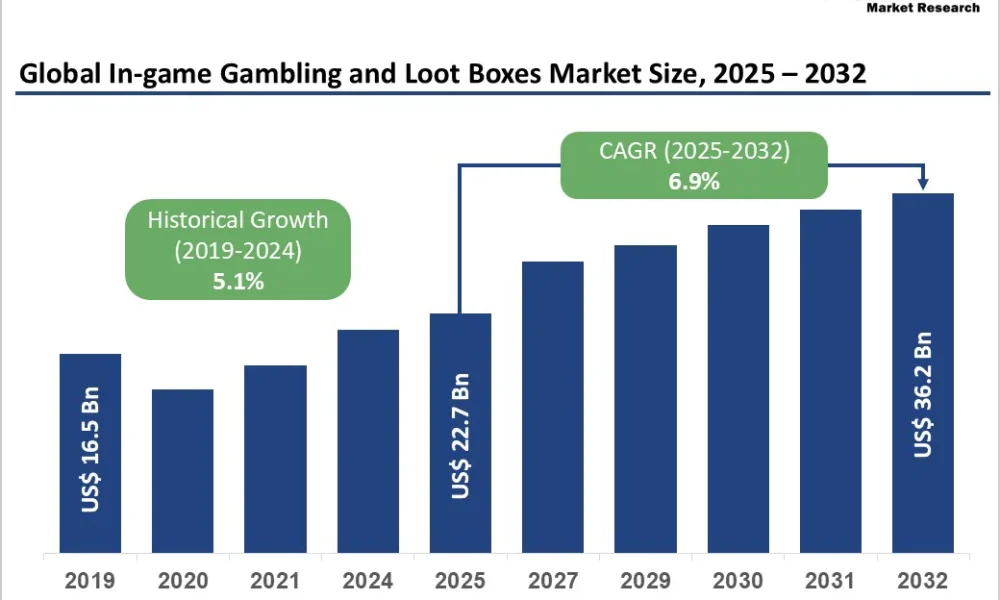
The in-game gambling and loot boxes market size is estimated to be valued at US$22.7 billion in 2025 and is projected to reach US$36.2 billion by 2032, expanding at a compound annual growth rate (CAGR) of 6.9% during the forecast period from 2025 to 2032.
This growth is largely fueled by rising demand for interactive and monetized gaming experiences, where players seek risk–reward mechanics, personalized content, and access to exclusive virtual items. Loot boxes, gacha systems, skins, and wagering-based mechanics are increasingly embedded into mainstream games across mobile, PC, and console platforms.
Technological advancements in mobile gaming, cloud computing, real-time analytics, and artificial intelligence have made it easier for developers to seamlessly integrate these features while optimizing player engagement and spending behavior.
Understanding In-Game Gambling and Loot Boxes
In-game gambling refers to digital wagering activities embedded within video games, where players stake real or virtual currency for randomized rewards. Loot boxes are a prominent subset of this category, offering players a chance to receive randomized virtual items such as skins, characters, weapons, or upgrades.
Unlike traditional gambling, these mechanics are often woven into gameplay progression, social competition, and cosmetic customization, making them appealing to both casual and hardcore gamers. The psychological appeal of uncertainty, anticipation, and instant gratification plays a crucial role in driving repeated purchases.
Key Industry Highlights
Loot Boxes Lead by Game Type
Loot boxes dominate the market landscape, accounting for over 40% of total revenue in 2025. This segment is projected to reach US$9.1 billion by 2032, making it the leading game type within the in-game gambling ecosystem.
Their success is driven by several factors:
- Instant gratification, as players receive rewards immediately after purchase
- Personalization, enabling players to customize avatars and gameplay
- Social recognition, particularly in multiplayer and esports titles
- Integration with live events, battle passes, and seasonal content
Loot boxes are especially prevalent in multiplayer online games, battle royale titles, and collectible-based games, where visual identity and rarity significantly influence player behavior.
Meanwhile, sports betting within games is emerging as the fastest-growing segment, supported by real-time engagement, in-play wagering, and convergence with fantasy sports and micro-betting models.
Mobile Platforms Dominate the Market
From a platform perspective, mobile gaming leads the in-game gambling and loot boxes market, accounting for over 54% share in 2025, with revenues exceeding US$12.3 billion.
The dominance of mobile platforms can be attributed to:
- Widespread smartphone penetration
- Easy access to in-app purchases
- Seamless payment integrations
- Strong social connectivity and virality
Free-to-play mobile games rely heavily on loot boxes and chance-based mechanics to monetize large user bases, especially in emerging markets.
At the same time, PC platforms are witnessing significant growth, driven by high-performance gaming hardware, immersive graphics, and robust esports ecosystems. PC gamers, often categorized as serious or competitive players, demonstrate higher average spending on premium in-game content and gambling mechanics.
Elevate your business strategy with comprehensive market data. Request a sample report now: https://www.persistencemarketresearch.com/samples/33025
Regional Market Analysis
Asia Pacific Leads Global Revenue Share
The Asia Pacific region accounts for over 42% of the global market share in 2025, making it the largest and most influential regional market. Countries such as China, Japan, South Korea, and ASEAN nations are at the forefront of this growth.
Several factors contribute to Asia Pacific’s dominance:
- Cultural acceptance of gacha mechanics
- High mobile gaming penetration
- Strong online and social gaming communities
- Integration of gaming with tourism, anime, and pop culture
Japan’s gacha-based games and South Korea’s competitive gaming culture have set global benchmarks for monetization through loot boxes and chance-based systems.
North America: A Mature but Profitable Market
North America represents a mature market, characterized by high gaming adoption, advanced infrastructure, and strong regulatory oversight. The region has seen increasing convergence between gaming and sports betting, particularly as regulations evolve at the state level.
With legalized sports betting expanding across U.S. states, in-game gambling mechanics tied to live sports and esports are gaining traction, creating new revenue streams for developers and operators.
Europe: High Growth Potential
Europe is expected to grow at a high CAGR during the forecast period, driven by regulatory harmonization, consolidation among gaming operators, and rising consumer acceptance of digital entertainment spending.
While regulatory scrutiny around loot boxes remains strong in parts of Europe, clearer frameworks are enabling compliant monetization strategies that balance player protection with revenue growth.
Key Market Drivers
Mobile Gaming Adoption and 5G Expansion
The rapid adoption of mobile gaming is a major driver of market growth. As of April 2025, there are approximately 2.25 billion 5G connections globally, enabling low-latency, high-quality gaming experiences on mobile devices.
Faster networks allow real-time updates, live events, and seamless integration of loot boxes and gambling mechanics, significantly enhancing user engagement.
Esports Integration
Esports continues to play a pivotal role in popularizing in-game gambling features. With over 320 million esports enthusiasts worldwide, competitive gaming environments encourage spending on cosmetic items, loot boxes, and wagering-based mechanics tied to performance and status.
Esports livestreaming platforms further amplify this effect by showcasing rare items and high-stakes moments to millions of viewers.
Rising Awareness and Acceptance
Consumer awareness of paid in-game items is growing rapidly. In the U.K., for example, 68% of youth are aware of paid in-game items, highlighting the normalization of digital purchases within gaming ecosystems.
Emerging Opportunities
AI-Driven Personalization
Artificial intelligence is transforming how loot boxes and gambling mechanics are designed and delivered. AI-driven personalization enables developers to:
- Tailor rewards to player preferences
- Optimize pricing strategies
- Improve retention through targeted offers
By analyzing real-time player behavior, developers can create more engaging and responsible monetization systems.
Sports Betting Legalization
The legalization of sports betting presents a significant opportunity for the market. In North America, regulated sports betting generated US$505.96 million in Q3 2023, demonstrating strong consumer demand.
Similarly, in Australia, 12.5% of adults placed sports bets in 2024, highlighting the global momentum behind legalized wagering. Integration of sports betting features within games is expected to accelerate monetization and user engagement.
Challenges and Regulatory Considerations
Despite strong growth prospects, the market faces challenges related to regulation, ethical concerns, and consumer protection. Governments and regulators are increasingly scrutinizing loot boxes due to their resemblance to gambling, especially among minors.
As a result, transparency, probability disclosures, spending limits, and age restrictions are becoming critical for sustainable growth. Companies that proactively adopt responsible gaming practices are better positioned to maintain long-term trust and compliance.
Competitive Landscape and Future Outlook
The competitive landscape is shaped by major game publishers, mobile developers, esports operators, and betting platforms. Innovation in monetization models, user experience, and compliance will determine future market leaders.
Looking ahead, the in-game gambling and loot boxes market is expected to evolve toward more immersive, transparent, and personalized experiences. Technologies such as AI, blockchain-based digital assets, and cross-platform ecosystems will further redefine how players interact with chance-based mechanics.
Conclusion
The global in-game gambling and loot boxes market is on a strong growth trajectory, driven by mobile gaming expansion, esports integration, technological innovation, and changing consumer behavior. With the market projected to grow from US$22.7 billion in 2025 to US$36.2 billion by 2032, opportunities abound for developers, publishers, and platform providers.
However, balancing monetization with ethical design and regulatory compliance will be crucial. Companies that prioritize transparency, personalization, and player trust will be best positioned to capitalize on the evolving dynamics of this rapidly expanding market.
Related Reports:




