
The global smart cards market is undergoing a steady transformation as digital security, cashless transactions, and connected ecosystems become integral to modern economies. Smart cards—embedded with secure integrated circuits—have evolved far beyond their early use cases, now serving as essential tools for authentication, encryption, identity management, and secure data storage across industries.
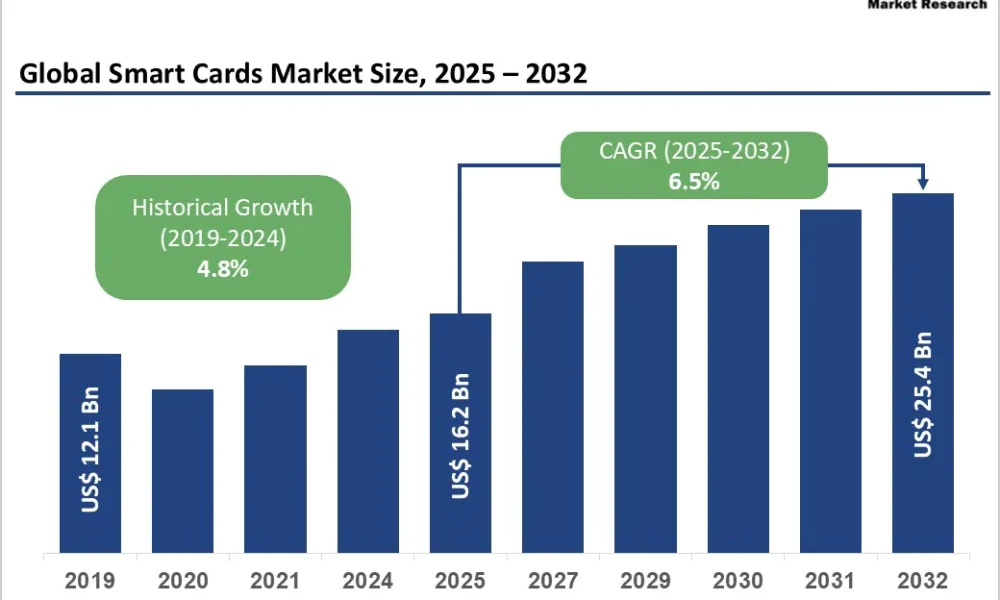
In 2025, the global smart cards market is expected to be valued at US$ 16.2 billion and is projected to reach US$ 25.4 billion by 2032, expanding at a compound annual growth rate (CAGR) of 6.5% during the forecast period from 2025 to 2032. This growth is being fueled by rising concerns over data security, the rapid adoption of 5G and IoT technologies, and widespread digitalization initiatives led by governments and enterprises alike.
Understanding Smart Cards and Their Growing Importance
Smart cards are physical cards embedded with microprocessor chips or memory chips capable of securely storing and processing data. Unlike traditional magnetic stripe cards, smart cards offer significantly higher security, tamper resistance, and multi-application functionality.
Their ability to support encryption, authentication, and secure transactions has made them indispensable across sectors such as banking and financial services, telecommunications, healthcare, transportation, and government services. As cyber threats increase and regulatory compliance becomes more stringent, smart cards are increasingly viewed as a trusted backbone of secure digital infrastructure.
Key Market Drivers Shaping Industry Growth
Rising Demand for Secure Authentication and Data Protection
One of the primary growth drivers of the smart cards market is the increasing need for secure user authentication and data encryption. With rising incidents of identity theft, payment fraud, and data breaches, organizations are shifting toward hardware-based security solutions that are difficult to clone or compromise.
Smart cards provide strong two-factor and multi-factor authentication, making them ideal for secure access control, financial transactions, and identity verification.
Expansion of Cashless Payments and Digital Wallets
The global shift toward cashless economies is accelerating smart card adoption, particularly in payment and financial transaction applications. EMV-compliant payment cards, contactless cards, and NFC-enabled solutions are now standard in many regions, supporting faster and safer transactions.
The proliferation of mobile payment systems, contactless point-of-sale terminals, and digital wallets is reinforcing demand for secure smart card technology, especially in emerging economies.
Rapid Adoption of 5G, IoT, and Connected Devices
The rollout of 5G networks and the expansion of IoT ecosystems are significantly boosting demand for smart cards, particularly in the IT and telecom sector. Smart cards play a critical role in subscriber identity management, device authentication, and secure network access.
The transition toward eSIMs, machine-to-machine (M2M) communication, and connected devices further strengthens the relevance of smart card technology in next-generation digital infrastructure.
Technological Advancements Enhancing Smart Card Capabilities
Innovation remains a key factor in market expansion. Modern smart cards now support multiple applications on a single card, enabling seamless integration across payment, identification, and access control functions.
Advancements in biometric smart cards, which integrate fingerprint sensors for enhanced security, are gaining traction in high-value payment and identity applications. Similarly, NFC-enabled and dual-interface smart cards allow users to switch effortlessly between contact-based and contactless transactions, improving convenience and compatibility with legacy systems.
Elevate your business strategy with comprehensive market data. Request a sample report now: https://www.persistencemarketresearch.com/samples/11149
Market Segmentation Analysis
By Chip Type: MPU Cards Lead the Market
Microprocessor unit (MPU) smart cards dominate the global market, accounting for more than 58% share in 2025, with a valuation exceeding US$ 9.4 billion. Their leadership is driven by high processing power, robust security features, and compatibility with complex, multi-functional applications.
MPU cards are widely used in banking, telecom, government ID programs, and enterprise security systems where advanced encryption and secure data processing are critical.
Memory cards, while offering simpler functionality, are witnessing rapid growth due to increasing demand for larger data storage in multi-application deployments, IoT solutions, and e-Governance programs. Their cost-effectiveness makes them suitable for large-scale implementations.
By Interface Type: Contactless Cards Dominate
Contactless smart cards hold a commanding position in the market, capturing over 46% share in 2025, with revenues exceeding US$ 7.5 billion. Their popularity is driven by faster transaction speeds, enhanced security, and hygienic, touch-free usage—factors that gained particular importance following the COVID-19 pandemic.
Contactless cards are extensively used in banking, public transportation, retail, and access control applications.
Dual-interface smart cards represent the fastest-growing interface segment. These cards support both contact and contactless communication, allowing organizations to maintain compatibility with existing infrastructure while transitioning to contactless systems. Their flexibility and enhanced security features are accelerating adoption across multiple industries.
By Application: Payments Lead, Identity Grows Fastest
Payment and financial transactions represent the largest application segment, accounting for over 37% share in 2025. Growth in this segment is driven by EMV standards, NFC-based payments, and biometric authentication, which together enhance transaction security and user confidence.
Smart cards remain the backbone of debit cards, credit cards, and prepaid cards, particularly in regions where digital payment adoption is expanding rapidly.
Meanwhile, ID and access control is the fastest-growing application segment. Governments and enterprises are increasingly deploying smart cards for national identity programs, employee authentication, secure facility access, and digital database integration. The rising emphasis on secure identity verification is expected to sustain strong growth in this segment throughout the forecast period.
By End User: IT & Telecom Takes the Lead
The IT and telecom sector leads the smart cards market, accounting for over 41% share in 2025, with a valuation exceeding US$ 6.7 billion. This dominance is attributed to widespread SIM and eSIM adoption, secure subscriber authentication, and integration with 5G and IoT networks.
Smart cards remain essential for mobile network security, roaming authentication, and device identity management.
The government and public sector segment is expected to grow at the highest CAGR during the forecast period. National digital identity programs, e-passports, social security cards, and voter ID initiatives are driving large-scale demand for tamper-proof, contactless smart card solutions worldwide.
Regional Outlook: Asia Pacific at the Forefront
Asia Pacific: Largest Market Share
Asia Pacific accounts for over 40% of the global smart cards market in 2025, valued at more than US$ 6.5 billion. Growth in the region is driven by large population bases, rapid digitalization, and ambitious government initiatives.
Programs such as India’s Aadhaar, smart city projects, transit card systems, and expanding digital payment ecosystems are significantly boosting smart card deployment. China, Japan, South Korea, and Southeast Asian countries are also investing heavily in secure digital infrastructure.
North America: Fastest Growth Rate
North America is expected to register the highest CAGR over the forecast period. Growth is supported by regulatory mandates, enterprise-level security adoption, healthcare digitization, and increasing use of smart cards for access control and identity management.
The region’s strong focus on cybersecurity and compliance continues to create opportunities for advanced smart card solutions.
Middle East & Africa: Emerging Opportunities
The Middle East and Africa are emerging as promising markets, driven by national e-ID programs, government procurement cycles, and infrastructure modernization. Several countries in the region are adopting smart cards for citizen identification, border control, and public service delivery.
Future Outlook: What Lies Ahead
The smart cards market is set to benefit from continued digital transformation, rising cybersecurity threats, and growing demand for secure, convenient authentication solutions. As technologies such as biometrics, blockchain integration, and advanced encryption evolve, smart cards will remain a trusted and adaptable security platform.
The convergence of smart cards with mobile ecosystems, digital identity frameworks, and IoT networks will further expand their role across industries. Vendors focusing on innovation, interoperability, and scalable solutions are expected to gain a competitive edge in this evolving market landscape.
Conclusion
The global smart cards market is on a solid growth trajectory, underpinned by increasing demand for secure digital transactions, identity management, and connected infrastructure. With strong adoption across payments, telecom, government services, and access control applications, smart cards continue to prove their relevance in a rapidly digitizing world.
As the market moves toward US$ 25.4 billion by 2032, smart cards will remain a cornerstone technology enabling trust, security, and efficiency across global digital ecosystems.
Related Reports:




