
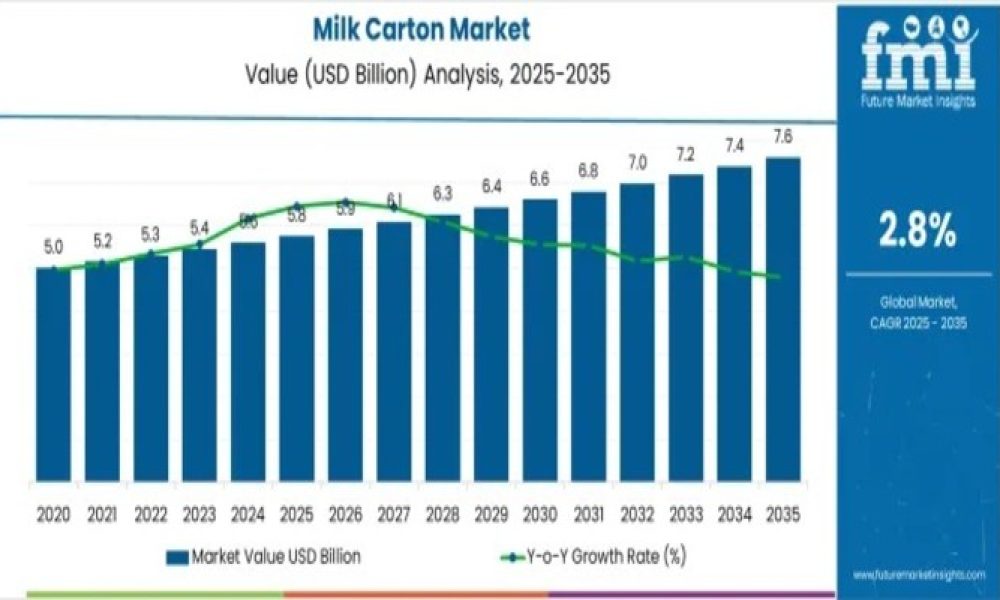
The global milk carton market plays a vital role in supporting the modern dairy industry by ensuring safe, hygienic, and sustainable packaging for liquid nutrition. As consumer expectations shift toward convenience, environmental responsibility, and product safety, milk cartons continue to evolve as a preferred packaging format. Between 2025 and 2035, the market is expected to grow steadily, reflecting both the maturity of dairy consumption patterns and innovation within packaging technologies.
Meaning and Scope of the Milk Carton Market
Milk cartons are paperboard-based packaging solutions designed to store, protect, and distribute milk and dairy beverages efficiently. They are widely used across households, schools, retail outlets, and institutional food programs.
Key characteristics of milk cartons include:
- Strong structural integrity for liquid containment
- Compatibility with aseptic and non-aseptic filling
- High printability for branding and regulatory information
- Recyclability and alignment with sustainable packaging goals
The milk carton market spans materials, product formats, capacities, and geographies, serving both conventional dairy and emerging plant-based alternatives.
Uncover the Massive Potential of the Market – Get Our Sample Report Now
Market Outlook (2025 to 2035)
The milk carton market is estimated at USD 5.8 billion in 2025 and is projected to reach USD 7.6 billion by 2035, registering a CAGR of 2.8%. While growth remains moderate, it is stable and resilient, supported by essential consumption patterns and regulatory backing for recyclable packaging.
Key outlook highlights include:
- Sustained demand from urban and semi-urban populations
- Expansion of single-serve and on-the-go consumption formats
- Gradual replacement of plastic packaging with paper-based cartons
- Continuous investment in carton sealing, barrier coatings, and printing technologies
Market Overview and Structure
The milk carton market is segmented by material, product type, capacity, and region.
By Material:
- Uncoated Paperboard
- LDPE Coated
- Aluminum
By Product Type:
- Brick Cartons
- Gable Top Cartons
- Shaped Cartons
By Capacity:
- Up to 100 ml
- 101 to 200 ml
- 201 to 500 ml
- Above 500 ml
Regionally, the market covers North America, Europe, Asia-Pacific, Latin America, and the Middle East & Africa, with Asia-Pacific emerging as a high-growth region.
Market Growth Drivers
A mix of regulatory, technological, and lifestyle-driven factors shapes growth in the milk carton market.
Key growth drivers include:
- Rising global consumption of milk and dairy products
- Government regulations promoting food safety and recyclable packaging
- Advancements in aseptic packaging and barrier coating technologies
- Expansion of online grocery and modern retail channels
- Increasing adoption of plant-based milk alternatives
Between 2020 and 2025, the market expanded at a faster 4.5% CAGR, driven by rapid sustainability adoption. Growth is moderating in the forecast period but remains structurally strong.
Demand Analysis and Segment Insights
Uncoated Paperboard: Leading Material Segment
Uncoated paperboard dominates the market, accounting for 75.6% share in 2025.
Key advantages driving demand:
- Cost efficiency and lightweight nature
- Excellent printability for branding
- Compatibility with recyclable and eco-friendly positioning
- Ease of integration with automated filling systems
Consumers increasingly associate paper-based cartons with freshness, safety, and quality, reinforcing this segment’s leadership.
Brick Cartons: Preferred Product Type
Brick cartons are expected to hold 53.4% of market share in 2025.
Reasons for dominance include:
- Superior stackability and space efficiency
- Compatibility with aseptic technology
- Extended shelf life without refrigeration
- Cost-effective large-scale manufacturing
Brick cartons remain the backbone of both domestic and export-oriented dairy supply chains.
Up to 100 ml: High-Growth Capacity Segment
The up to 100 ml capacity segment leads with a 36.7% market share in 2025.
Demand is fueled by:
- School milk programs and institutional use
- On-the-go and portion-controlled consumption
- Reduced material usage and lower logistics costs
- Strong alignment with hygiene and safety standards
Key Trends Transforming the Milk Carton Industry
Several trends are reshaping the competitive and operational landscape:
- Growing emphasis on sustainable and regenerative packaging materials
- Increasing use of QR codes, NFC tags, and smart packaging features
- Design optimization for e-commerce and home delivery durability
- Rising preference for single-serve and convenience packaging
- Stronger brand positioning around environmental and social responsibility
These trends are expected to define product differentiation strategies over the next decade.
Regional Demand Dynamics
High-growth countries include India (6.7% CAGR) and China (5.9% CAGR), supported by urbanization, rising incomes, and expanding retail infrastructure.
Regional highlights:
- United States: Sustainability-driven demand and health-focused consumption
- United Kingdom: Retailer-led preference for eco-friendly packaging
- China: Rapid expansion of modern retail and middle-class consumption
- Japan: Technological innovation and government-backed nutrition programs
- India: Cultural significance of milk and government nutrition schemes
Competitive Landscape
The milk carton market is moderately consolidated, with global leaders focusing on innovation, sustainability, and operational efficiency.
Key players include:
- Tetra Pak International
- Elopak AS
- SIG Group
- Oji Holdings Corporation
- Stora Enso Oyj
- Adam Pack S.A.
- H.B. Fuller Company
- Lami Packaging
Competitive strategies center on:
- Development of eco-friendly carton structures
- Investment in advanced filling and sealing technologies
- Expansion into high-growth emerging markets
- Alignment with global sustainability regulations
Why FMI: https://www.futuremarketinsights.com/why-fmi
About Future Market Insights (FMI)
Future Market Insights, Inc. (FMI) is an ESOMAR-certified, ISO 9001:2015 market research and consulting organization, trusted by Fortune 500 clients and global enterprises. With operations in the U.S., UK, India, and Dubai, FMI provides data-backed insights and strategic intelligence across 30+ industries and 1200 markets worldwide.



