
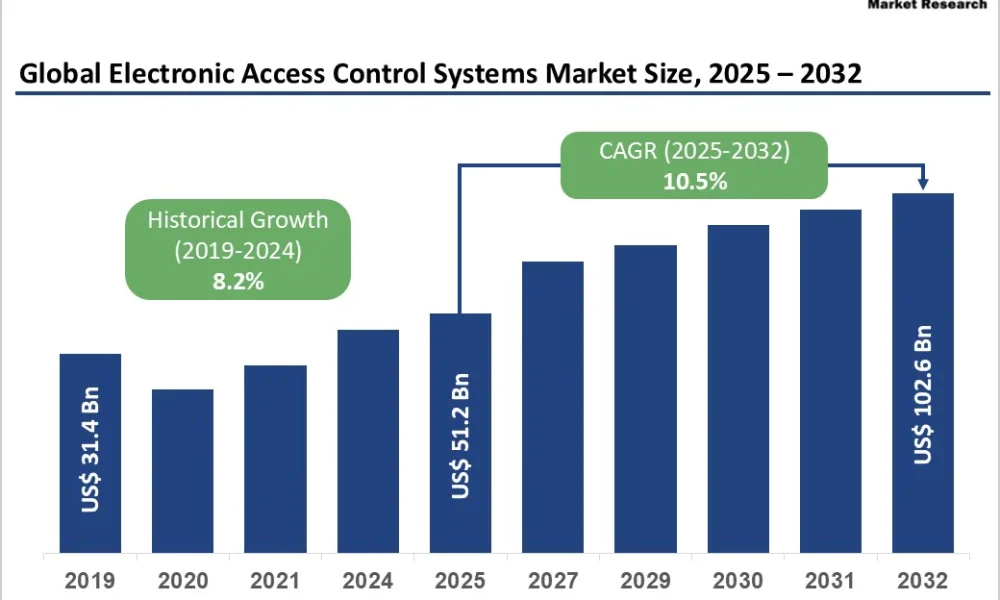
The global electronic access control systems (EACS) market is experiencing a strong upward trajectory as organizations and households worldwide place greater emphasis on security, compliance, and operational efficiency. Valued at US$51.2 billion in 2025, the market is projected to reach US$102.6 billion by 2032, expanding at a compound annual growth rate (CAGR) of 10.5% during the forecast period from 2025 to 2032.
This growth reflects the increasing need to safeguard physical assets, sensitive data, and personnel in an era marked by rising security threats, rapid urbanization, and digital transformation across industries.
Market Overview: Why Electronic Access Control Systems Matter
Electronic access control systems are designed to regulate and monitor who can enter or exit a physical space, replacing traditional mechanical locks with smarter, more secure, and more flexible solutions. These systems include hardware such as card readers, biometric scanners, controllers, and locks, as well as software platforms that manage authentication, authorization, and audit trails.
In today’s interconnected world, access control is no longer limited to physical security alone. Modern systems integrate with cloud platforms, mobile devices, artificial intelligence (AI), Internet of Things (IoT) networks, and building management systems, enabling real-time monitoring, remote access, and data-driven decision-making.
Key Market Growth Drivers
Rising Security Concerns Across Sectors
The increase in unauthorized access, theft, workplace violence, and identity fraud is a primary driver of electronic access control adoption. Enterprises, governments, and residential users are shifting toward advanced authentication systems to reduce security vulnerabilities and improve response times.
Critical infrastructure sectors such as healthcare, data centers, transportation hubs, and government facilities increasingly require multi-layered access control solutions to meet safety and compliance standards.
Regulatory Compliance and Data Protection
Stricter regulations related to data privacy, workplace safety, and critical infrastructure protection are pushing organizations to adopt compliant access control systems. Industries such as banking, healthcare, and government rely heavily on access logs, audit trails, and role-based access to meet regulatory requirements.
Electronic systems provide centralized control and detailed reporting, which are essential for regulatory audits and risk management.
Technological Advancements and Digital Transformation
Technological innovation is reshaping the access control landscape. The integration of AI-driven analytics, facial recognition, cloud-based platforms, and mobile credentials has significantly improved system performance and user experience.
Cloud-based access control allows organizations to manage multiple locations from a single dashboard, reduce infrastructure costs, and scale operations efficiently. Mobile credentials enable users to access facilities using smartphones, eliminating the need for physical cards and enhancing convenience.
Component Analysis: Hardware Leads, Software Gains Momentum
Hardware Segment Dominates the Market
The hardware segment accounts for over 58% of the market share in 2025, driven by strong demand for physical security components such as card readers, biometric scanners, electronic locks, and keypads. These components form the backbone of access control systems, particularly in high-security environments like airports, government buildings, and corporate offices.
Hardware remains essential for ensuring reliable authentication, durability, and compliance, especially in locations where security breaches could have severe consequences.
Software Segment Shows the Fastest Growth
While hardware leads in revenue, software is the fastest-growing segment, projected to exceed US$32 billion by 2032. Growth is fueled by increasing demand for cloud-based, scalable, and integrated access management platforms.
Software solutions enable features such as real-time monitoring, remote access control, analytics, and seamless integration with HR systems, video surveillance, and building automation platforms. As organizations prioritize flexibility and centralized control, software adoption continues to accelerate.
Function Analysis: Authentication Systems Take the Lead
Authentication Systems Dominate Market Share
Authentication systems hold over 43% of the market share in 2025, valued at more than US$22 billion. These systems focus on verifying user identity through methods such as PINs, RFID cards, biometrics, and mobile credentials.
The growing preference for user-friendly, contactless, and cloud-enabled authentication solutions is driving this segment’s dominance. Biometric technologies, including fingerprint, facial recognition, and iris scanning, are particularly popular due to their high accuracy and reduced risk of credential theft.
Intruder Alarm Systems Gain Traction
Intruder alarm systems represent another high-growth function, expanding at a CAGR of 11.3%. Rising incidents of theft and burglary, combined with the integration of alarms into smart buildings and IoT ecosystems, are driving adoption.
Modern intruder systems are increasingly connected with access control, surveillance cameras, and mobile alerts, providing a comprehensive security solution rather than standalone protection.
Elevate your business strategy with comprehensive market data. Request a sample report now: https://www.persistencemarketresearch.com/samples/2885
Industry Analysis: Commercial Sector Leads, Residential Surges
Commercial Sector Holds the Largest Share
The commercial sector accounts for more than 37% of the market in 2025, driven by demand from corporate offices, retail chains, hospitality, and business parks. Organizations rely on electronic access control to manage employee access, protect sensitive areas, and integrate security with building management systems.
Retailers also use access control to secure back offices, warehouses, and high-value inventory areas while maintaining smooth customer operations.
Residential Sector Records the Fastest Growth
The residential segment is growing at a CAGR of 14.1%, fueled by rising adoption of smart home technologies. Homeowners increasingly seek solutions that offer remote access, mobile control, and integration with IoT-enabled devices such as smart locks, cameras, and alarms.
Urbanization, rising disposable income, and growing awareness of home security are further accelerating demand for residential electronic access control systems.
Regional Insights: North America Leads, Asia Pacific Accelerates
North America Maintains Market Leadership
North America holds over 37% of the global market share in 2025, valued at more than US$19 billion. The United States dominates the region with a 78% share, driven by strong adoption across enterprises, government agencies, and healthcare institutions.
Factors such as stringent security regulations, early technology adoption, and high investment in digital infrastructure support market leadership in the region.
Asia Pacific Emerges as the Fastest-Growing Region
The Asia Pacific market is expanding at a CAGR of 15.4%, making it the fastest-growing region globally. Countries such as China and India are leading adoption due to smart city initiatives, rapid infrastructure development, and increasing preference for mobile-based access solutions.
Government investments in urban security, transportation hubs, and commercial infrastructure are creating substantial opportunities for access control vendors in the region.
Competitive Landscape and Industry Trends
The electronic access control systems market is highly competitive, with global and regional players focusing on innovation, partnerships, and acquisitions. Key trends shaping the competitive landscape include:
- Integration with AI and analytics for predictive security and behavior analysis
- Shift toward cloud-native and SaaS-based access control platforms
- Increased adoption of mobile and biometric credentials
- Convergence of access control with video surveillance and IoT systems
Vendors are increasingly offering end-to-end security ecosystems rather than standalone products, enabling customers to manage access, monitoring, and analytics through unified platforms.
Challenges and Market Constraints
Despite strong growth, the market faces certain challenges. High initial installation costs, especially for large-scale or legacy infrastructure upgrades, can limit adoption among small and medium enterprises. Additionally, concerns related to data privacy, biometric misuse, and cybersecurity risks require vendors to invest heavily in secure system architectures.
Interoperability issues between different systems and vendors can also pose challenges, particularly in complex, multi-site deployments.
Future Outlook: A Smarter, More Connected Security Ecosystem
The future of the electronic access control systems market lies in intelligent, connected, and user-centric solutions. As organizations continue to embrace digital transformation, access control will evolve from a standalone security function into a strategic component of smart buildings and smart cities.
Emerging technologies such as AI-driven facial recognition, blockchain-based identity management, and advanced analytics are expected to redefine how access is granted, monitored, and optimized.
With strong growth fundamentals, rising security awareness, and continuous technological innovation, the global electronic access control systems market is well-positioned to double in value by 2032, reinforcing its critical role in modern security infrastructure.
Related Reports:




