
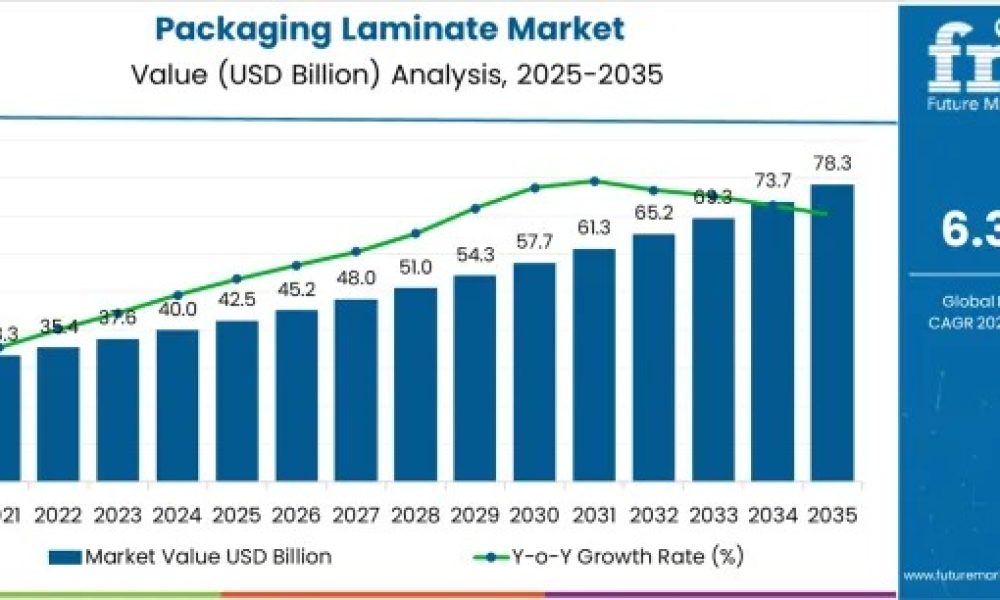
The global packaging laminate market is entering a decade of strong structural expansion, driven by the rapid growth of flexible packaging and the increasing need for high-performance barrier materials. Valued at USD 42.5 billion in 2025, the market is forecast to reach USD 78.3 billion by 2035, growing at a CAGR of 6.3%. This near doubling of market size reflects the central role laminates now play in protecting food, pharmaceuticals, consumer goods, and industrial products across increasingly complex global supply chains. From ready-to-eat meals and nutraceutical sachets to premium cosmetics and e-commerce shipments, packaging laminates are no longer just protective layers they are becoming strategic enablers of shelf life, brand differentiation, and distribution efficiency.
Industry Meaning
Packaging laminates are multi-layer material structures created by bonding two or more substrates such as polyethylene, polypropylene, polyester, aluminum foil, or paper into a single composite film. Each layer contributes a functional benefit, including moisture resistance, oxygen barrier, light protection, mechanical strength, or printability. Unlike single-material packaging, laminates allow manufacturers to custom-engineer packaging performance for specific applications. This makes them essential in industries where product integrity, hygiene, and regulatory compliance are non-negotiable. Laminates are widely used in pouches, sachets, blister packs, lidding films, wraps, and protective mailers.
Strategic Outlook
Strategically, the packaging laminate market is shifting from commodity supply toward high-value engineered solutions. Between 2025 and 2030, nearly half of the market’s total growth will be driven by demand for high-barrier food packaging and pharmaceutical laminates. From 2030 onward, growth accelerates through:
- Bio-based and compostable laminates,
- Mono-material recyclable structures,
- Smart packaging features like QR codes and freshness indicators,
- Expansion of direct-to-consumer (DTC) and e-commerce packaging.
Converters and material suppliers are increasingly investing in solvent-free lamination, extrusion coating, and barrier film technologies to improve sustainability credentials while maintaining performance.
Request For Sample Report | Customize Report |purchase Full Report – Sample link
Market Evolution
Historically, packaging laminates were developed primarily to replace rigid containers and glass packaging with lighter alternatives. Over time, they evolved into multi-functional protective systems capable of withstanding thermal processing, long-distance shipping, and extended storage.
Key evolutionary phases include:
- Adoption of retortable laminates for shelf-stable meals,
- Integration of aluminum foil barriers for pharmaceuticals,
- Development of high-graphics laminates for premium branding,
- Current transition toward recyclable mono-material laminates.
Today’s laminate structures are not just about protection they enable cost reduction, material lightweighting, and enhanced consumer experience.
Growth Opportunities
The strongest growth opportunities lie across seven strategic pathways:
- High-barrier pharmaceutical laminatesfor blister packs and sachets.
- Retortable and hot-fill food laminatesfor convenience meals.
- Mono-material recyclable laminatessupporting circular economy goals.
- E-commerce protective laminatesfor DTC shipping.
- Geographic expansion in Asia-Pacific, especially India, China, and Indonesia.
- Agricultural and chemical packagingrequiring chemical-resistant films.
- Premium brand packagingwith metallic finishes and tactile coatings.
Among these, India leads global growth with an 8.4% CAGR, driven by rapid food processing expansion and pharmaceutical manufacturing. China follows at 7.1%, while Indonesia shows strong momentum at 7.8%.
Demand Patterns
By product type, multi-layer laminates dominate with 58% market share, reflecting their superior barrier performance and versatility. These structures are widely used in food pouches, dairy packaging, medical sachets, and industrial wraps.
By application, food & beverage accounts for 52% of total demand, making it the largest consumer of packaging laminates globally. The segment benefits from:
- Growth in ready-to-eat meals,
- Rising frozen food consumption,
- Demand for microwave-safe and portion-controlled packaging.
Pharmaceuticals & healthcare follow closely, where laminates are essential for moisture protection, light shielding, and contamination prevention.
Technology Trends
Technology is redefining packaging laminates from simple films into intelligent material systems. Key trends include:
- Solventless and adhesive-free lamination, reducing VOC emissions.
- Extrusion lamination and UV-curable systems, improving bond strength.
- Barrier coating innovations, enabling thinner but stronger films.
- Smart packaging integration, including QR codes, traceability tags, and freshness sensors.
- Mono-polymer laminate designs, improving recyclability.
Manufacturers are also exploring functional coatings that add antimicrobial properties, aroma barriers, and heat resistance especially in pharmaceutical and premium food packaging.
Competitive Landscape
The competitive landscape is moderately concentrated, with the top three players controlling nearly half of the global market. The leader, Amcor plc, holds around 18% share, supported by its extensive portfolio of high-barrier and recyclable laminate solutions.
Other global leaders include Sealed Air Corporation and Berry Global Inc., both known for advanced coextrusion and solvent-free lamination capabilities.
Challenger firms such as Constantia Flexibles, Mondi Group, and Coveris Holdings are gaining ground through lightweight, sustainable, and application-specific laminate innovations.
Regional powerhouses like Uflex Limited, Huhtamaki Oyj, Toray Industries, and Dai Nippon Printing are expanding aggressively in Asia-Pacific, supplying cost-efficient laminates to FMCG and e-commerce brands.
Emerging manufacturers in India, Southeast Asia, and Latin America are also investing in regional converting plants, benefiting from proximity to food processors and lower logistics costs.
Executive-Level Insights
- Market Size (2025): USD 42.5 billion
- Market Forecast (2035): USD 78.3 billion
- Growth Rate: 6.3% CAGR
- Leading Product Type: Multi-layer laminates (58%)
- Leading Application: Food & Beverage (52%)
- Top Growth Markets: India, China, Indonesia
- Key Technology Trends: Solvent-free lamination, smart packaging, mono-material designs
- Strategic Drivers: Shelf-life extension, e-commerce growth, sustainability regulations
Conclusion
The packaging laminate market is evolving into a core infrastructure of modern consumer economies. As lifestyles become more urban, mobile, and convenience-driven, laminates provide the protective backbone that keeps food fresh, medicines safe, and brands visually distinctive. Over the next decade, competitive advantage will increasingly belong to companies that can combine barrier performance, sustainability, digital integration, and regional manufacturing agility. From high-tech pharmaceutical films to recyclable mono-material food pouches, packaging laminates are no longer optional they are strategic assets shaping the future of global packaging systems.
Why FMI: https://www.futuremarketinsights.com/why-fmi
About Future Market Insights (FMI)
Future Market Insights, Inc. (FMI) is an ESOMAR-certified, ISO 9001:2015 market research and consulting organization, trusted by Fortune 500 clients and global enterprises. With operations in the U.S., UK, India, and Dubai, FMI provides data-backed insights and strategic intelligence across 30+ industries and 1,200 markets worldwide.
Contact Us:
Future Market Insights Inc.
Christiana Corporate, 200 Continental Drive,
Suite 401, Newark, Delaware – 19713, USA
T: +1-347-918-3531
For Sales Enquiries: [email protected]



