
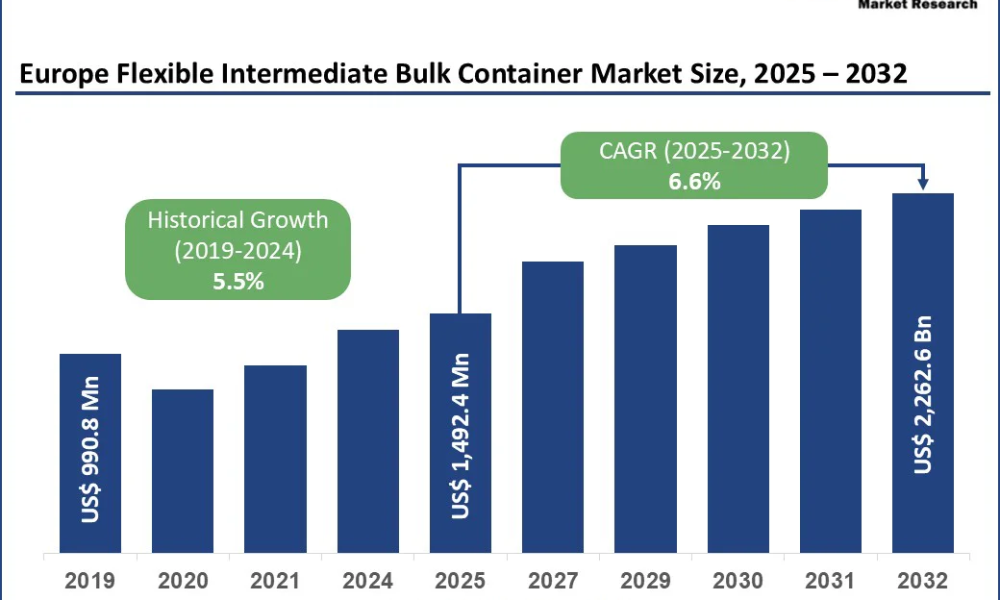
The Europe Flexible Intermediate Bulk Container (FIBC) market is witnessing steady and sustained growth, supported by the rising need for efficient, cost-effective, and sustainable bulk packaging solutions across multiple end-use industries. According to consolidated insights from leading market research firms, the market is projected to grow from a valuation of US$ 1,492.4 million in 2025 to US$ 2,262.6 million by 2032, registering a compound annual growth rate (CAGR) of 6.6% during the forecast period from 2025 to 2032.
Flexible Intermediate Bulk Containers, commonly referred to as FIBCs or bulk bags, are widely used for storing and transporting dry, flowable products such as grains, powders, chemicals, fertilizers, and pharmaceutical ingredients. Their growing adoption across Europe is closely linked to their advantages over rigid packaging alternatives, including lower transportation costs, reduced storage space requirements, high load-bearing capacity, and enhanced customization options.
Market growth is primarily driven by the expanding food processing sector, where FIBCs are increasingly used for sugar, flour, starch, grains, and other food ingredients. Additionally, the chemical industry continues to be a major contributor, leveraging FIBCs for the safe handling of hazardous and non-hazardous materials. The pharmaceutical sector is also playing a critical role, as manufacturers demand contamination-free, high-purity, and regulatory-compliant packaging solutions for active pharmaceutical ingredients (APIs) and excipients.
Further growth drivers include increasing cross-border trade within Europe, the rise of contract manufacturing, advancements in packaging materials, and a strong push toward sustainable and reusable packaging solutions. Regulatory emphasis on reducing packaging waste and improving supply chain efficiency is further accelerating the transition toward flexible bulk packaging formats.
Get Your FREE Sample Report Instantly Click Now: https://www.persistencemarketresearch.com/samples/35622
Market Segmentation
By Product Type
- Type A
- Type B
- Type C
- Type D
By Material Type
- Polypropylene (PP)
- Polyethylene (PE)
- Polyethylene Terephthalate (PET)
- Others
By End-user
- Food
- Chemical
- Pharmaceutical
- Others
By Sales Channel
- OEM
- Aftermarket
By Region
- North America
- Europe
- Asia Pacific
- Latin America
- Middle East & Africa
Regional Insights
From a regional standpoint, Western Europe remains the leading market for FIBCs, with countries such as Germany, France, the United Kingdom, and Italy accounting for a significant share of total demand. Germany, in particular, stands out due to its strong chemical manufacturing base, advanced logistics infrastructure, and high export activity. The presence of major pharmaceutical and food processing companies further supports market growth in the region.
Eastern Europe is emerging as the fastest-growing regional market, driven by rapid industrialization, expanding agricultural exports, and increasing foreign investments in manufacturing. Countries such as Poland, the Czech Republic, and Hungary are witnessing rising adoption of FIBCs as manufacturers seek cost-effective and scalable packaging solutions to support growing production volumes.
Southern Europe is also experiencing moderate growth, supported by the expansion of the food and beverage sector and increased focus on sustainable packaging practices. Across all regions, the harmonization of EU packaging regulations and cross-border trade policies is facilitating market expansion and standardization.
Customize This Report for Your Exact Requirements: https://www.persistencemarketresearch.com/request-customization/35622
Unique Features and Innovations in the Market
The modern Europe FIBC market is characterized by continuous innovation aimed at improving safety, sustainability, and operational efficiency. Manufacturers are increasingly focusing on lightweight yet high-strength fabrics, which reduce material usage while maintaining load-bearing performance. The use of recyclable polypropylene and mono-material designs is gaining prominence as companies align with circular economy principles.
Technological advancements are also reshaping the market landscape. IoT-enabled FIBCs, equipped with tracking sensors and RFID tags, are being adopted to enhance supply chain visibility, inventory management, and loss prevention. These smart containers allow real-time monitoring of location, temperature, and humidity, which is particularly valuable for pharmaceutical and food applications.
Artificial intelligence is being leveraged in manufacturing processes to improve quality control, detect fabric defects, and optimize production efficiency. Automation and data-driven analytics are enabling manufacturers to reduce waste, improve consistency, and meet stringent regulatory requirements. Although still in early stages, the integration of 5G-enabled connectivity is expected to further enhance real-time data transmission and logistics coordination in the coming years.
Market Highlights
One of the key reasons industries across Europe are increasingly adopting FIBCs is their cost-effectiveness compared to rigid packaging alternatives such as drums and metal containers. FIBCs offer higher payload capacity, lower transportation costs, and reduced storage requirements, making them an attractive option for bulk material handling.
Sustainability is another major market highlight. The growing emphasis on reducing carbon footprints and packaging waste has led to increased demand for reusable and recyclable FIBCs. Regulatory initiatives at both national and EU levels are encouraging the adoption of environmentally responsible packaging solutions, further supporting market growth.
Additionally, the flexibility of FIBCs in terms of customization, including size, shape, liners, and discharge mechanisms, allows manufacturers to tailor solutions to specific industry needs. This adaptability is particularly valuable in complex supply chains where product safety, efficiency, and compliance are critical.
Key Players and Competitive Landscape
The Europe FIBC market is moderately consolidated, with the presence of several established manufacturers and regional players competing on the basis of product quality, innovation, and distribution reach. Leading companies are focusing on capacity expansions, product differentiation, and strategic partnerships to strengthen their market position.
Key players operating in the Europe FIBC market include:
- Berry Global Group, Inc.
The company focuses on high-performance FIBC solutions with an emphasis on sustainability, leveraging recycled materials and advanced fabric technologies to serve food and chemical applications. - Greif, Inc.
Greif maintains a strong presence in Europe through its extensive manufacturing network and offers a wide range of bulk packaging solutions, emphasizing safety-compliant and value-added products. - LC Packaging International B.V.
Known for its strong sustainability initiatives, LC Packaging focuses on reusable FIBCs and innovative designs tailored to agricultural and food industries. - Conitex Sonoco
The company specializes in industrial-grade FIBCs and emphasizes customization, safety features, and long-term customer partnerships across Europe. - Rishi FIBC Solutions
With a growing footprint in Europe, the company focuses on high-quality, regulatory-compliant FIBCs for food, chemical, and pharmaceutical applications.
Competition in the market is intensifying as players invest in advanced manufacturing technologies, digitalization, and compliance with evolving safety and environmental regulations.
Recent Developments
- Several European FIBC manufacturers have recently expanded their production capacities and warehousing facilities to meet rising demand from the pharmaceutical and chemical sectors, reflecting confidence in long-term market growth.
- Leading players have introduced next-generation antistatic and food-grade FIBCs, incorporating improved barrier properties and traceability features to address stricter regulatory and quality requirements across Europe.
Ready to Dive Deep? Buy Full Report Today: https://www.persistencemarketresearch.com/checkout/35622
Future Opportunities and Growth Prospects
The future outlook for the Europe FIBC market remains highly positive, with significant opportunities arising from technological advancements, regulatory alignment, and evolving end-user requirements. The increasing adoption of smart packaging solutions, combined with the integration of digital supply chain platforms, is expected to create new value propositions for manufacturers and end users alike.
Growth opportunities are particularly strong in the pharmaceutical and specialty chemical sectors, where demand for high-purity, contamination-free packaging continues to rise. Additionally, the expansion of agricultural exports and food processing activities in Eastern Europe is expected to create new demand streams for cost-efficient bulk packaging.
Evolving regulations focused on sustainability, workplace safety, and packaging waste reduction will continue to shape the competitive landscape. Companies that proactively invest in compliant, innovative, and environmentally responsible FIBC solutions are likely to gain a competitive edge. As Europe continues to prioritize efficiency, safety, and sustainability across industrial supply chains, the flexible intermediate bulk container market is well-positioned for sustained growth through 2032 and beyond.




