
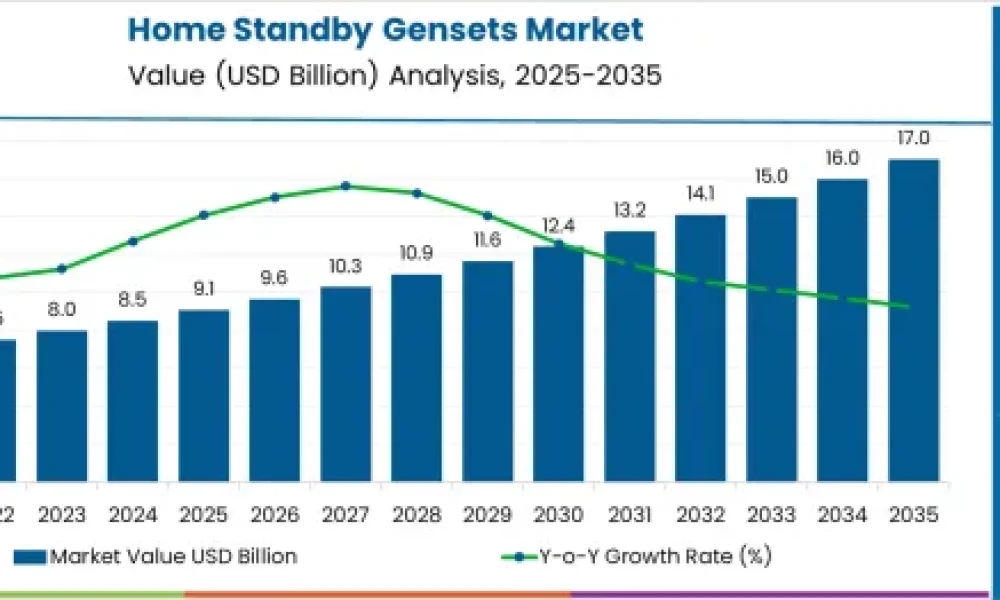
The global Home Standby Gensets Market is entering a decade of steady expansion as households worldwide seek reliable backup power solutions in response to power outages, extreme weather events, and increasing electrification of residential infrastructure. According to the latest market assessment, the market is valued at USD 9.1 billion in 2025 and is forecast to reach USD 17.0 billion by 2035, registering a compound annual growth rate (CAGR) of 6.5% over the forecast period.
This growth reflects structural shifts in how residential consumers manage power reliability, particularly in regions experiencing grid stress, climate-related disruptions, and rising dependence on electricity for critical household functions.
Explore the full market insights and exclusive data breakdowns – Request Your Sample Report Now
Market Growth Outlook: From Acceleration to Stability
A breakpoint analysis of the home standby gensets market highlights two distinct phases of growth. Between 2025 and 2030, the market is projected to grow from USD 9.1 billion to USD 12.4 billion, contributing USD 3.3 billion in incremental value at a CAGR of 6.7%. This phase is characterized by accelerated adoption, driven by heightened awareness of power reliability risks and demand for uninterrupted electricity for heating, cooling, security systems, and essential appliances.
Around 2030, the market reaches a structural inflection point as adoption becomes more widespread. From 2030 to 2035, growth moderates to a CAGR of 5.9%, with the market expanding by USD 4.6 billion to reach USD 17.0 billion. This phase reflects increasing market maturity, supported by technological advancements such as quieter operation, improved fuel efficiency, and the emergence of hybrid and renewable-integrated standby power systems.
Key Market Drivers and Industry Context
The primary driver of the home standby gensets market is the growing need for reliable residential backup power amid more frequent and prolonged power outages. Climate-driven extreme weather events, aging grid infrastructure, and rising electricity demand are increasing household vulnerability to power disruptions.
Technological improvements in genset efficiency, automatic transfer switches, and noise reduction are improving user experience and lowering operational barriers. In parallel, rising consumer awareness of energy security, combined with government initiatives aimed at strengthening residential power resilience, is supporting adoption across both developed and emerging economies.
The integration of smart home technologies with standby generators is also reshaping the market, enabling remote monitoring, diagnostics, and control—features increasingly valued by homeowners.
Segment Insights: Power Rating, Fuel, and Phase
- By power rating, gensets in the 10 kVA to 50 kVA range are expected to account for 4% of market share in 2025, making them the leading segment. Their dominance is driven by their ability to balance capacity, efficiency, and cost, effectively supporting typical household loads such as HVAC systems and kitchen appliances.
- In terms of fuel, diesel-powered gensets are projected to hold 7% of the market share by 2025. Diesel’s higher energy density, long operational life, and established supply infrastructure continue to make it the preferred option for homeowners requiring extended runtime and higher load support. Advances in emission control and noise reduction technologies have further strengthened diesel’s position.
- By phase, single-phase gensets are anticipated to generate 2% of market revenue in 2025, reflecting their compatibility with standard residential electrical systems. Their simpler design, ease of installation, and cost-effectiveness continue to drive widespread adoption.
Regional and Country-Level Growth Dynamics
Regionally, North America, Asia-Pacific, and Europe remain the key growth engines of the home standby gensets market. Among individual countries, China leads with a CAGR of 8.8%, followed by India at 8.1%, supported by rapid urbanization, rural electrification, and frequent power disruptions caused by natural disasters.
Developed markets show more moderate but stable growth. Germany (7.5%), the UK (6.2%), and the USA (5.5%) continue to invest in residential backup power due to extreme weather risks, energy security concerns, and growing adoption of renewable energy systems that require reliable backup solutions.
Competitive Landscape and Recent Developments
The competitive landscape includes established global and regional manufacturers such as Generac Power Systems, Gillette Generators, HIMOINSA, Hipower, Kirloskar, Mahindra Powerol, Pinnacle Generators, Ashok Leyland, Briggs & Stratton, Caterpillar, Champion Power Equipment, Cummins, Eaton, and Echo Group. Competition is shaped by factors including fuel efficiency, reliability, ease of installation, and integration with home automation systems.
Recent developments underscore broader industry momentum., Generac raised its full-year revenue forecast following increased power outages linked to volatile weather conditions., the company introduced its largest generators to date for the North American market, reflecting rising demand for high-capacity power solutions.
Market Outlook
As residential energy consumption intensifies and power reliability becomes a strategic concern for households, the home standby gensets market is expected to maintain stable, long-term growth through 2035. While high initial costs and maintenance requirements remain challenges, ongoing innovation, smart integration, and growing awareness of energy resilience are reinforcing the market’s role as a critical component of modern residential infrastructure.
Have a specific Requirements and Need Assistant on Report Pricing or Limited Budget please contact us – [email protected]
About Future Market Insights (FMI)
Future Market Insights, Inc. (FMI) is an ESOMAR-certified, ISO 9001:2015 market research and consulting organization, trusted by Fortune 500 clients and global enterprises. With operations in the U.S., UK, India, and Dubai, FMI provides data-backed insights and strategic intelligence across 30+ industries and 1200 markets worldwide
Why Choose FMI: https://www.futuremarketinsights.com/why-fmi



