
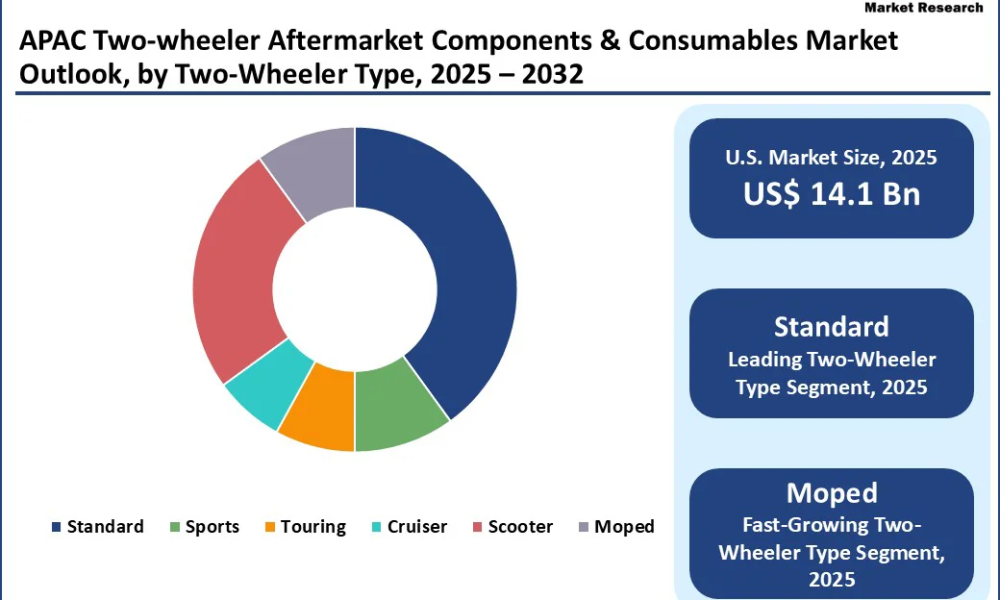
The APAC Two-Wheeler Aftermarket Components & Consumables Market is witnessing strong and sustained expansion, driven by the region’s dominance in global two-wheeler production and ownership. According to consolidated insights from leading market research firms, the market is likely to be valued at US$ 14.1 billion in 2025 and is projected to reach approximately US$ 24.7 billion by 2032, registering a compound annual growth rate (CAGR) of 8.4% during the forecast period 2025–2032. This robust growth trajectory reflects the rising demand for replacement parts, consumables, and value-added services across both internal combustion engine (ICE) and electric two-wheelers.
APAC remains the epicenter of global two-wheeler usage due to high population density, cost-sensitive mobility needs, and underdeveloped public transportation in several emerging economies. Increasing disposable incomes, urban congestion, and fuel efficiency concerns have further reinforced the preference for motorcycles and scooters as primary modes of transportation. As vehicle parc continues to expand, the need for routine maintenance, wear-and-tear replacements, and performance upgrades has become a key growth catalyst for the aftermarket ecosystem.
Another major factor underpinning market growth is the accelerating adoption of electric two-wheelers across countries such as China, India, Vietnam, and Indonesia. While electric powertrains reduce the need for certain mechanical components, they introduce new aftermarket opportunities in batteries, electronic controllers, software-enabled diagnostics, and specialized consumables. In parallel, rising consumer interest in vehicle personalization, aesthetic upgrades, and premium accessories is reshaping the aftermarket landscape, pushing manufacturers and distributors toward innovation-driven portfolios.
Get Your FREE Sample Report Instantly Click Now: https://www.persistencemarketresearch.com/samples/35619
APAC Two-wheeler Aftermarket Components & Consumables Market Segmentation
By Product Type
- Engine Parts
- Braking Systems
- Suspension Systems
- Transmission Parts
- Electrical Components
- Exhaust Systems
- Lighting Systems
- Consumables
- Lubricants
- Filters
- Spark Plugs
- Batteries
By Two-wheeler Type
- Standard
- Sports
- Touring
- Cruiser
- Scooter
- Moped
By Sales Channel
- Sales Channel
- Authorized Dealers
- Independent Dealers
- Online Platforms
By Country
- China
- Japan
- South Korea
- India
- Southeast Asia
- ANZ
- Rest of APAC
Regional Insights
APAC as a region leads the global two-wheeler aftermarket, with China and India representing the largest revenue contributors. China’s leadership is supported by its massive electric two-wheeler fleet, well-established component manufacturing ecosystem, and advanced digital service infrastructure. India, on the other hand, benefits from one of the world’s largest two-wheeler populations, a growing middle class, and increasing formalization of the aftermarket sector.
Southeast Asian countries such as Indonesia, Vietnam, Thailand, and the Philippines collectively form a high-growth sub-region within APAC. These markets are characterized by high two-wheeler penetration rates, favorable demographics, and expanding urban populations. Among them, India and Southeast Asia are expected to emerge as the fastest-growing markets over the forecast period, driven by rising vehicle sales, increasing awareness of preventive maintenance, and the rapid adoption of electric scooters and motorcycles.
Japan and South Korea represent more mature markets, where growth is driven primarily by premiumization, advanced technologies, and high-quality replacement components rather than volume expansion. These countries are also playing a critical role in innovation, exporting advanced aftermarket solutions and setting quality benchmarks for the region.
Customize This Report for Your Exact Requirements: https://www.persistencemarketresearch.com/request-customization/35619
Unique Features and Innovations in the Market
The modern APAC two-wheeler aftermarket is increasingly differentiated by technology integration, product customization, and service digitization. Manufacturers are investing in advanced materials to enhance component durability, reduce weight, and improve performance, particularly for braking systems, suspension, and drivetrain components. Consumables such as lubricants and fluids are being reformulated to meet stricter emission norms and improve energy efficiency.
Technologies such as artificial intelligence (AI), the Internet of Things (IoT), and cloud-based analytics are playing a transformative role in the aftermarket. AI-driven diagnostics enable predictive maintenance by analyzing riding patterns, component wear, and operating conditions. IoT-enabled sensors embedded in batteries, brakes, and engines allow real-time monitoring and early fault detection, reducing downtime and maintenance costs. While 5G adoption is still emerging, its integration is expected to enhance connected vehicle ecosystems, enabling faster data transmission and more responsive service platforms.
Customization and personalization have also become defining features of the market. Consumers increasingly seek aesthetic enhancements, performance upgrades, and smart accessories, prompting aftermarket players to offer modular and configurable solutions. This shift is particularly evident among younger riders and urban consumers, who view two-wheelers as lifestyle products rather than mere transportation tools.
Market Highlights
One of the key reasons for the widespread adoption of aftermarket components and consumables in APAC is the cost-effectiveness of maintenance compared to vehicle replacement. Regular servicing and timely replacement of consumables significantly extend vehicle life, making aftermarket solutions economically attractive for both individual consumers and fleet operators.
Regulatory frameworks across the region are also shaping market dynamics. Stricter emission standards and safety regulations are driving demand for compliant components, advanced braking systems, and environmentally friendly consumables. Sustainability has emerged as a critical consideration, with manufacturers focusing on recyclable materials, longer-lasting products, and low-emission lubricants. Additionally, the growth of organized service networks and digital platforms is improving service quality, transparency, and consumer trust.
Key Players and Competitive Landscape
The APAC two-wheeler aftermarket components and consumables market is moderately fragmented, with the presence of global players, regional manufacturers, and a large number of local suppliers. Leading companies are focusing on product innovation, strategic partnerships, and geographic expansion to strengthen their competitive positions.
Key players operating in the market include:
- Robert Bosch GmbH – Leveraging advanced engineering capabilities and digital diagnostics to expand its aftermarket portfolio across APAC.
- Continental AG – Focusing on safety systems, braking components, and smart mobility solutions tailored for two-wheelers.
- ZF Friedrichshafen AG – Strengthening its presence through high-performance drivetrain and chassis components.
- Denso Corporation – Expanding its aftermarket offerings in electrical and electronic components, particularly for electric two-wheelers.
- Bridgestone Corporation – Maintaining leadership in the tire segment through product innovation and regional manufacturing expansion.
- Castrol Limited – Driving growth through premium lubricants, sustainability-focused formulations, and strong distribution networks.
- TVS Motor Company (Aftermarket Division) – Capitalizing on OEM-backed trust and a wide service network in India and Southeast Asia.
- Hero MotoCorp (Genuine Parts Business) – Expanding organized aftermarket reach with branded components and accessories.
These players are increasingly investing in R&D, digital platforms, and strategic collaborations with OEMs and mobility service providers to capture emerging opportunities.
Recent Developments
- Several leading aftermarket manufacturers have introduced EV-specific components and consumables, including advanced battery packs, smart chargers, and EV-compatible lubricants, to address the growing electric two-wheeler fleet across APAC.
- Strategic partnerships between aftermarket players and e-commerce platforms have been announced to enhance digital distribution, improve last-mile delivery, and expand access to branded components in tier-2 and tier-3 cities.
Ready to Dive Deep? Buy Full Report Today: https://www.persistencemarketresearch.com/checkout/35619
Future Opportunities and Growth Prospects
The future of the APAC two-wheeler aftermarket components and consumables market is closely tied to electrification, digitalization, and sustainability. As electric two-wheelers gain mainstream acceptance, aftermarket players have significant opportunities to develop specialized products and services that address new maintenance and performance requirements. Battery lifecycle management, software updates, and predictive maintenance services are expected to emerge as high-value segments.
Evolving regulations related to emissions, safety, and recycling will continue to influence product design and material selection, encouraging innovation and standardization across the industry. At the same time, advancements in AI, IoT, and connectivity will enable more efficient supply chains, data-driven decision-making, and enhanced customer experiences. With strong fundamentals, a vast vehicle parc, and continuous technological evolution, the APAC two-wheeler aftermarket components and consumables market is well-positioned for sustained growth over the coming decade.




