
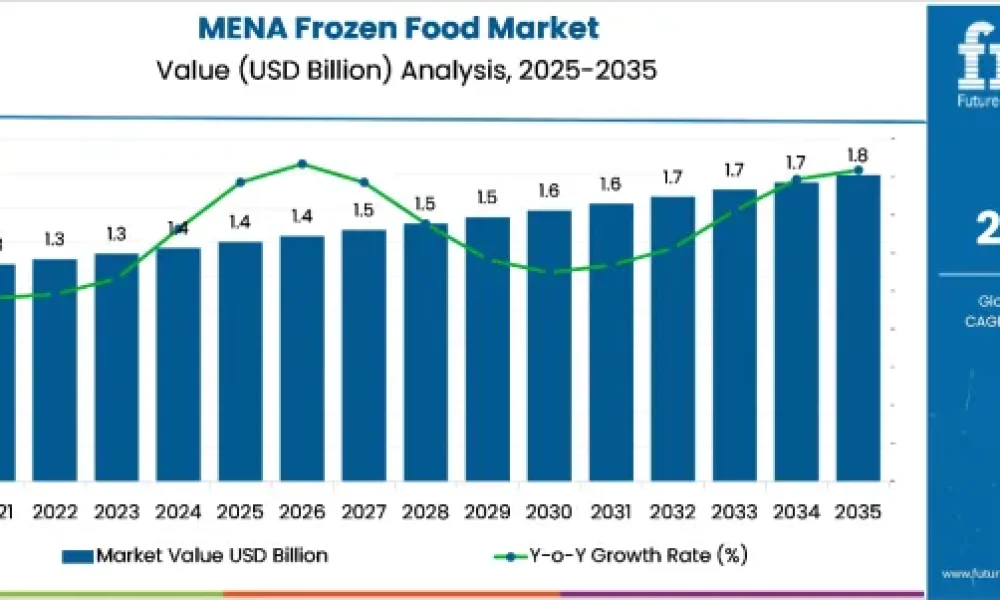
The Middle East and North Africa (MENA) frozen food market is undergoing steady structural transformation as changing lifestyles, expanding urban populations, and improved cold-chain capabilities reshape food consumption across the region. Valued at USD 1.4 billion in 2025, the market is projected to reach USD 1.8 billion by 2035, growing at a compound annual growth rate (CAGR) of 2.5% during the forecast period. Over the next decade, the market is expected to generate an absolute dollar opportunity of USD 0.4 billion, reflecting consistent demand rather than short-term volatility.
Growth momentum is being supported by rising demand for convenient, long-shelf-life food products, increasing penetration of modern retail formats, and the growing popularity of frozen meals among both urban households and expatriate populations. By 2030, the market is anticipated to reach approximately USD 1.6 billion, indicating balanced value creation across both halves of the forecast period.
Download a Sample Report, customize your research scope, or secure the Full Report for comprehensive industry analysis. : https://www.futuremarketinsights.com/reports/brochure/rep-nf-243
Frozen Food Becomes a Core Part of the Regional Convenience Economy
Frozen food now accounts for nearly 36% of the overall convenience food market in MENA, underlining its importance in regional food systems. The category contributes around 28% of the ready-to-eat meals segment, driven by demand from working households and a rapidly expanding HoReCa sector. It also represents close to 25% of the premium packaged food segment, supported by innovations in freezing technologies, packaging, and premium ingredient sourcing.
In health-focused categories, frozen fruits and vegetables hold about 18% of the healthy snacking market, benefiting from growing awareness of nutrient retention in frozen produce. Meanwhile, frozen foods contribute nearly 20% of the plant-based convenience food segment, aligning with increasing interest in vegetarian and flexitarian meal options.
Ready-to-Eat Products Anchor Market Value
Among categories, ready-to-eat (RTE) frozen foods dominate with a 40% market share in 2025, making them the most lucrative segment. RTE products benefit from high repeat purchase rates, premium pricing potential, and strong alignment with urban lifestyles. Innovation in ethnic cuisines, single-serve meals, and healthier formulations with reduced sodium and preservatives is supporting higher average selling prices.
Fruits and vegetables represent the largest product type, accounting for 20% of total market share. Their year-round availability, competitive pricing, and wide acceptance across households and foodservice channels make them a stable revenue driver. Advanced individual quick freezing (IQF) technology is enabling premium offerings such as berries, mixed vegetable blends, and portion-controlled kits, helping brands improve margins while maintaining quality.
UAE and Saudi Arabia Lead Regional Growth
Growth dynamics vary significantly across countries, with the United Arab Emirates and Saudi Arabia emerging as the fastest-growing markets.
- UAE is forecast to expand at a 9.2% CAGR, supported by a large expatriate population, strong tourism inflows, and advanced retail infrastructure. Demand is particularly strong for premium ready meals, frozen meats, seafood, and desserts.
- Saudi Arabia follows closely with a 9.1% CAGR, driven by Vision 2030 reforms, retail modernization, and rising consumption of frozen poultry, seafood, and bakery products.
- Qatar is projected to grow at 7.2%, benefiting from high disposable incomes and tourism-led foodservice demand.
- Kuwait is expected to expand at 6.5%, supported by premium imports and changing household structures.
- Egypt, while growing more moderately at 5.6%, benefits from population growth, affordability-driven demand, and rising female workforce participation.
Retail Expansion and Cold Chain Investments Support Accessibility
The expansion of supermarkets, hypermarkets, and online grocery platforms is significantly improving product accessibility across MENA markets. E-commerce grocery channels, particularly in Gulf countries, are accelerating frozen food adoption by offering reliable cold delivery and wider product assortments. Strategic investments in cold chain infrastructure and freezing technologies are helping manufacturers maintain product integrity in the region’s hot climate.
At the same time, partnerships between frozen food producers, logistics providers, and large retail chains are strengthening distribution efficiency and shelf visibility. Premiumization trends are evident as consumers increasingly opt for organic, gluten-free, high-protein, and internationally inspired frozen meals.
Challenges Persist Across Import-Heavy Markets
Despite positive fundamentals, the market faces notable constraints. High dependence on imported frozen products exposes manufacturers and retailers to global price volatility and currency fluctuations, with import costs accounting for up to 40% of retail pricing. Energy-intensive cold storage raises operating costs, while customs clearance delays can disrupt seasonal supply.
Infrastructure gaps remain more pronounced in parts of North Africa, where limited cold storage capacity contributes to higher spoilage rates and restricts product diversity. Addressing these challenges will be critical for sustaining long-term growth beyond major Gulf economies.
Competitive Landscape Favors Scale and Localization
The MENA frozen food market is moderately consolidated. General Mills Inc. leads with an estimated 18% market share, supported by a diversified portfolio and strong retail relationships. Other prominent players include Nestlé S.A., Al Kabeer Group, Sunbulah Group, and Kraft Heinz Company, all of which leverage global sourcing, advanced freezing technologies, and localized product strategies.
Regional players are gaining traction by focusing on Halal-certified offerings, value pricing, and country-specific taste profiles, while established multinationals maintain an edge through scale efficiencies and premium positioning.
Outlook: Steady Growth Anchored in Convenience and Quality
Looking ahead, the Middle East and North Africa frozen food market is set for measured but resilient growth, anchored in convenience-driven consumption, retail modernization, and ongoing premiumization. As cold chain infrastructure improves and consumer trust in frozen food quality continues to rise, frozen products are expected to move further into the mainstream, reinforcing their role as a core pillar of the region’s evolving food landscape through 2035.
About Future Market Insights (FMI)
Future Market Insights, Inc. (FMI) is an ESOMAR-certified, ISO 9001:2015 market research and consulting organization, trusted by Fortune 500 clients and global enterprises. With operations in the U.S., UK, India, and Dubai, FMI provides data-backed insights and strategic intelligence across 30+ industries and 1,200 markets worldwide.
Contact Us:
Future Market Insights Inc.
Christiana Corporate, 200 Continental Drive,
Suite 401, Newark, Delaware – 19713, USA
T: +1-347-918-3531
For Sales Enquiries: [email protected]



