
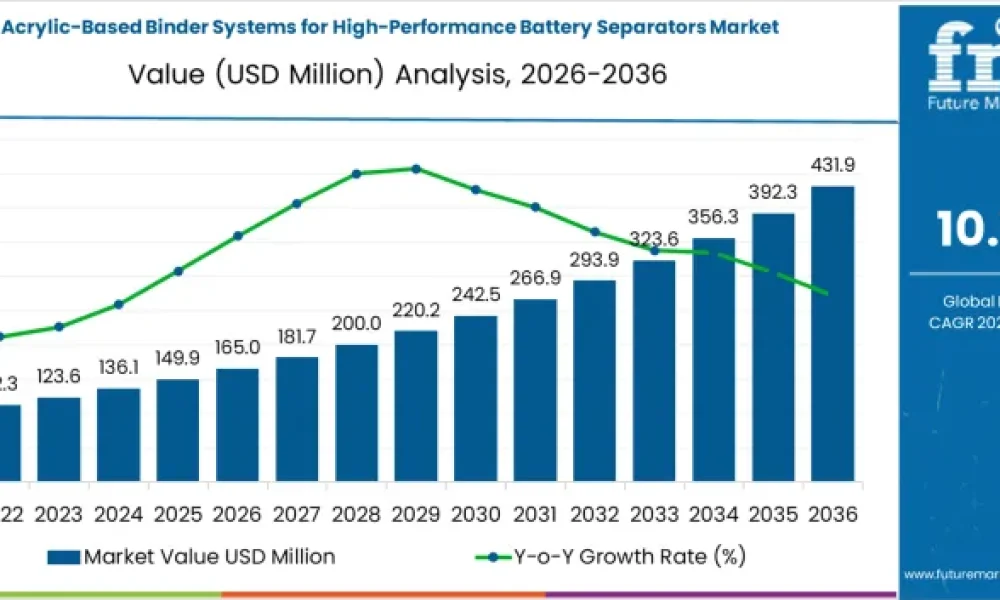
The global Acrylic-Based Binder Systems for High-Performance Battery Separators Market is projected to grow from an estimated USD 165 million in 2026 to approximately USD 431.9 million by 2036 at a robust CAGR of 10.1%, driven by unprecedented demand for advanced lithium-ion batteries across electrification and energy storage applications. This rapid expansion reflects the accelerating role of advanced binder chemistries in driving next-generation battery performance, safety, and lifecycle improvements.
In an era where energy transition imperatives are reshaping industrial priorities, acrylic-based binders are emerging as indispensable components in high-performance separator technologies. Market growth is anchored in the need for binders that enhance thermal stability, mechanical integrity, and electrolyte compatibility, particularly in electric vehicles (EVs), grid energy storage systems, and high-duty mobile electronics.
Key Market Insights at a Glance
The acrylic-based binder systems market is characterized by diversity in formulation types—including standard acrylic systems, PVDF-acrylic hybrids, water-based dispersions, and nano-enhanced composite solutions—that cater to distinct performance and manufacturing requirements. Acrylic binders currently hold approximately half of the total binder chemistry market share, with their widespread adoption attributed to superior adhesion properties and compatibility with battery separator fabrication processes. Lithium-ion battery separator applications account for nearly 48% of the total demand, underscoring the critical role of acrylic binders in enabling separator functionality, especially in high-cycle and high-safety environments.
Segment Overview
Market segmentation highlights a balance between binder chemistry innovations and application performance requirements. Acrylic binder systems dominate due to their ability to deliver a consistent coating profile on separator membranes, which enhances mechanical strength and thermal resilience—essential for high-performance cells. PVDF-acrylic hybrids and water-based acrylic dispersions are gaining traction where process sustainability and solvent reduction are priorities, while nano-enhanced composites are advancing in niche, high-duty applications that require tailored property combinations. Across these segments, manufacturers prioritize uniform rheology, regulatory alignment, and scalable production to meet strict battery manufacturing specifications.
To access the complete data tables and in-depth insights — Request Your Sample Report Now
Regional Overview
Geographic growth patterns reveal strong adoption in Asia Pacific markets, notably India and China, where EV manufacturing and stationary storage capacity are scaling rapidly. India leads with the highest regional projected CAGR, supported by domestic investments in battery assembly and energy storage infrastructure. China follows closely with substantial production volumes and global export demand, while the United States and Brazil are also notable markets with accelerating integration of high-performance binders in battery supply chains. The United Kingdom is gradually expanding its footprint, driven by regulatory emphasis on energy storage safety and performance.
Competitive Landscape
The competitive landscape features established material science leaders and specialist polymer innovators that are expanding their product portfolios through technology upgrades, strategic partnerships, and capacity enhancements. Key players are enhancing capabilities in high-precision binder formulations and process reliability to maintain differentiation in a competitive arena. Market leaders are increasingly focusing on integrated solutions that offer performance consistency, validated application outcomes, and supply chain resilience.
Market Outlook: Powering the Next Decade
Looking ahead, market expansion will align with broader electrification trends, supportive regulatory frameworks, and investments in sustainable energy solutions. The transition to cleaner transportation and grid systems places advanced battery materials at the forefront of innovation. Over the next decade, acrylic-based binder systems are expected to evolve beyond performance enhancements to become central components in enabling cost-effective, reliable, and safer battery architectures—critical for achieving global decarbonization goals.
Key Players of Sustainable Label Industry
The industry’s competitive ecosystem comprises diversified chemical manufacturers and niche binder system developers that are setting benchmarks for quality, sustainability, and performance. These players are actively engaged in innovation pipelines, focusing on material science breakthroughs, eco-friendly formulations, and collaborative development with battery manufacturers to co-optimize separators for specific cell requirements.
Recent Strategic Developments
Recent strategic developments include R&D investments aimed at expanding binder applications across next-generation battery formats, partnerships to validate performance under accelerated aging protocols, and supply chain initiatives to secure raw polymer resources. These efforts illustrate a market in motion, where agility and technological differentiation are key to capturing value as demand for high-performance batteries continues its upward trajectory.
Have a specific Requirements and Need Assistant on Report Pricing or Limited Budget please contact us – [email protected]
About Future Market Insights (FMI)
Future Market Insights, Inc. (FMI) is an ESOMAR-certified, ISO 9001:2015 market research and consulting organization, trusted by Fortune 500 clients and global enterprises. With operations in the U.S., UK, India, and Dubai, FMI provides data-backed insights and strategic intelligence across 30+ industries and 1200 markets worldwide.
Why Choose FMI: https://www.futuremarketinsights.com/why-fmi



