
The textile industry is undergoing a transformative shift, fueled by technological innovations, sustainability demands, and evolving consumer preferences. Among the most significant developments is the rise of digital textile printing, a technology that is redefining how textiles are produced, customized, and consumed. As the global digital textile printing market continues its rapid expansion, understanding the underlying trends, market dynamics, and growth drivers is essential for businesses, investors, and industry stakeholders.
Market Overview and Size
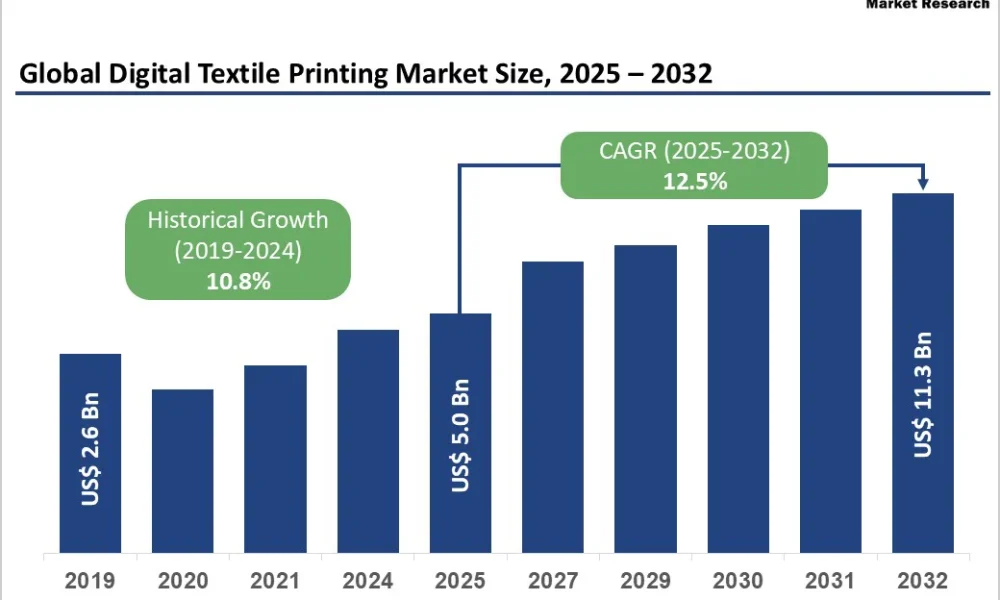
The global digital textile printing market was valued at US$ 5.0 billion in 2025 and is projected to reach US$ 11.3 billion by 2032, growing at a CAGR of 12.5% during the forecast period. This robust growth highlights the increasing adoption of digital printing solutions across apparel, home textiles, and industrial fabrics. The surge is primarily driven by technological convergence in digital printing hardware, software, and inks, alongside the global push toward sustainable manufacturing and on-demand production models.
Digital textile printing is favored for its ability to offer high-resolution designs, rapid production cycles, and personalized customization, which are increasingly demanded by both brands and end consumers. Unlike conventional screen printing, digital printing significantly reduces water consumption, chemical usage, and energy requirements, aligning with global sustainability objectives and environmental regulations.
Key Market Drivers
- Technological Advancements
The rapid development of Direct-to-Fabric (DTF) and Direct-to-Garment (DTG) printing technologies has been pivotal in accelerating market growth. These methods allow manufacturers to produce complex designs with high precision and minimal waste, reducing the need for multiple production steps. Furthermore, improvements in ink formulations, including pigment and reactive dyes, have enhanced print quality, durability, and vibrancy across both natural and synthetic fabrics.
Automation and AI-integrated printing systems are further enhancing production efficiency. Smart printers equipped with AI and IoT connectivity can monitor print consistency, detect errors, and optimize resource use, making large-scale digital printing operations more cost-effective and scalable.
- Sustainability and Eco-Friendly Practices
Sustainability has become a central concern in the textile industry, prompting brands to explore greener manufacturing methods. Traditional textile printing is notorious for high water consumption and chemical discharge, whereas digital printing offers a significantly more eco-efficient alternative. Companies are increasingly adopting waterless digital printing systems and bio-based inks, contributing to reduced environmental footprints and compliance with regulations in key markets such as Europe and North America.
Government initiatives and policies are also incentivizing sustainable practices. For instance, the European Union’s textile sustainability regulations encourage manufacturers to reduce waste and invest in eco-friendly production technologies, which has directly bolstered the adoption of digital printing solutions in the region.
- Shift to On-Demand and Custom Manufacturing
Consumer preferences are increasingly moving toward personalized, fast-fashion, and limited-edition textiles, a trend that traditional bulk manufacturing struggles to accommodate. Digital textile printing enables on-demand production, allowing brands to produce smaller batches quickly while maintaining high-quality output. This approach not only minimizes inventory costs but also mitigates the risk of overproduction, a major challenge in conventional textile supply chains.
Retailers and fashion brands are leveraging this technology to offer custom designs, seasonal collections, and niche products, thereby enhancing customer engagement and brand loyalty. The ability to print complex patterns without the need for screens or plates provides unmatched flexibility in design execution.
Regional Insights
East Asia: Market Leader
East Asia dominated the global digital textile printing market with a 37% share in 2025, driven largely by China’s textile manufacturing prowess. China’s strong export-oriented textile sector and initiatives under the “Made in China 2025” framework have accelerated the adoption of eco-efficient digital printing technologies. Manufacturers in China are increasingly integrating advanced digital printers and sustainable production techniques to meet international demand for high-quality, environmentally conscious textiles.
Europe: Premium Manufacturing Hub
Europe accounted for 23% of the global market, with Italy leading the regional share at 36% of European turnover. Italy’s premium fashion and textile industry relies heavily on digital printing for bespoke, luxury fabrics. Coupled with stringent sustainability regulations and a strong emphasis on craftsmanship, digital printing has become a key enabler for high-end European manufacturers, providing both design flexibility and eco-conscious production methods.
North America: Innovation and Reshoring
North America held a 20% market share in 2025, supported by reshoring initiatives, substantial investments in modern textile production, and strict EPA-led environmental standards. Companies are modernizing production facilities with advanced digital printing systems, often exceeding $22 billion in investments, to improve efficiency, reduce environmental impact, and meet the growing demand for locally produced, customizable textiles.
Elevate your business strategy with comprehensive market data. Request a sample report now: https://www.persistencemarketresearch.com/samples/27313
Technology Segmentation
Direct-to-Fabric (DTF) and Direct-to-Garment (DTG)
DTF and DTG technologies dominated the market with a 33% share, favored for their versatility, production efficiency, and customization capabilities. These methods allow rapid printing of small batches and intricate designs directly onto fabrics or garments, making them ideal for fashion brands, promotional materials, and specialty textiles.
Sublimation and Inkjet Printing
Other digital printing technologies such as sublimation and inkjet are gaining traction due to their ability to deliver vivid colors and durable prints. Sublimation printing, in particular, is widely used for polyester fabrics and home textiles, offering long-lasting prints without compromising fabric integrity. Inkjet printing, meanwhile, is preferred for detailed artwork and limited-edition collections due to its precision and low setup requirements.
End-Use Insights
Apparel and Fashion
The apparel and fashion segment dominated the market with a 42% share in 2025, fueled by growing demand for personalized, sustainable, and fast-fashion solutions. Digital printing allows brands to produce small, customized runs with high speed and quality, which is increasingly important in an era of consumer-driven trends and short product life cycles.
Home Textiles and Industrial Applications
Home textiles, including curtains, upholstery, and bedding, also contribute significantly to the market. Industrial applications, such as automotive textiles, workwear, and protective fabrics, are increasingly adopting digital printing for functional customization, such as UV-resistant coatings, flame-retardant inks, and corporate branding.
Soft Signage and Promotional Materials
The fastest-growing application segment is soft signage and promotional materials. Lightweight, reusable, and visually impactful, digitally printed banners, posters, and displays are revolutionizing the events, retail, and advertising sectors. Digital textile printing enables rapid production of high-quality displays that can be updated frequently without excessive waste.
Fabric Insights
Natural Fibres
Natural fibres held the largest fabric share at 48%, with cotton-based textiles being particularly popular in apparel and home furnishing applications. Consumers are increasingly seeking breathable, comfortable, and sustainable fabrics, which aligns perfectly with digital printing technology that supports natural fibre compatibility.
Blended Fabrics
Blended fabrics emerged as the fastest-growing segment, offering enhanced durability, comfort, and sustainability. The versatility of blends, such as cotton-polyester and silk-wool mixes, allows manufacturers to combine aesthetics with functionality, meeting the evolving demands of both fashion and industrial textiles. Digital printing technologies are particularly adept at handling these blends, ensuring high-quality output without compromising fabric properties.
Key Market Trends
- Customization and Personalization
Consumer demand for unique and individualized products is driving a surge in digital textile printing adoption. Retailers are offering options such as monogramming, custom patterns, and limited-edition prints, which are impractical with traditional printing methods.
- Sustainability as a Core Strategy
Sustainability is no longer optional but a strategic imperative. Digital textile printing minimizes water usage, chemical waste, and energy consumption, positioning it as a preferred solution for eco-conscious brands and consumers.
- Integration of Smart Technologies
The integration of AI, IoT, and cloud-based production management is enabling real-time monitoring, predictive maintenance, and automated quality control, significantly enhancing productivity and consistency.
- On-Demand Production and Supply Chain Restructuring
Digital textile printing facilitates on-demand manufacturing, allowing brands to reduce inventory costs and respond quickly to market trends. This capability is reshaping global textile supply chains, moving away from bulk production toward flexible, demand-driven models.
Challenges and Considerations
Despite the strong growth, the digital textile printing market faces several challenges:
- High initial capital investment in advanced printers and production infrastructure.
- Technical expertise requirements for operating and maintaining digital printing systems.
- Ink and material limitations, particularly for certain synthetic fibres or specialty fabrics.
Addressing these challenges requires continued innovation, workforce training, and strategic partnerships between technology providers and textile manufacturers.
Future Outlook
The global digital textile printing market is poised for sustained growth, driven by:
- Expansion of sustainable production practices across major regions.
- Increasing consumer demand for personalized fashion and home textiles.
- Adoption of blended and functional fabrics in industrial applications.
- Growth of soft signage and promotional applications, reflecting broader marketing trends.
By 2032, the market is expected to more than double in value to US$ 11.3 billion, demonstrating the resilience and adaptability of digital textile printing as a core textile manufacturing technology.
Conclusion
Digital textile printing represents a paradigm shift in the textile industry, combining speed, flexibility, sustainability, and design innovation. With rising consumer demand for personalized, eco-friendly, and fast-fashion solutions, digital printing is not just an optional technology but a strategic enabler for modern textile businesses.
As the market continues to expand, manufacturers and brands that invest in advanced printing technologies, sustainable practices, and on-demand production models will be best positioned to capitalize on growth opportunities and meet evolving consumer expectations.
The future of textiles is digital, and the printing revolution is just beginning. Companies that embrace this transformation are likely to lead the industry into a new era of sustainable, creative, and highly responsive production.
Related Reports:




