
The high content screening (HCS) market has emerged as a critical pillar of modern life-sciences research, enabling researchers to extract rich, multiparametric data from complex cellular systems. HCS combines automated microscopy, advanced image analysis, and high-throughput workflows to analyze cellular responses at scale, making it indispensable for drug discovery, toxicology studies, and functional genomics. Unlike traditional single-endpoint assays, high content screening delivers detailed phenotypic insights, helping scientists better understand disease mechanisms and predict drug behavior earlier in development pipelines.
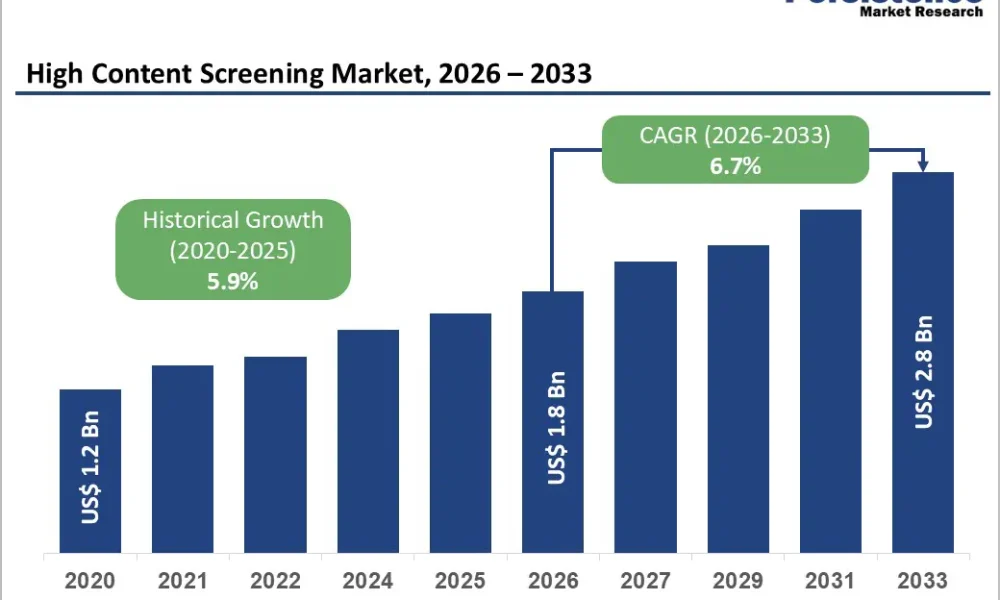
Globally, the high content screening market is estimated to grow from US$ 1.8 billion in 2026 to US$ 2.8 billion by 2033, registering a compound annual growth rate (CAGR) of 6.7% during the forecast period. This growth is fueled by increasing drug discovery activity, rising adoption of complex cell-based assays, and growing reliance on automation and AI-powered imaging technologies. Instruments currently represent the leading market segment due to their foundational role in HCS workflows, while North America dominates geographically because of its advanced research infrastructure, high R&D spending, and early adoption of automated screening platforms. Asia Pacific, supported by expanding biotech investments and a rapidly growing research ecosystem, stands out as the fastest-growing regional market.
Key Highlights from the High Content Screening Market Report
• The global high content screening market is projected to grow at a steady CAGR of 6.7% from 2026 to 2033.
• Instruments remain the dominant product segment, accounting for over 41% of total market share.
• Rising drug discovery pipelines are significantly increasing demand for high-throughput, image-based screening.
• North America leads the global market due to strong R&D investment and advanced life-sciences infrastructure.
• Asia Pacific is the fastest-growing region, driven by expanding biotech startups and clinical research activity.
• Integration of AI-driven image analysis and 3D cell models is reshaping the future of HCS platforms.
Download Your Free Sample & Explore Key Insights: https://www.persistencemarketresearch.com/samples/12931
Market Segmentation Analysis
The high content screening market is segmented based on product type, application, and end-user, each contributing uniquely to overall market dynamics. From a product perspective, the market includes instruments, consumables, software, and services. Instruments dominate the market because automated imaging systems, high-content microscopes, and robotic platforms are essential to acquiring high-resolution cellular data. These systems form the backbone of HCS workflows, and once installed, they drive recurring demand for consumables and software.
By application, primary and secondary screening account for the largest share of market usage. These stages require rapid, high-throughput evaluation of large compound libraries, where multiparametric cellular readouts are critical for identifying viable drug candidates. High content screening enables researchers to observe changes in cell morphology, protein localization, viability, and signaling pathways simultaneously, making it highly effective in early-stage drug discovery.
In terms of end-users, pharmaceutical and biotechnology companies represent the largest customer base, followed by academic research institutes and contract research organizations. Pharmaceutical companies increasingly rely on HCS to improve predictive accuracy, reduce late-stage drug failures, and accelerate development timelines. Academic and government-funded research institutions also play a significant role, particularly in disease biology, functional genomics, and translational research applications.
Regional Insights into the High Content Screening Market
North America continues to dominate the high content screening market, accounting for the largest share of global revenue. The region benefits from substantial investment in biomedical research, with the United States alone spending tens of billions of dollars annually on pharmaceutical R&D. A dense concentration of pharmaceutical companies, biotech startups, academic research centers, and contract research organizations creates a highly favorable environment for the adoption of advanced HCS platforms. Early integration of automation, artificial intelligence, and high-throughput screening technologies further strengthens North America’s leadership position.
Europe represents another significant market for high content screening, supported by strong public and private investment in life sciences research. Countries such as Germany, Sweden, Belgium, and Austria consistently invest a high percentage of GDP into R&D, fostering advanced laboratory infrastructure and skilled scientific talent. Europe’s emphasis on translational research, personalized medicine, and regulatory-driven safety testing continues to drive demand for high content screening systems across both academic and industrial settings.
Asia Pacific is the fastest-growing regional market, driven by rapid expansion of pharmaceutical manufacturing, increasing clinical trial activity, and a rising number of biotech startups. Countries such as China, India, Japan, South Korea, Singapore, and Australia are investing heavily in research infrastructure and innovation ecosystems. The region’s large patient populations, growing prevalence of chronic diseases, and increasing adoption of AI-powered imaging and analysis platforms are accelerating the uptake of high content screening technologies, positioning Asia Pacific as a key growth engine for the global market.
Get Custom Insights Designed for Your Business: https://www.persistencemarketresearch.com/request-customization/12931
Market Drivers
The primary driver of the high content screening market is the rapid growth of global drug discovery and development activities. With thousands of new drug candidates entering development pipelines each year, researchers require screening technologies that can evaluate efficacy, toxicity, and mechanisms of action efficiently and accurately. High content screening addresses this need by enabling detailed, multiparametric analysis of cellular responses in high-throughput formats, making it indispensable for modern drug discovery workflows.
Another major driver is the increasing adoption of complex cell-based assays over traditional biochemical tests. As understanding of disease biology deepens, researchers are moving toward phenotypic and functional assays that better replicate in vivo conditions. Advances in imaging technologies, machine learning, and AI-based data analysis have further enhanced the analytical power of HCS systems, allowing scientists to extract meaningful insights from vast volumes of imaging data. Additionally, growing focus on personalized medicine and safety testing is increasing reliance on high content screening platforms across pharmaceutical and academic research environments.
Market Restraints
Despite its strong growth potential, the high content screening market faces significant restraints, primarily related to the high cost of instruments and associated software. Advanced HCS systems often require substantial upfront investment, with fully automated imaging and screening platforms costing several hundred thousand dollars. For smaller laboratories, academic institutions, and early-stage biotech companies, these capital requirements can be prohibitive, limiting broader adoption.
Operational complexity and recurring costs also present challenges. High content screening workflows require specialized reagents, consumables, proprietary software licenses, and ongoing maintenance. In addition, managing and analyzing large imaging datasets demands robust IT infrastructure and skilled personnel. These factors increase the total cost of ownership and can discourage adoption, particularly in resource-constrained settings or emerging markets where funding availability may be limited.Market Opportunities
The expansion of 3D cell models, spheroids, and organoids represents a significant growth opportunity for the high content screening market. As researchers increasingly shift away from traditional 2D cultures, demand is rising for screening platforms capable of analyzing complex, physiologically relevant models. High content screening is uniquely suited to this transition, as it provides spatial and multiparametric data necessary to study cellular interactions and tissue-like structures.
Additional opportunities lie in the integration of AI-powered image analysis, cloud-based analytics, and organ-on-a-chip systems. These innovations can enhance data interpretation, reduce analysis time, and improve scalability across research programs. Expanding adoption in emerging markets, along with development of specialized assays for phenotypic and toxicity screening, further strengthens the long-term growth outlook for the high content screening market.
Checkout Now & Download Complete Market Report: https://www.persistencemarketresearch.com/checkout/12931
Company Insights
Key players operating in the high content screening market include:
• Thermo Fisher Scientific Inc.
• Danaher Corporation
• Revvity, Inc.
• GE HealthCare Technologies Inc.
• Becton, Dickinson and Company
• Yokogawa Electric Corporation
• Agilent Technologies Inc.
• Olympus Corporation
• Sartorius AG
• Tecan Group Ltd.
• Merck KGaA
• Bio-Rad Laboratories, Inc.
• Arrayjet Ltd.
• Bitplane AG (Oxford Instruments)
• Others
Market Segmentation
By Product
- Instruments
- Consumables & Reagents
- Software & Data-Analysis Platforms
- Services
- Others
By Application
- Primary & Secondary Screening
- Drug Discovery & Development
- Target Identification & Validation
- Toxicity / Safety Testing
- Compound Profiling
- Others
By End-user
- Pharmaceutical & Biotechnology Companies
- Contract Research Organizations
- Academic & Research Institutions
- Others
By Region
- North America
- Europe
- East Asia
- South Asia & Oceania
- Latin America
- Middle East and Africa
Recent developments in the market highlight continued innovation and strategic expansion. In December 2025, Thermo Fisher Scientific expanded its bioprocessing capabilities across Asia, strengthening regional support for biopharmaceutical manufacturing and advanced research workflows. In November 2025, Revvity collaborated with MDIC and NIST to launch new somatic cancer reference standards, improving diagnostic assay accuracy and supporting more reliable high content screening applications in oncology research.
Conclusion
The high content screening market is poised for sustained growth as drug discovery pipelines expand and researchers demand more biologically relevant, data-rich screening technologies. Driven by advances in automation, imaging, and AI-based analysis, HCS has become an essential tool across pharmaceutical, biotech, and academic research settings. While high costs and operational complexity remain challenges, emerging opportunities in 3D cell models, personalized medicine, and emerging markets are reshaping the competitive landscape. As innovation continues and adoption broadens globally, high content screening will play an increasingly central role in accelerating drug discovery, improving predictive accuracy, and advancing life-sciences research worldwide.




