
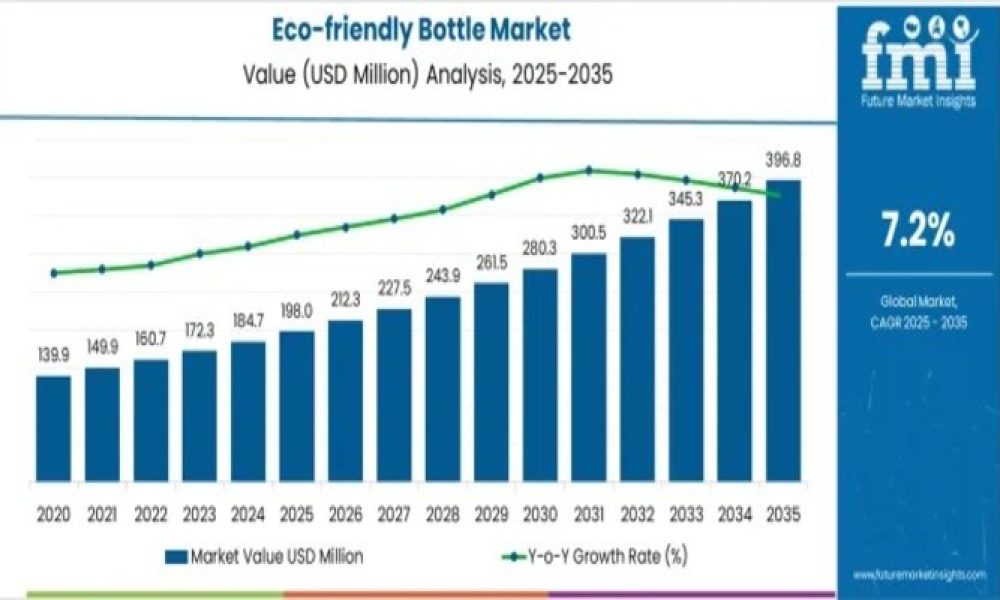
The global eco-friendly bottle market is entering a decisive growth phase as sustainability transitions from a brand differentiator to a regulatory and operational necessity. Valued at USD 198.0 million in 2025, the market is projected to reach USD 396.8 million by 2035, expanding at a compound annual growth rate (CAGR) of 7.2% over the forecast period.
This steady expansion reflects a structural shift in packaging strategies across beverage, water, personal care, and pharmaceutical industries. Heightened environmental awareness, tightening restrictions on single-use plastics, and rising consumer preference for recyclable and biodegradable packaging are accelerating adoption across global supply chains.
Unlock Growth Potential – Request Your Sample Now and Explore Market Opportunities!
Market at a Glance: Key Performance Indicators
- Market Value (2025): USD 198.0 million
- Forecast Value (2035): USD 396.8 million
- Forecast CAGR (2025–2035): 7.2%
- Leading Material Segment (2025): Paper (36.8% share)
- Top End-Use Segment: Beverage and Water
- High-Growth Regions: North America, Asia-Pacific, Europe
- Key Market Players:
Paper Water Bottle, One Green Bottle, Earthlust, Ecologic Brands, SKS Bottle and Packaging, Pachamama, ENSO Bottles, Earth Bottles, SafeBottles, Pepsi-Cola Metropolitan Bottling Company, Cascade Designs Inc.
Sustainability-Led Demand Reshaping Packaging Economics
The growth rationale of the eco-friendly bottle market is anchored in the global transition toward circular economy practices. Governments across regions are offering incentives for sustainable manufacturing while imposing penalties on conventional plastic usage. At the same time, corporate sustainability commitments are reshaping procurement decisions, forcing packaging innovation at scale.
Eco-labeling, carbon footprint transparency, and lifecycle optimization are now influencing purchasing behavior in both retail and e-commerce packaging, reinforcing demand for eco-friendly bottles beyond niche segments.
Material Segment Insights: Paper Maintains Market Leadership
The paper segment, accounting for 36.8% of the material market in 2025, continues to dominate due to its strong recyclability profile, biodegradability, and regulatory acceptance.
Key drivers supporting paper bottle adoption include:
- Compatibility with global plastic-reduction mandates
- Advancements in coating technologies improving moisture resistance and durability
- Cost competitiveness and scalable production capabilities
- Strong alignment with beverage and food brand sustainability initiatives
Ongoing investment in molded fiber and hybrid paper-based structures is expected to further enhance performance, reinforcing paper’s leadership position through the forecast period.
End-Use Industry Analysis: Beverage and Water Lead Volume Growth
The beverage segment, representing 41.5% of end-use demand, remains the primary growth engine of the eco-friendly bottle market. Rapid substitution of plastic bottles in soft drinks, juices, and packaged water is being driven by:
- Heightened consumer awareness of packaging waste
- Government mandates promoting renewable packaging
- Improved bottle strength, shelf life, and aesthetic appeal
Additionally, the water industry alone is projected to account for 62.1% of end-use demand in 2025, supported by rising consumption among school-going children, fitness-oriented consumers, and urban populations seeking reusable alternatives.
Capacity Trends: 201–500 ml Segment Emerges as Industry Standard
The 201 to 500 ml capacity range, holding 47.2% of market share, has become the preferred format across beverages, personal care, and household consumables.
This dominance is attributed to:
- On-the-go convenience and portability
- Retail shelf optimization and transportation efficiency
- Strong adoption in single-serve and travel-friendly packaging
Lightweighting innovations and flexible material engineering are enabling manufacturers to reduce production costs while maintaining durability, ensuring sustained demand for this size category.
Regional Outlook: Asia-Pacific and Europe Drive Momentum
The Asia-Pacific region is emerging as one of the most lucrative markets due to population growth, expanding beverage consumption, and increasing government intervention against plastic waste.
Country-level growth highlights (CAGR, 2025–2035):
- India: 8.7%
- China: 7.9%
- Thailand: 7.5%
- South Korea: 7.1%
- France: 6.8%
India’s aggressive stance on single-use plastic bans and South Korea’s focus on locally sourced starch and fiber materials are accelerating regional adoption. Meanwhile, Europe’s stringent sustainability standards and eco-conscious consumer base continue to push innovation in bottle design and material science.
Competitive Landscape: Innovation and Partnerships Take Center Stage
Competition in the eco-friendly bottle market is intensifying as manufacturers invest heavily in research and development, material innovation, and strategic collaborations.
Notable industry developments include:
- September 2025: India’s Defence Food Research Laboratory (DFRL) launched a biodegradable water bottle
- 2025: JRE-Slovenija and Hrastnik 1860 Design Studio introduced the REwater glass bottle
- 2025: BBDO Guerrero launched dissolving shampoo “bottles,” eliminating plastic packaging entirely
Multinational beverage and packaging brands are increasingly entering the space, forming partnerships to secure sustainable material supply and scale production.
Outlook: From Alternative Packaging to Industry Norm
The eco-friendly bottle market is transitioning from an alternative packaging solution to a mainstream industry standard. As infrastructure for recycled and plant-based materials matures, production efficiency is expected to improve, unlocking broader adoption across end-use sectors.
Why FMI: https://www.futuremarketinsights.com/why-fmi
About Future Market Insights (FMI)
Future Market Insights, Inc. (FMI) is an ESOMAR-certified, ISO 9001:2015 market research and consulting organization, trusted by Fortune 500 clients and global enterprises. With operations in the U.S., UK, India, and Dubai, FMI provides data-backed insights and strategic intelligence across 30+ industries and 1200 markets worldwide.



