
The global MiFi market is entering a decisive growth phase as mobile connectivity becomes an essential utility rather than a convenience. MiFi—short for Mobile Wi-Fi—enables users to create secure, portable wireless hotspots using cellular networks, allowing multiple devices to connect simultaneously. Once considered a niche travel accessory, MiFi devices have evolved into a critical connectivity solution for enterprises, remote workers, field teams, and consumers who demand reliable internet access anytime and anywhere.
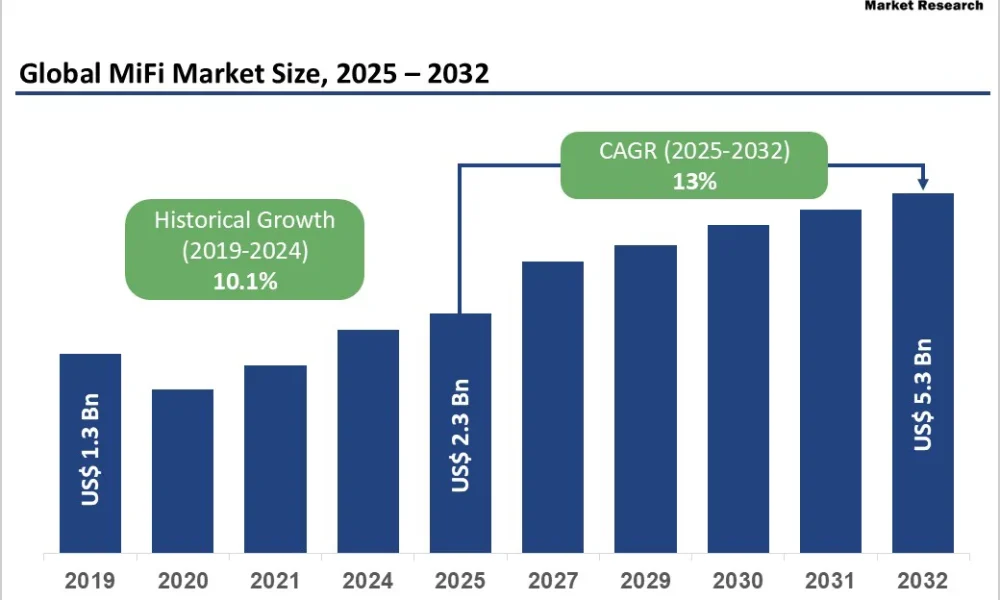
In 2025, the global MiFi market is estimated to be valued at US$2.3 billion, and it is projected to reach US$5.3 billion by 2032, expanding at a compound annual growth rate (CAGR) of 13% during the forecast period. This acceleration reflects the convergence of 5G rollouts, hybrid work models, rising mobile broadband usage, and increasing demand for secure, flexible internet access across use cases.
Understanding MiFi and Its Expanding Role
MiFi devices act as compact wireless routers powered by cellular data networks such as 4G LTE and 5G. Unlike smartphone tethering, MiFi offers better battery life, stronger signal stability, higher security, and the ability to support multiple connected devices without degrading performance.
Modern MiFi devices are no longer basic hotspots. They now integrate Wi-Fi 6 and Wi-Fi 6E, embedded SIM (eSIM) capabilities, cloud-based device management, and enhanced security protocols. Some models even double as power banks, addressing both connectivity and charging needs for mobile users.
As digital lifestyles become more mobile, MiFi is increasingly positioned as a primary connectivity solution rather than a backup option.
Global MiFi Market Size and Growth Outlook
The MiFi market has demonstrated steady historical growth, posting a CAGR of 10.1% from 2019 to 2024. This momentum has strengthened since 2022, driven by normalized supply chains, declining chipset costs, and renewed demand following pandemic-related disruptions.
Looking ahead, the market is expected to grow significantly faster between 2025 and 2032, with a projected 13% CAGR. This acceleration reflects both volume growth and value expansion, as premium 5G-enabled devices gain a larger share of total market revenue.
By 2032, MiFi will be deeply embedded in enterprise IT strategies, travel connectivity ecosystems, and consumer mobile broadband plans.
Key Growth Drivers Shaping the MiFi Market
Accelerated 5G Rollouts
The global expansion of 5G networks is the single most influential driver of MiFi market growth. 5G-enabled MiFi devices deliver faster speeds, lower latency, and higher device capacity compared to legacy LTE models.
In 2025, 5G MiFi is expected to account for approximately 52% of total market value, despite representing a smaller share of total units. This underscores its role as the premium revenue driver within the market.
As telecom operators expand mid-band and millimeter-wave coverage, the performance gap between 5G MiFi and traditional connectivity options will continue to widen.
Rise of Remote and Hybrid Work Models
Remote and hybrid work environments have permanently altered enterprise connectivity needs. Employees increasingly work from home offices, client locations, coworking spaces, or while traveling. MiFi enables secure, enterprise-grade connectivity without dependence on public Wi-Fi networks.
Enterprises are deploying MiFi devices for:
- Temporary project sites
- Field service teams
- Disaster recovery operations
- Backup connectivity for critical roles
This shift has expanded MiFi adoption beyond IT departments into operations, logistics, construction, healthcare, and public safety sectors.
Growing Mobile Broadband User Base
The global increase in mobile broadband subscribers is expanding the addressable market for MiFi devices. In many regions, mobile data is more accessible and affordable than fixed broadband, particularly in emerging economies.
Consumers increasingly rely on MiFi for:
- Home internet in underserved areas
- Travel and international roaming
- Multi-device connectivity without draining smartphone batteries
This trend is especially prominent in regions where fiber and cable infrastructure remains limited.
Technology Advancements Driving Replacement Cycles
New features are accelerating MiFi device replacement cycles. Innovations such as Wi-Fi 6/6E, eSIM support, and cloud-based management platforms offer tangible performance and usability improvements.
Hybrid MiFi designs that combine hotspot functionality with power-bank capabilities are also gaining traction, particularly among travelers and remote workers. These enhancements are encouraging users to upgrade older devices sooner than expected.
Key Industry Highlights
North America: The Market Leader
North America dominates the global MiFi market, accounting for approximately 37.4% of total revenue in 2025. The region benefits from advanced telecom infrastructure, high 5G adoption rates, and strong enterprise demand across the U.S. and Canada.
Carrier-led distribution models, bundled data plans, and widespread adoption of connected devices continue to support market leadership. Enterprises in North America also prioritize secure mobile connectivity, further strengthening demand for premium MiFi solutions.
Asia Pacific: The Fastest-Growing Region
Asia Pacific is projected to expand at the fastest pace through 2032. Growth is driven by rising mobile internet penetration, expanding middle-class populations, and government-backed digital infrastructure initiatives in countries such as India, China, and Southeast Asia.
In many Asia Pacific markets, MiFi serves as a practical alternative to fixed broadband. Affordable device pricing, prepaid data plans, and growing e-commerce penetration are accelerating consumer adoption across both urban and semi-urban areas.
Investment Momentum Across the Ecosystem
Leading manufacturers—including Inseego, Huawei, and ZTE—are collectively investing over US$450 million between 2024 and 2026 to strengthen their MiFi portfolios.
These investments focus on:
- 5G-enabled MiFi development
- Cloud-based device and fleet management platforms
- AI-driven connectivity optimization
- Enhanced security and encryption features
Such investments highlight growing competition for both enterprise and consumer segments and signal long-term confidence in the market.
Elevate your business strategy with comprehensive market data. Request a sample report now: https://www.persistencemarketresearch.com/samples/35857
Product and Technology Segmentation Insights
Portable Consumer MiFi Dominates Unit Shipments
Portable consumer MiFi devices are expected to account for around 50% of total unit shipments in 2025, making them the volume leader. These devices are primarily distributed through carrier bundles, retail channels, and travel-focused outlets.
Consumers favor portable MiFi for its simplicity, flexibility, and ability to connect multiple devices simultaneously. Travel-friendly designs and long battery life are key differentiators in this segment.
5G MiFi Leads in Revenue Contribution
While LTE devices continue to ship in large volumes, 5G MiFi represents the premium tier, contributing a disproportionate share of market value. Enterprise customers and power users are driving demand for higher-speed, lower-latency connectivity.
As chipset costs decline and 5G coverage expands, the price gap between LTE and 5G MiFi is narrowing, accelerating adoption across broader user segments.
Enterprise vs. Consumer Adoption Trends
Enterprise Use Cases Expand Rapidly
Enterprises use MiFi for more than just employee connectivity. It is increasingly deployed as part of business continuity planning, IoT backhaul, and secure remote access strategies.
Key enterprise benefits include:
- Centralized device management
- Enhanced data security
- Rapid deployment without fixed infrastructure
- Scalable connectivity for temporary operations
These factors position MiFi as a strategic asset rather than a discretionary expense.
Consumer Preferences Shift Toward Premium Features
Consumers are becoming more discerning, favoring MiFi devices with better speeds, longer battery life, and global roaming capabilities. eSIM-enabled devices are particularly attractive to frequent travelers, eliminating the need for physical SIM swaps.
As digital consumption rises—driven by streaming, gaming, and remote learning—consumer demand for reliable mobile internet continues to grow.
Competitive Landscape and Market Structure
The MiFi market is moderately consolidated, with a mix of global manufacturers and regional players. Competition centers on device performance, carrier partnerships, pricing strategies, and ecosystem integration.
Manufacturers are increasingly differentiating through software capabilities such as remote diagnostics, usage analytics, and AI-based signal optimization. These value-added features are becoming as important as hardware specifications.
Challenges and Market Constraints
Despite strong growth prospects, the MiFi market faces several challenges. Competition from smartphone tethering remains a concern, particularly among cost-sensitive users. Additionally, regulatory complexities related to spectrum allocation and cross-border data usage can limit adoption in certain regions.
Battery limitations and thermal management issues in high-performance 5G devices also present technical challenges that manufacturers must address.
Future Outlook: What Lies Ahead for the MiFi Market
Looking ahead to 2032, MiFi devices will continue to evolve into intelligent connectivity hubs rather than simple hotspots. Integration with cloud platforms, AI-driven network optimization, and deeper enterprise IT integration will define the next generation of devices.
As mobile data consumption grows and connectivity becomes increasingly mission-critical, MiFi will remain a key enabler of digital mobility across industries and lifestyles.
Conclusion
The global MiFi market is on a strong upward trajectory, supported by technological innovation, changing work patterns, and expanding mobile broadband access. From a valuation of US$2.3 billion in 2025 to a projected US$5.3 billion by 2032, the market reflects both volume expansion and premiumization.
With North America leading in revenue, Asia Pacific emerging as the fastest-growing region, and 5G MiFi redefining performance expectations, the industry is well-positioned for sustained growth. As connectivity becomes increasingly mobile, secure, and on-demand, MiFi will play a central role in shaping the future of wireless internet access.
Related Reports:




